Record High US Crude Production Challenges Traditional Growth Indicators, Says EIA
The tie between US crude output and key indicators such as rig counts and the number of new wells has significantly weakened.
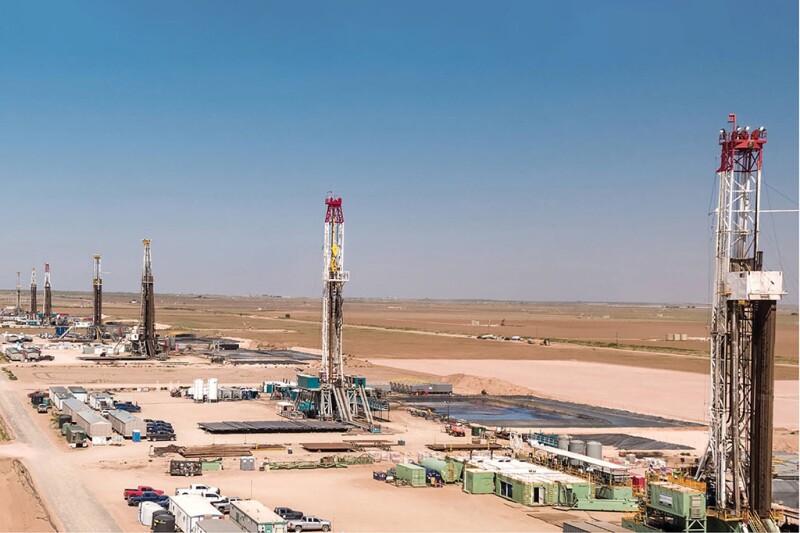
A row of drilling rigs help form what is known as a cube development in the Permian Basin.
Source: ExxonMobil.
Crude production in the US topped an average of 13.3 million B/D in December according to the latest estimate from the US Energy Information Administration (EIA). The new figure, both a global and US record, is about 300,000 B/D above the nation’s pre-COVID 19 pandemic November 2019 peak.
While the number of new wells added each year has served as a key driver of production growth, the EIA suggested that is no longer the case. Instead, it credited advances in drilling and hydraulic fracturing technology which have not only increased well productivity but have also led to a stabilization in output from existing wells since 2021.
Source: US Energy Information Administration/Enverus.
Although the report did not detail specific technologies contributing to the growth, a major trend emerging in the US shale sector is the shift toward 3-mile lateral wells. The longer wells lower operational costs while also decreasing the number of 2-mile lateral wells an operator would otherwise drill.
The EIA noted that the peak year for new wells was 2014, with 13,745, when average production was 8.7 million B/D. In 2020, when the pandemic paralyzed the global economy, only 7,147 new wells were drilled, and although there has been a gradual increase in drilling activities, with nearly 8,000 wells in 2021 and close to 10,000 in 2022, recovery has been slower than in previous years.
The EIA added that the rig count is no longer the leading indicator that it once was either given the number of active rigs has dropped nearly 70% over the past decade without impairing productivity growth over the same period. The final US rig count of 2023 showed there were 602 onshore rigs (including 565 horizontal rigs) and 20 offshore rigs operating, according to Baker Hughes.
Despite the upward trajectory of the past 3 years, the EIA anticipates a dip in production due to winter weather-related shutdowns in February. The administration is also projecting a decline in production throughout much of the year before output swings back in the fourth quarter and sets new records again in 2025.