Industry Leaders See Collaboration, Tech Driving Path to Sustainable Hydrocarbon Production
Technology and partnerships play a pivotal role in how the oil industry finds and produces energy from frontier regions and brownfields, both now and in the future.
As the oil and gas industry faces a host of challenges, it is doubling down on technology development and collaboration.
Across the 3 days of the International Petroleum Technology Conference (IPTC) in Kuala Lumpur in February, energy leaders shared their insights on the need for balance, collaboration, and innovation in the evolving energy landscape.
Fadillah Yusof, Malaysia’s deputy prime minister and minister of energy transition and water transformation, told an opening ceremony audience that even as sustainability, reliability, accessibility, and equity are factors in the industry, “access to affordable energy is not a privilege but a right.”
Petronas President and Group CEO Tan Sri Tengku Taufik said the industry finds itself in changing circumstances with shifts in how energy is discovered and distributed, as well as how the world consumes it. Global dynamics and geopolitics play a role as the world and industry strive to balance supplying energy to the world while being sustainable and mindful of climate change, he said.
“We stand at a crossroads. Rising energy demands intersect with the urgent need for climate action, even as positions taken by major economies diverged,” he said. “The path forward calls for more collaboration, rather than divergence; cooperation between governments, businesses, academia, and the industry at large, so we can all share our best practices and unearth innovative solutions.”
He said that meeting such demands requires "a pragmatic and coordinated approach. No single company, I would also argue no single country, can fully address the requirements for energy security, affordability, and sustainability, and do so alone. It is only through collaboration and collective practical effort that we can achieve a just, coordinated, and equitable transition that enriches lives and protects the environment but still delivers lasting value for future generations.”
Petronas announced intentions to sign five memoranda of understanding with various companies during IPTC.
Mohd Jukris Abdul Wahab, executive vice president and CEO, Upstream for Petronas, said during the CEO Dialogue that the nature of collaborations seems to be evolving from that of service provider and client to “collaboration in a different form” where both parties share a common goal.
In fact, he said, collaboration must extend to include multiple shareholders, including regulators, the service sector, and the operators, with all parties coming together in a focused effort. “This is not one person or one company’s job to drive this thing. Opening up more for collaboration, creating the trust, and having a shared goal is the way to go.”
And in the world of technology, digital transformation will be a major driver for how Petronas moves forward, he said. “The innovation of digital advancement actually helped us to make these ventures a lot more viable.”
Speaking during the same session, SLB CEO Olivier Le Peuch said digital operations and artificial intelligence (AI) capabilities will be crucial technologies for the industry.
They have, he said, the potential to transform the way the industry works and can help unlock “the huge data lakes that all of us have, subsurface and surface data that are across assets. So if we do that as an industry, we can change the industry.”
And while the industry may change, the expectation is that oil production will continue, making pollution recovery important. “Oil is here to stay and needs support for enhancing production, reducing the electricity cost, and reducing the carbon,” he said.
Finding Oil
When it comes to enhancing production, Khalid Rufaii, director for Saudi Aramco’s western area and strategic exploration, said during a panel on the future of exploration that the industry needs to become better at extracting more from the oil it has already found. Currently, He said, it’s typical to only recover between 35 and 45% of the oil in place.
“Over 50% remains in the subsurface and needs to be extracted,” he said.
At the same time, she said, oil shouldn’t be threatened by renewable or unconventional energy sources. “I don't look at those as competing with oil and gas exploration, but rather complementing our effort,” Rufaii said.
He cited unconventional oil as a case in point. Techniques used to exploit unconventional reserves such as horizontal wells and hydraulic fracturing were able to accelerate conventional exploration and production as well, he said. “All of us complement each other in one way or another.”
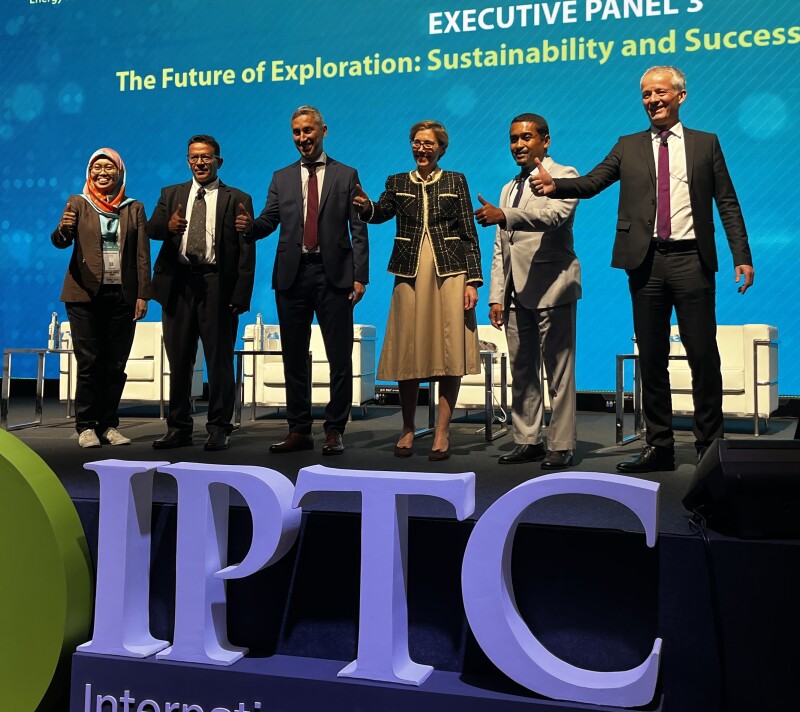
“The Future of Exploration: Sustainability and Success for the Next Decade” participants from left: session co-chair Suhaileen Shahar of Petronas with panelists Khalid Rufaii of Aramco, Amine Soudani of TotalEnergies, Sophie Zurquiyah of Viridien, and Mohamad Rizam Sarif of Petronas, with moderator Andrew Latham of Wood Mackenzie on 19 February during IPTC.
Source: Jennifer Pallanich/JPT
Viridien CEO Sophie Zurquiyah, speaking on the same panel, noted that she has seen a focus on higher-end technologies that enable faster and better understanding of the subsurface, helping to shorten the exploration cycle.
“The idea is to be able to shorten the cycle time,” particularly since the industry needs to unlock hydrocarbons faster than even a decade ago, she said. “You need to be more efficient; you need to get those barrels out quicker. And to get them out quickly, you need a better understanding of the substance.”
She said that’s why there have been so many significant advances in acquisition and interpretation technologies for geophysics and geoscience data. Among these are ocean bottom node surveys and the use of AI to map the subsurface, she said.
Mohamad Rizam Sarif, senior general manager for geoscience solutions, exploration at Petronas, said that success in exploration comes from combining geoscience and engineering expertise.
Combining those teams at the outset “gets our minds together” and makes it possible to approach a wildcat with the mindset of “explore to develop versus explore to find,” he said. Integration from the outset makes it possible to meet “both exploration objectives and also development objectives, because, again, it's about making money.”
At the same time, Sarif acknowledged that some exploration work is best taken on with partners. For example, he said collaboration is key for exploring frontier areas because it helps to spread out risk and costs.
Amine Soudani, TotalEnergies’ VP for exploration in Europe, Middle East, North Africa, and Asia, agreed that collaboration is important for frontier areas and cited the cooperation between TotalEnergies and Petronas in exploration efforts to open up Papua New Guinea as a frontier.
“This is a frontier area where, actually, what is at stake is material,” he said.
He also noted that every basin, before it begins production, starts as a frontier.
Exploring in a frontier area, whether it’s PNG, or in South Africa where TotalEnergies discovered but couldn’t monetize gas, does carry “first-comer risk,” he said.
And as operators have access to less capital for exploration, they are becoming choosier about where they spin the drill bit, he said. What could help, though, is predictability from governments, particularly in frontier regions, he added.
Producing Oil
While pushing technology innovations of the past can make possible a field development project, sometimes the tech required needs to be created, experts said during a panel on pushing the frontiers of field development.
Sun Fujie, vice president at China National Offshore Oil Corp. (CNOOC), pointed to the use of sub-seabed production systems in use at the company’s JZ25-1W field, the cylindrical floating production, storage, and offloading vessel in use at Liuhua 11-1, and the enhanced oil recovery program in place at its Lingshui 36-1 field as projects made possible through technology innovations.
He called the subsea production system under the seabed in the field in about 30 m water depth a “new solution for efficient and economic oil and gas development in restricted areas.” And at the Liuhua 11-1 oil field, the cylindrical Haikui-1 FPSO is the first such unit to be installed offshore Asia and is being used for secondary development of the deepwater field, he noted.
CNOOC is also relying on digital and AI technology. He said the operator has collected E&P data for every oil field for the past 40 years and is now also able to take advantage of real-time drilling and production data, which can be used to better understand subsurface and production performance. The tools can help “enhance efficiency and accuracy.”
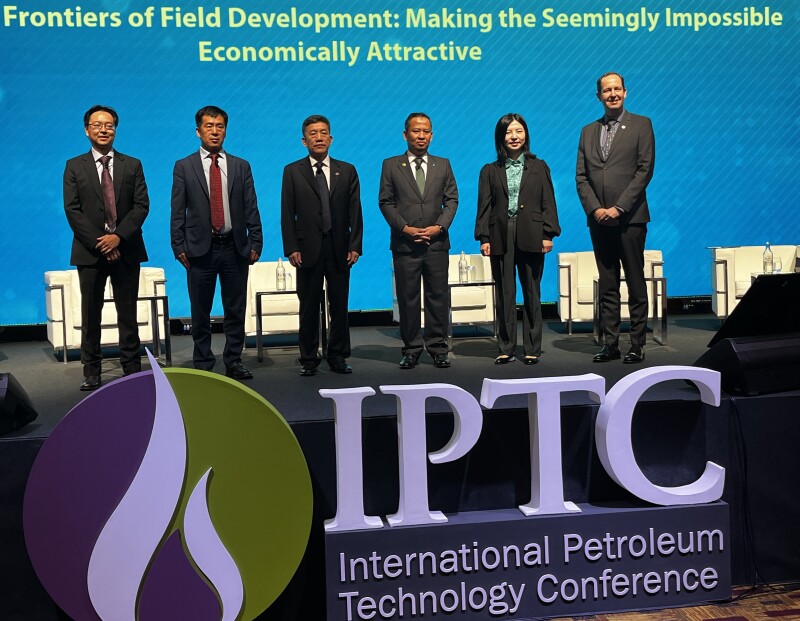
“Pushing the Frontiers of Field Development: Making the Seemingly Impossible Economically Attractive” panelists, from left, Khoo Choo Beng of Shell Malaysia Upstream, Hongkun Dong of OneSubsea, Sun Fujie of CNOOC, Hazli Sham Kassim of Petronas, and Zhuang Ye of Baker Hughes, with moderator Roald Rijnbeek of Sarawak Shell Berhad at IPTC on 19 February.
Source: Jennifer Pallanich/JPT
Hazli Sham Kassim, VP for upstream development at Petronas, said one of the challenges he faces is delivering projects more quickly—sometimes in half the time that a project of yesteryear may have required. On the procurement and logistics side, there’s a focus on doing things faster and more cost effectively, he said.
“How do we use the technology to help us to deliver the project faster and better? And to me, the way we achieve that is by collaborating with partners,” he said.
Hongkun Dong, sales and commercial regional director for OneSubsea, said collaboration that enables a share of risk and rewards have helped bring technologies like subsea compression into the industry.
“Can we do it faster? Faster means more economical. Better is faster,” he said.
Through strategic use of technology, partnerships, and collaboration, it was possible to bring a gas field from discovery to first production in 30 months offshore Turkey, he said, adding there are ambitions to halve project schedules.
Khoo Choo Beng, business opportunity manager for Shell Malaysia Upstream, said developing projects sometimes requires more time, not less. The supermajor’s Rosemari-Marjoram deepwater development is the longest subsea sour gas pipeline offshore Malaysia, and the project is designed to produce 800 MMcf/D. It is also Shell’s first high-H2S project in Malaysia, and it will enable nearby tieback opportunities.
“It’s an engineer’s dream playground because in a single integrated development, we have every kit and technology that you can find that is all into a single project,” he said.
Discovered in 2014, the project went to front-end engineering and design in 2021 and reached final investment decision in September 2022. The platform was installed in October 2024 and first gas is expected in 2026.
“We actually took about 7 years, a bit contrary to what my colleagues say, faster and cheaper,” Beng said, noting Shell had to go back to the drawing board because of the high H2S content of the gas.
Zhuang Ye, VP for oilfield services and equipment, Asia Pacific, at Baker Hughes, said one thing that can help with field development is incorporating solutions providers into the earliest planning stages for a project.
“It has to start at the planning stage, the beginning stage, the engineering stage, to come up with the technology and solution that is fit for purpose,” she said.
She also said digital technologies are driving change in the way the industry operates, particularly around autonomous operations, remote monitoring and operations, asset health and monitoring, emissions abatement, predictive operations, and change management. “It will help to increase the efficiency, no doubt.”
Marginal and Brownfield Focus
Sunu Broto Wusono, senior manager for project delivery offshore at Medco Energi, said during a brownfield panel that marginal fields present challenges such as lower reserves but higher capex and opex, distance from existing facilities, and uncertainty around pricing and demand, all of which can be complicated by the looming expiration of a production license.
In one instance where Medco holds a production sharing contract set to expire in 2028, the company opted to fast-track the development of an unmanned system using a lightweight platform design and a simplified processing facility to access reserves at the marginal field. The approach “saved a lot of time” and allowed Medco to meet its schedule for the project, he said.
Because so much fossil fuel production comes from existing fields, mature assets took center stage during a panel on maximizing brownfield potential through innovation and best practices.
Martin White, Halliburton’s senior vice president for Asia Pacific, noted that about three-quarters of oil produced around the world originates from mature fields, although recovery factors may not even reach 50%.
“The more we can do to maximize recovery from brownfields, the more barrels we can add to the global system,” he said. And as energy demand grows, the industry will need to grow supply to meet that demand.
“The easiest oil to find is where we already know it is,” White said.
Maximizing oil production from brownfields starts with data but also requires technological innovations and best practices. “We can take data from every step of the process from the reservoir to the petrol pump. We can track that data, and we can model it, and we can de-risk it,” he said.
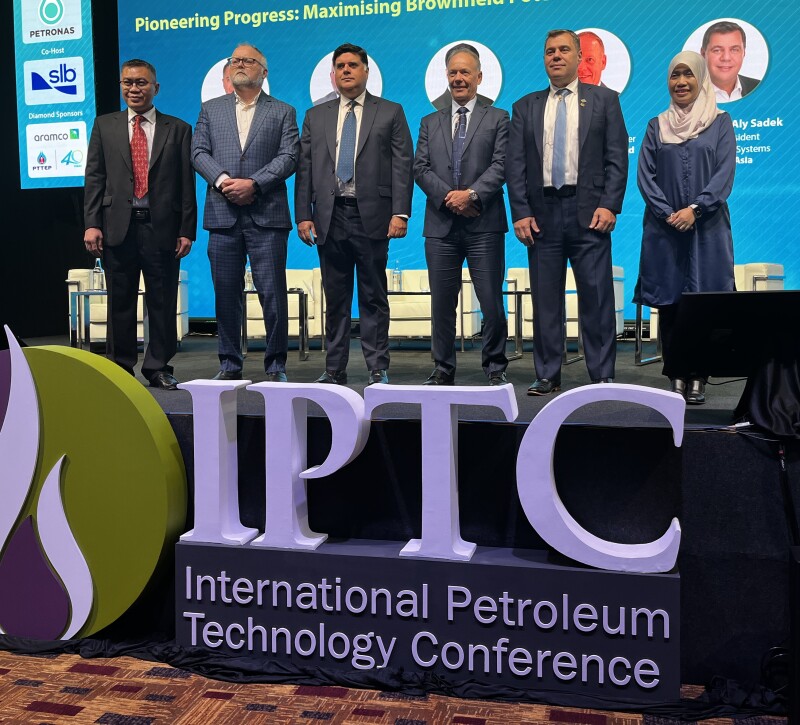
“Pioneering Progress: Maximising Brownfield Potential through Innovations and Best Practices” panelists, from left, Sunu Broto Wusono of Medco Energi, Martin White of Halliburton, Mrinal Vohra of Expro, Keith Collins of Dialog Group Berhad, and Mohamed Aly Sadek of SLB, with moderator Irmawaty Bt Abdullah of Petronas on 20 February at IPTC.
Source: Jennifer Pallanich/JPT
Mrinal Vohra, vice president, APAC at Expro, called for a holistic approach to maximizing brownfield production, one that incorporates well, reservoir, and facility management (WRFM). The WRFM framework can bring various disciplines together to keep production going, he said.
“Most operators that I found are not even aware of what’s going on within their manifold on a platform,” he said. “You take the information, you diagnose it, you put it into a model, you then make plan decisions, whether you’re going to intervene with reservoir facilities, and then you go and execute that on the asset” and the cycle continues.
He said there is no magic silver bullet, but a holistic approach can make it possible to identify and address the factors that enable optimal production.
Dialog Group Berhad Chief Operating Officer Keith Collins said the potential of brownfields is high, especially when secondary owners such as themselves apply new technology to a mature field.
He said that sometimes, fields have been neglected under previous owners, so secondary owners apply a different type of thinking to the assets. “We look at the operating standards and procedures and … get people involved in a different mindset. A lot of this is about the mindset of the organization.”
During the stabilization phase, the focus is on optimizing opex, repairing priority items, and enhancing production, he said. Part of enhancing production is mining existing data for new insights and correcting potential misinterpretations of the past. Collins said errors sometimes creep in due to time pressure and then remain “hardwired in” rather than being corrected. “It continues to manifest itself.”
Stepping back and looking at data periodically and even reprocessing seismic data every 5 to 8 years makes sense, he said. It’s also not necessary to spend a fortune on new data, he added, if you first understand the existing data.
Mohamed Aly Sadek, vice president production systems at SLB in Asia, said it’s critical to understand data and use that to understand equipment and facility performance. And because technological innovations must be tested before operators are willing to deploy the tech in their fields, brownfields are often a target for such trials.
“Brownfields are a very well-known environment” that make it possible to test technology in a controlled environment, he said. “Overall, brownfields are an excellent testing ground” although it’s important to remember that they may present their own issues.
Sadek said one of his colleagues frequently says the greenfields of today are the brownfields of the future. But to be successful in the future, he said, the industry needs to make sure what it learns is carried over as part of the development of the greenfields of today.