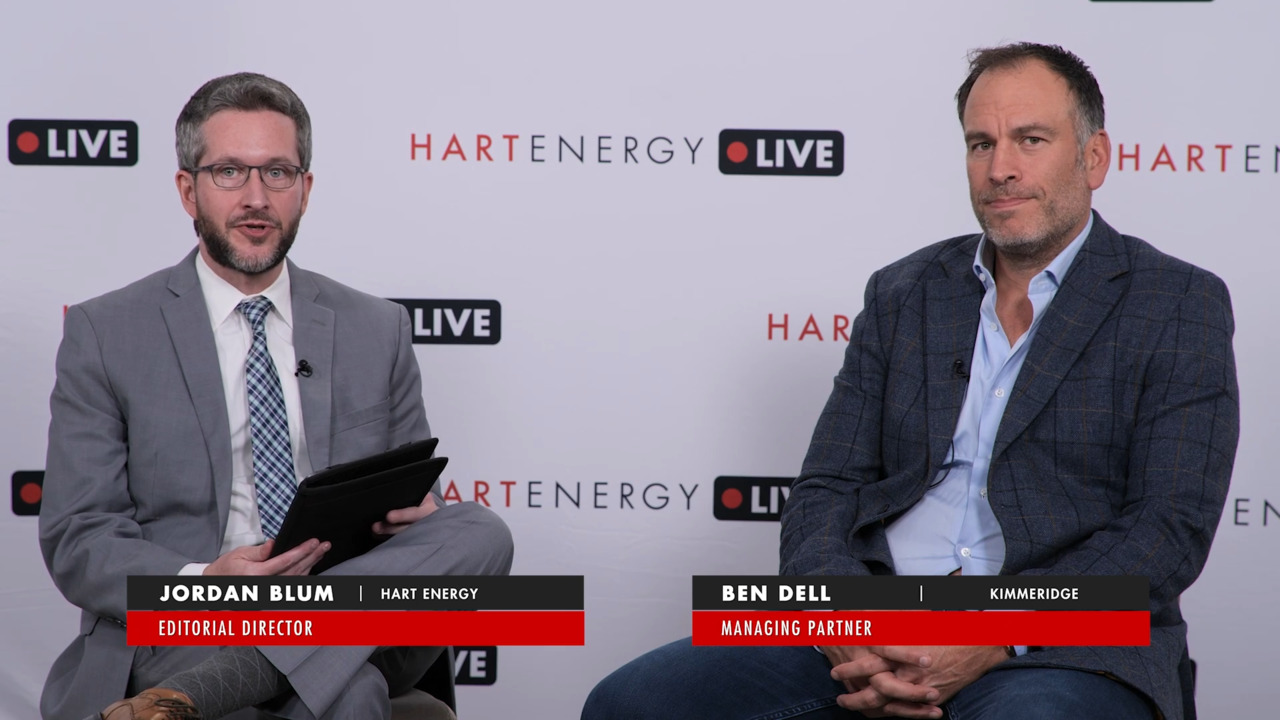
Jordan Blum, editorial director, Hart Energy: We are here at Hart Energy's Energy Capital Conference in Dallas. I'm joined by Ben Dell, the co-founder and managing director of Kimmeridge. Thank you so much for joining us. Really appreciate it.
Obviously, you all are involved a lot in the private equity, the M&A space. The last year or so, couple years, there's been a whole lot of energy M&A, but I wanted to get your take on the current state of things and what's ahead. Are things going to continue to proceed at a rapid clip or slowdown?
Ben Dell, co-founder and managing director, Kimmeridge Energy Management Co.: Yeah, I think we expect to see continued M&A in this space. One of the things I point out is if you took this industry and merged everyone together and then merged them again, you still wouldn't have the concentration you have in autos or financials, let alone the tech space. So I think there's still a lot of room for consolidation across the board. I think the scale of those transactions are getting bigger, so the number of individual transactions will obviously drop, but I do think you'll continue to see it. And as long as we have, one of the things that I think has enabled that recently is a fairly stable commodity price that stayed within a certain bound, and that's sort of taken away a lot of the issues over relative value and pricing in this sector.
JB: Very good. And is there much concern with the FTC and them potentially getting more involved?
BD: I think there's always concern with management and the FTC and I think there's concern over the expense that it's costing people to get through the FTC, even if it's not necessarily leading to any significant changes. At least from our standpoint, the industry consolidation here really doesn't pose a great threat from a pricing standpoint. Even if you took the two biggest gas producers today, you're talking about 13% of the market, so still relatively small. And I think as we've seen with OPEC, which 40% of the market still struggles to control the price of crude. I think it's hard to argue there's a real direct impact to consumers here by incremental consolidation.
JB: Very good. At any point, does it get difficult to manage this kind of push for scale and inventory while maintaining that capital discipline that's finally maybe been instilled in the industry?
BD: Well, I actually think the supportive of each other, which is, as you get larger and you trim the lower-quality inventory that you have and you lower your growth rate, you are to a certain extent extending that runway out as a company. Look, I think inventory management is a big issue for this sector. I think we've seen a lot of the core of the core’s being drilled out, and look, the way to address that is to lower drilling costs, lower completion costs, control your operating costs—find capital benefits other ways. And that's really what scale allows you to do. I mean, a lot of people focus on the G&A side of that because that's probably the most sensitive, but when you actually look at it going from a single-mile lateral to a four-mile lateral, it's a huge capital improvement. Being able to optimize your facilities, your pipeline takeaway, your realizations, those are actually where the big improvements. And the one thing I would point out that is often overlooked is particularly when you look at Chesapeake-Southwestern, to move to an investment grade has a huge capital synergy from a financing standpoint. And it's things like that that can actually continue to offset the degradation in well performance.
JB: Yeah. Now Expand Energy is the nation's top gas producer.
BD: I'm not going to comment on that name.
JB: Switching gears, obviously, y'all are involved in the Permian, big presence in the Eagle Ford, Powder River, but can I get you to take your views on which basins look most desirable now, where maybe assets might be, I guess, best acquired and just the approach you'll be looking at going forward?
BD: Yeah, I think it's always tough because people want to say which basin is better than another basin. And what I would say is, there's core high quality inventory really in every basin within the U.S. Now, there's more in certain basins. Obviously the Permian with multiple stacked intervals has more core inventory, less to drill. I think when you look at the Eagle Ford, it's getting longer in the tooth on the oil side of the window. I think when you look at the D-J, there's still good rock, good economics there, but there's obviously political risks that people are concerned about. From our standpoint, when we look at investing into an asset, the real question is, what type of risks are we willing to take? Where do we think the economics are? And what I mean by that is if you gave, put a 40,000-acre package in the center of the Permian into the markets in a marketed process, we do not have the lowest cost of capital, and we will not be competitive in that process.
When I look at it as, are we going to take political risk, permitting risk like we did in Colorado, are we going to take commercial risk around marketing or FID-ing an LNG facility, are we going to take geology risk by de-risking intervals and horizons that we haven't been able to prove are economic? Or is it operating in terms of driving down well costs because we're still in the early stages of running into a play. So it's really about aggregating an asset that we think can be at the front end of the cost curve and understanding what risks we've got to take on to demonstrate that and that those risks are mispriced by the market.
So from our standpoint, there's no one specific basin where it's got to be here. I think we are looking at where are the assets with the most hair and the most risk that we can manage better than other participants in the market.
JB: Very good. Well, thank you so much for being here at the Energy Capital Conference. We really appreciate it. To read and watch more, please visit online at hartenergy.com.