As Africa’s top oil producer, Libya is ramping up momentum—offering 22 exploration areas and welcoming BP back to Tripoli with a major deal.
BP announced plans to reopen its Tripoli office in 2025 and signed an MOU with Libya’s NOC to explore new opportunities. From left, William Lin, BP executive vice president for gas and low carbon energy; Masoud Suleman, NOC chairman; Khalifa Abdulsadek, Libyan oil minister; Mahmud Ismail, BP general manager for Libya; Ariel Flores, BP head of subsurface; and Paul Barnes, BP vice president global oil access.
Source: BP
BP will assess rehabilitation of Libya’s Sarir and Messla oil fields in the Sirte Basin which rank among Triopli’s largest hydrocarbon resources, while also evaluating unconventional asset development across the war-torn country that displaced Nigeria a year ago as Africa’s No. 1 oil producer.
At a ceremony held in London on 7 July, BP announced plans to reopen its Tripoli office in late 2025. During the event, company executives inked a memorandum of understanding (MOU) with Libya’s National Oil Corp. (NOC) to explore new opportunities. According to a BP news release, these opportunities “promise a significant potential addition to BP’s Libya portfolio.”
The MOU also includes evaluating the exploration potential of areas adjacent to the Sarir and Messla fields, as well as conducting studies “to understand the country’s wider unconventional oil and gas potential,” according to the release.
On the same day in London, but during a separate meeting, Shell reached an agreement with NOC to evaluate hydrocarbon prospects and conduct a comprehensive technical and economic feasibility study for the development of the al-Atshan field and other fields fully owned by NOC. The agreement excludes any areas where third parties hold rights. NOC announced the deal in a news release, which the Financial Times later confirmed with Shell.
BP and Shell are among several Western companies seeking to restart exploration efforts in Libya, with Eni, OMV, and Repsol topping the list. Turkey’s TPAO also entered the mix, signing an agreement on 25 June in Istanbul to conduct a geological and geophysical study of four offshore areas. The plan includes a 10,000-km 2D seismic survey and processing over 9 months.
Bid Round Widens Exploration
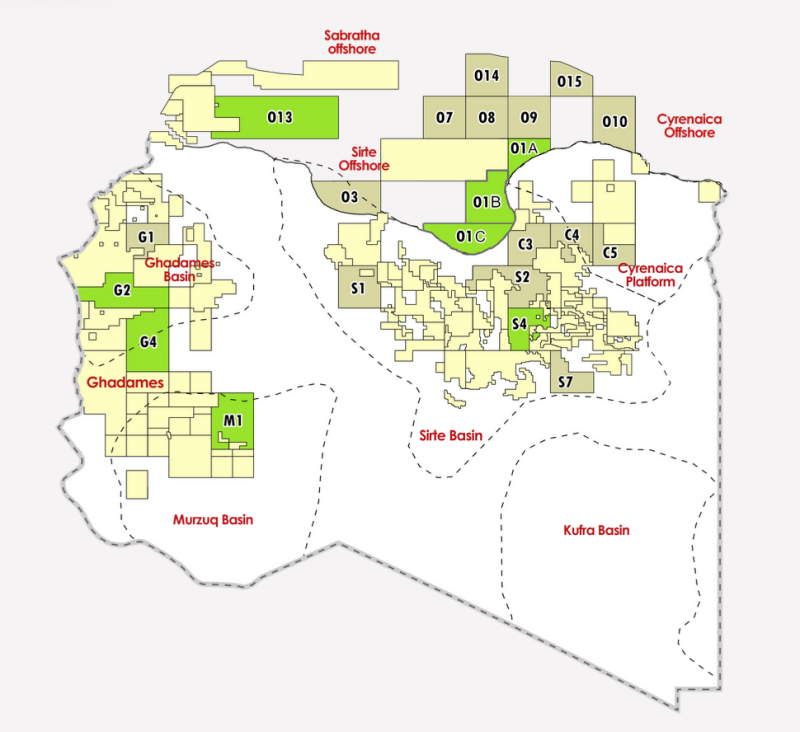
Libya’s NOC is managing the country’s 2025 bid round, launched by the government in March—the first in 17 years. The round offers 22 blocks located near existing infrastructure: 11 onshore in the Ghadames, Murzuq, and Sirte basins, and 11 offshore in the Sirte offshore, Sabratha basin, and offshore Cyrenaica areas, according to NOC.
Libya’s 2025 bid round offers 22 areas for exploration and development (shown in green) and exploration only (shown in brown.)
Source: Libya’s National Oil Corp.
As it struggles to grow out of more than a decade of underinvestment and civil war, NOC said it aims to raise its crude oil and condensate production to 2.0 million B/D from the 1.4 million B/D, a goal that the Financial Times said would exceed Libya’s peak oil production of 1.75 million B/D achieved in 2006.
For context, Reuters reported after an April roadshow in London that Libya would need between $3 billion and $4 billion in investment just to reach 1.6 million B/D.
At the latest MOU signing, BP’s Executive Vice President for Gas and Low Carbon Energy, William Lin, said the agreement “reflects our strong interest in deepening our partnership with NOC and supporting the future of Libya’s energy sector.” He added that BP aims to contribute by applying its experience in “redeveloping and managing giant oil fields around the world.”
NOC Chairman Masoud Suleman called for his company’s cooperation with BP to include technical and leadership training for Libyan staff.
BP re-entered Libya in 2007 after signing an exploration and production sharing agreement (EPSA) covering exploration areas A and B (onshore), and area C (offshore)—areas unrelated to the Sarir and Messla MOU just reached.
A declaration of force majeure which put the EPSA on hold in 2011 was lifted in 2023 and onshore exploration resumed, according to BP. In 2022, BP sold Eni a 42.5% exploration operator interest in the EPSA while BP retained BP 42.5% interest. The Libyan Investment Authority holds the remaining 15%.