Geothermal Demands Extreme Tools, but Which Will Really Be Required?
When confronted by extremely hot wells drilled into hard rock, engineers start looking for new tools and then ask, is there a cheaper option?
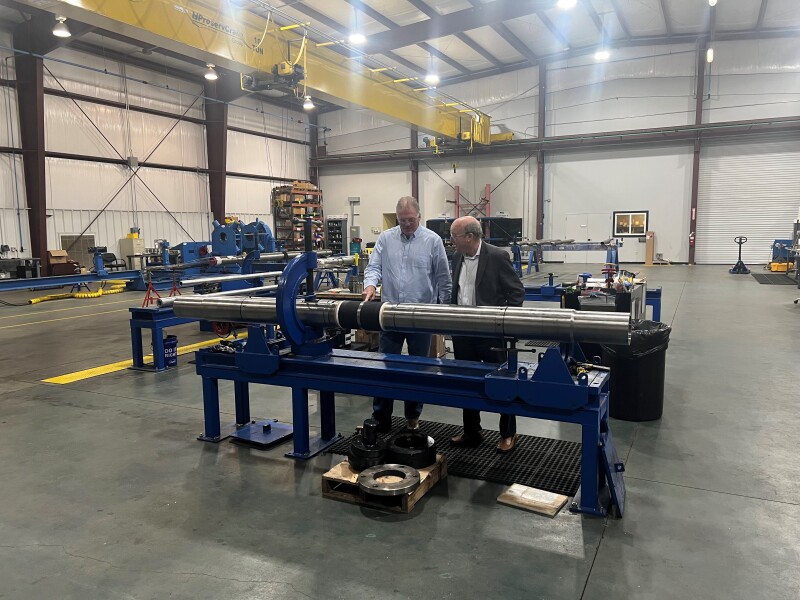
Robert Coon of PetroQuip Energy Services (left) shows John McLennan of Utah FORGE the 12-in. elastomer sealing element for an openhole packer built to stand up to extremely high temperatures.
Source: PetroQuip.
For now, geothermal energy is a tiny market with an extensive wish list of high-temperature equipment and other ideas about tools.
On the face of it, drilling and completing long-lasting, high-capacity wells in extremely hard, hot rock is beyond the capabilities of much of the available hardware and supplies.
“A lot of people think, OK, you're trying to hydraulically fracture geothermal wells. You know, the first thing that comes to their mind is how are you going to do that in high temperatures? Are your downhole tools going to work … wireline, frac plugs, and so forth,” said Jack Norbeck, co-founder and CTO for Fervo Energy.
He made that point during the opening panel discussion at the recent SPE Hydraulic Fracturing Technology Conference and Exhibition (HFTC) when describing an instance where they found lower-cost alternatives to a plug developed for extremely hot conditions.
This isn’t to say that no new tools will be needed to inject water through fractures in hot, dry rock and produce steam for power generation and other uses.
But at this early stage of testing, it is not clear what will ultimately be required based on testing programs trying to improve hardware and methods and develop new ones.
The US Department of Energy (DOE) funding for Utah FORGE is paying for testing at a highly instrumented geothermal test site and finding and evaluating tools for subsurface work in future wells, which are likely to be hotter than the rock at current test sites.
“The future of geothermal is deeper and hotter, which will lead to significantly higher power production,” said John McLennan, a University of Utah associate professor working on reservoir management at FORGE.
Workarounds now that reduce the high cost of testing may not work if future wells produce hotter, higher-value steam.
“We are on the low end of the geothermal temperature scale for EGS (enhanced geothermal systems) at this time,” McLennan said.
The long-term concerns include the need for lab methods and instruments to test equipment and materials to be used for those extreme wells.
A paper presented at the 48th Workshop on Geothermal Reservoir Engineering held at Stanford University in February called for a “facility to study the behavior of rocks, proppants, diverters, cements, instrumentation, and equipment” built for geothermal wells.
“Currently available laboratory test equipment generally is limited to temperatures 300°C or below, most often at temperatures below 200°C,” according to the paper by AltaRock Energy and Blade Energy, which added that what is available often can only test small-sized samples.
But engineers will never stop looking for lower-cost proven methods.
At the FORGE geothermal test site, they have shown it is possible to drill significantly faster through hard rock using a method developed by Fred Dupriest, a Texas A&M professor who developed it while he was with ExxonMobil. That process improvement method led to drill bit modifications, but nothing really new and different.
Fervo said about its Nevada test site, the “project was completed using drilling and completions tools and technology that already commonly exist in the industry,” in a paper presented at the Stanford workshop.
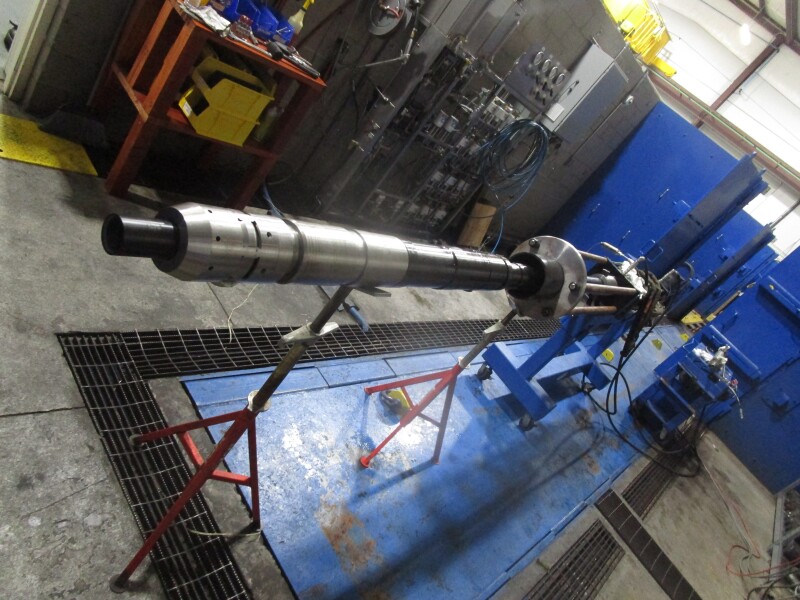
A bridge plug designed and built by PetroQuip for FORGE will be tested at its Waller facility at temperatures exceeding 400°F.
Source: PetroQuip.
Some Needs
FORGE’s equipment wish list has grown since it drilled its first well. While describing at HFTC a fracturing test performed last spring at the FORGE site, McLennan offered some advice on geophones. They can be “really sensitive to temperatures” (SPE 212346).
His comment was based on geophone failures that limited microseismic data gathering while fracturing a well a year ago. Since then, they launched a project to move to fiber-optic cables, which are more heat tolerant, for downhole data collection.
There are two pairs of partners working on that problem: Rice University and Shell are on one team, and the other team comprises the University of Texas at Austin and Silixa, a fiber-optics company.
Another challenge for FORGE was to find gels that could stand up to the high heat, and engineers with experience in hot rock.
“Some old options are no longer available and some subject matter experts (SMEs) are no longer available,” McLennan said, during an HFTC presentation.
After the talk, he moved to a lobby outside the rooms used for technical sessions, where he was a magnet for SMEs with questions about FORGE and some suggestions.
An SME with long experience in fracturing chemistry told him about a high-temperature gel he patented years ago that might work in even hotter wells. Doing so, though, would require a deal with the large service company that acquired his former employer and its intellectual property.
The need for gel may hang on the results of one stage at FORGE’s first fracturing tests where they pumped to see if it allowed them to better manage fracture growth.
Based on what they could observe during the test, cross-linked polymer gel may have helped. McLennan said, based on their fracture modeling, they observed greater height growth and the creation of simple planar fractures.
But that is an early impression of a single stage test based heavily on microseismic imaging. What they learn from drilling a well though the fractured area and doing injection tests will tell them more.
Plug Problems
For engineers at Fervo and FORGE, plugs are a problem. Exposure to the heat in a 400°F well will make most elastomers rigid and unable to form a tight seal on an irregular surface.
Among the experts McLennan met in the lobby at HFTC wasRobert Coon, the VP of operations for PetroQuip Energy Services, who was following up on their meeting the day before to see two tools they are building for wells for temperatures up to 475°F. McLennan got to see an isolation tool and an openhole packer they are building and testing at the company’s Waller facility for FORGE.
The equipment maker sees geothermal as an opportunity for suppliers with ideas for doing things better. But that comes with some uncertainty about what customers will ultimately need.
“No one has come up with a definite best way” to complete the wells needed to inject and produce water flowing through hot rock, Coon said.
For FORGE, PetroQuip is building an openhole packer with a 12-in.-long sealing element and a bridge plug using thermal plastics for sealing at that extreme temperature.
FORGE wants to replace the bridge plug it used to isolate stages on its first fracturing test because it had to be set using drillpipe, which added the expense of using a drilling rig for fracturing, McLennan said.
What they are building at PetroQuip can be run using coiled tubing, so no rig is required, and possibly could be pumped down using an electric wireline.
Anything less than coiled tubing for a plug designed for 7-in. casing worries Coon because that is not something he has ever seen done effectively in such a large-diameter lateral.
Cooler While Fracturing
Previously, Fervo went through a similar plug development process. It worked with a supplier to build a plug rated for 400°F wells with funding from DOE. But it also found lower cost off-the-shelf plugs for fracturing in higher-temperature oil and gas wells.
“We're targeting generally 375° to 425°F. So we're not talking extreme temperatures but you know, higher than even the hottest oil and gas fields like the Haynesville,” said Norbeck.
Based on Fervo’s fiber-optic cable in their test well in Nevada, the highest temperature inside the casing was around 250°F. That opened the door to several lower-cost portions.
To be sure they had their numbers right, they used downhole data to model how much the temperature rose when they were not pumping a stage.
Based on that work, which assumed the temperature in the reservoir was 400°F, the temperature could top out at 265°F even when the pumps were off during fracturing.
“We actually felt fairly confident that we could run these lower-temperature plugs that are more standard (and) lower cost. And we'd be okay,” he said.
They followed up by successfully using several lower-cost plugs.
“I just bring this up as an example of something where people's first intuition is to say, okay, this was a really challenging issue, due to high-temperature conditions.”
But when the engineers studied the in-well data, they saw there were cost-saving options.