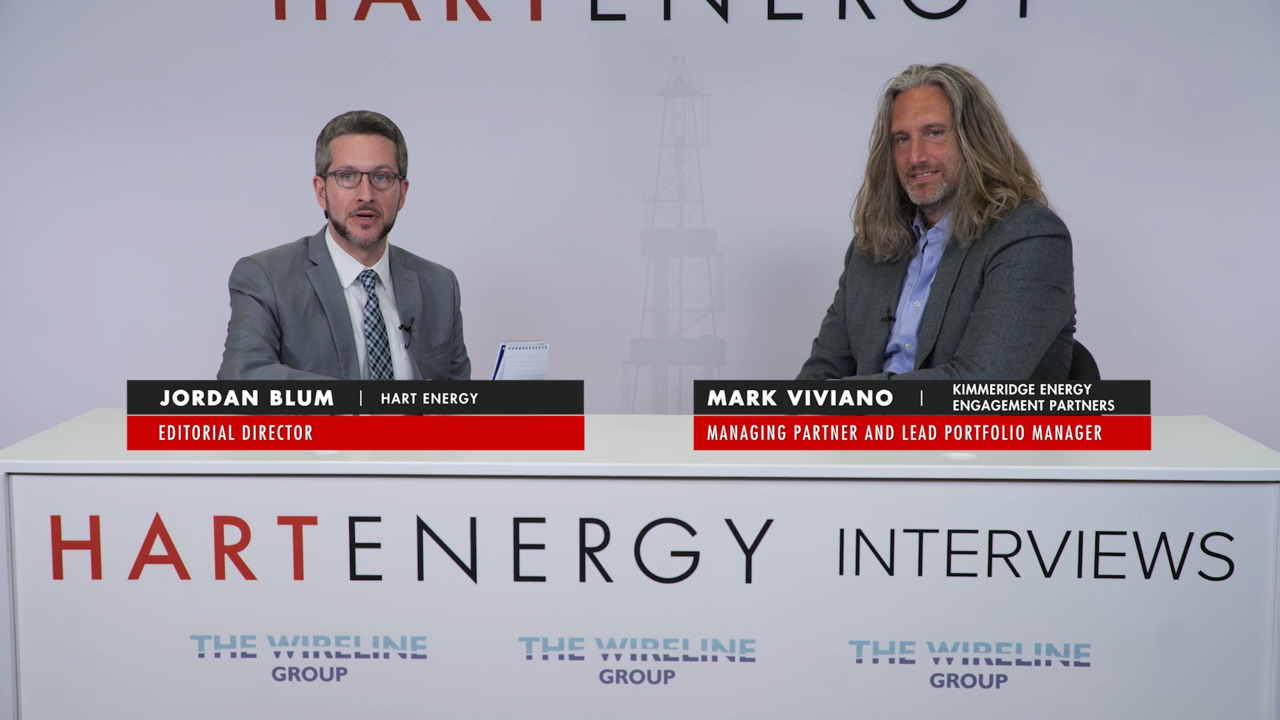
Jordan Blum, editorial director, Hart Energy: We are here at SUPER DUG in Fort Worth, Texas. I'm joined by Mark Viviano, managing partner and lead portfolio director with Kimmeridge Energy Engagement Partners. That's KEEP for short. Thank you so much for joining us. I really appreciate it. Just to get the cliched elephant out of the room first, so Crescent Energy and SilverBow announced this morning an acquisition. Obviously y'all have been heavily involved with SilverBow. Kimmeridge Texas Gas has made an offer to combine there. I know you can only say so much, but what can you say and is this the end of the story, so to speak?
Mark Viviano, managing partner and lead portfolio director, Kimmeridge Energy Engagement Partners: It is breaking news. We found out about the deal like everybody else this morning, so I would just say we are evaluating the deal. We want to understand from the management team why this is the right deal for shareholders, and then we'll make our next steps from there. So I would just say more to come, but there's not much more I can comment on than that today.
JB: Understood. I won't push, but just in that context of SilverBow plus other companies, I want to take a step back and get you to talk about how you and Kimmeridge, and you with Wellington before Kimmeridge, have played honestly a pretty key role in reshaping the energy sector, the shale sector, in terms of capital discipline, dividends consolidation compared to five [years ago], six years ago.
MV: It really was this recognition amongst large investors that the sector had become un-investible and it had a lot to do with the value destruction that we saw during the Shale Revolution. But then increasingly the risks associated with the energy transition and given the increased terminal value risk, the only way to overcome that was for the industry to really compensate with higher returns of capital today. And this was an industry that had perpetually spent too much money. Its reinvestment rate, which is just how much capital you spend relative to its cashflow, was off the charts relative to other sectors. It just didn't make sense for a mature industry with a growing terminal value risk to be spending 100% plus of its cashflow every year. So we and other investors were just highly critical to the lack of capital discipline. We've obviously seen a lot of progress from that perspective in the industry. What we've been focused on more recently is consolidation, and I think consolidation in this industry is important for two reasons. One, it's just this idea of operational scale and then investor relevancy. We have too many small, irrelevant companies relative to how much investor interest there is in the sector.
JB: Obviously you see that coming to fruition, right?
MV: We've seen a lot of progress in the last 12 months.
JB: Can I get you to touch on some examples? I mean, obviously you're involved with Chesapeake acquiring Southwestern. That's Appalachia, Haynesville and Chord and Enerplus and a big Bakken merger.
MV: Yeah, I mean, we had been critical of the deals that had been struck over the previous four to five years. In a lot of ways there weren't operational synergies. We think they were done for the wrong reasons, generally who was for sale rather than the deals that made the most logical sense. We had been vocal about a year ago that those were the two deals that made the most sense. If you take Chesapeake-Southwestern as an example, those are two companies where operationally in the Haynesville and Marcellus fit like a glove. We think there's going to be meaningful synergies likely ahead of what management has guided the market to. But importantly, you had companies that were, one was 11 billion [Bcf], one was 7 [Bcf], you put them together, all of a sudden, you're going to have the largest gas producer likely to get included in the S&P 500 index, eventually likely to be upgraded to investment grade. That's how you can transform companies where one plus one equals more than two. That's really where the shareholder value creation comes in as a key component to these deals.
JB: You all are pretty involved in some of the newer, bigger Permian players too: Civitas, and I guess this one happened right before you joined, but Ovintiv and others?
MV: Ovintiv was the first investment we made when I joined. And I think what you're seeing is this kind of natural consolidation of publics buying privates. You're seeing companies like Civitas enter a new basin after they had demonstrated success within their own basin, and I think that has a lot to do with the maturity of a basin like the D-J. There wasn't a lot of consolidation steps to be done after everything else had been acquired. So I think moving to the Permian was a natural extension of the success they had had in that basin.
JB: Very. Those are a bit more Permian centric now. And oilier, obviously, you're pretty bullish on natural gas though, despite the pretty morbid prices at the moment. Can I get you to maybe elaborate on that a bit?
MV: Yeah, I mean, there's two components of it. One is just the short term supply demand, the low prices today, everybody likes the phrase ‘cure for best low prices, low prices.’ We think there's inevitability to the rationalization of the supply demand imbalance. Clearly, we're dealing with a storage overhang coming off a very warm winter, but we're seeing supply decline today. We're seeing shut-ins, we’re seeing the rig count decline. Ultimately, you'll see that rationalization particularly into 2025 when a lot of the LNG projects are going to start up. So that's kind of the short term attraction of natural gas. But what we're really focused on is the longer term rerating of the natural gas equities, and that has a lot to do with the reassessment of the role of natural gas in the energy transition. So when you think about the security of supply for Europe and moving off of Russian gas, so the decarbonization efforts that exporting our gas to the rest of the world can have off moving off coal, those are investment themes that a generalist portfolio manager will ultimately be attracted to when they come back to the sector. There's a different duration of demand for natural gas than oil, and I think that should be reflected in the equity valuations over time. So I think we're in the early innings of that reassessment, but we think it's got a multi-year thematic investment to it.
JB: Great. Well, thank you so much for joining us here at SUPER DUG. We really appreciate it. To read and watch more, please visit online at hartenergy.com.