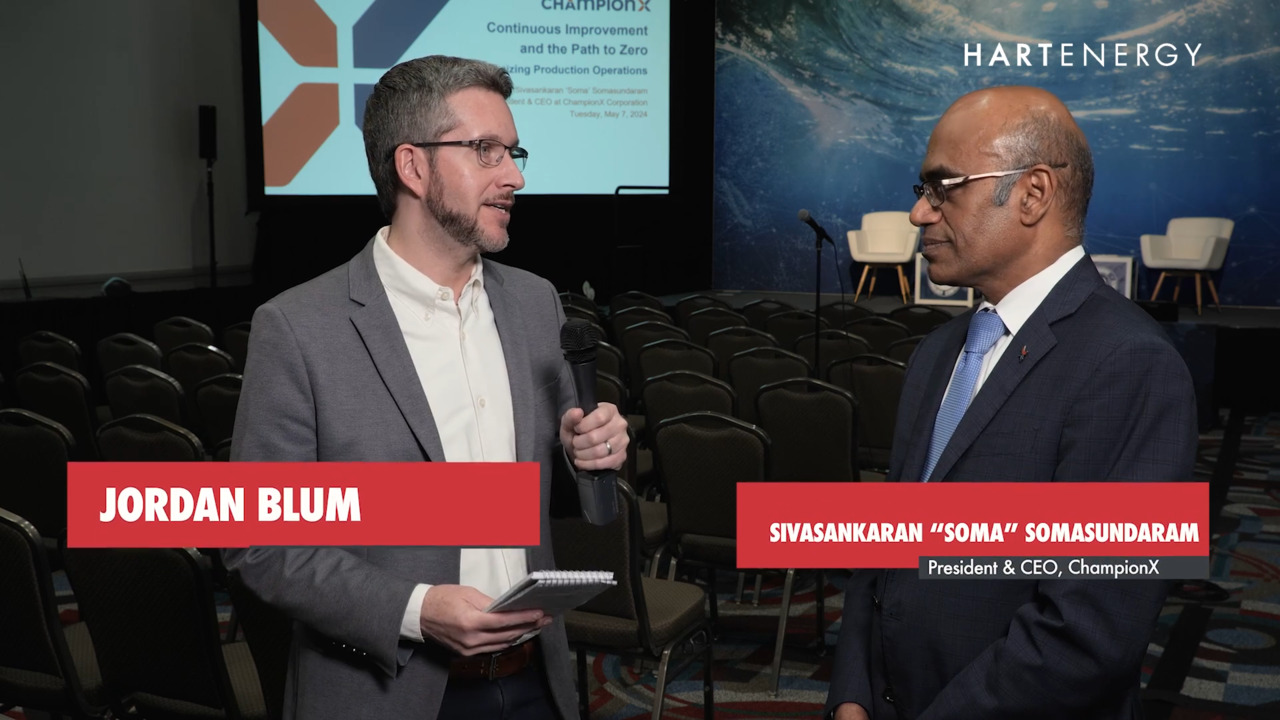
Jordan Blum, editorial director, Hart Energy: We are here at the Offshore Technology Conference here in Houston. I'm joined by Soma Somasundaram, the president and CEO of ChampionX. Thank you so much for joining us. Really appreciate it. Just to get right into it in the oilfield services (OFS) sector, I just wanted to get your take on the increasing role that the OFS space is playing in the path to net zero and really moving operators in that direction.
Sivasankaran (“Soma”) Somasundaram, president and CEO, ChampionX Corp.: Yeah, thank you, Jordan. Glad to be here with you. The oilfield services industry over the last several years, and all along, the oilfield services industry always has been an industry that is focused on technology, continuously improving efficiencies and so on and so forth. And that aspect has accelerated over the last several years with the path to net zero aspirations by our customers, the E&P operators. So if you look, it's in every part of the value chain. The oilfield services is working on it. We all know the amount of drilling efficiency we have gained, and we as ChampionX played a small part in drilling efficiency gain because we produce the cutters. So when I look at those cutters today we produce, they remove almost 1100% more rock than they did 15 years ago. So that's all due to technology improvements and innovations.
And then as you come down to the production operations, today there's a lot of technology development, particularly in areas such as methane emission monitoring, detection, measurement, as well as production chemicals where we are innovating chemistries that can improve performance. At the same time, lowering the dosage, artificial lift, lower power consumption technologies that pumps that consume less power. Digital solutions, so the oil field services sector, and if you go into the completions area, obviously all the e frac, all that. So I think the oilfield service companies always have played a major role in the technology development efficiency improvement. Now that's continuing on today with the path to net zero.
JB: Very good. Yeah. It's not as sexy, say, as the big drilling rigs and frac crews, but continuous monitoring with methane is something y'all have gotten really big into. Can I get you to just elaborate on the importance of that in increasing analytics and even AI?
SS: Yeah, no, Jordan, this is, as we all know, methane is one of the most potent greenhouse gases. In some estimates, it's almost 80% more potent than carbon dioxide. So reducing methane emissions or abating methane emissions is a near term priority for our industry as well as for the broader communities. So that's what… and since we play in the production operations where oil and gas industry as a whole constitute almost 25% of methane emissions in the global methane emissions world. So we feel that we have a responsibility to innovate in technologies that helps our customers detect and measure and reduce. So the continuous monitoring is a technology where you put sensors around the perimeter of a producing well site, and then it continuously samples the well site air to detect any methane emissions present. There's a lot of technology that goes into it because as you can imagine, in an open well site, a lot of factors can impact how you measure this—the wind direction, the speed of the wind, the humidity—that can all alter. So it's as much an atmospheric science that is enabled by a lot of analytics that digital, and particularly now with generative AI, all those technologies go into it and it just, the technology is moving really fast in this area, and I'm really, really proud of what our team is doing in this.
JB: Great. Very good. So in recent years, there's been a lot of big efficiency gains and drilling and completions, and now it seems like there's a lot more emphasis, the conversations pivoting more to artificial lift, production chemicals. Obviously that's a big part of the pending merger with SLB. Can I get you to kind of elaborate on how that is pivoting, if at all?
SS: Yeah. As you rightly pointed out, the incremental barrel of next barrel of oil that needs to get produced, they get more and more production intensive because it's getting harder to reach. It's getting harder to treat. So it requires increased level of chemistry technologies, increased level of artificial lift technologies, and then bringing them all together is the digital technologies where you are constantly monitoring these high producing wells and constantly optimizing so that it can continue to perform at the highest levels. Now with the industry, with our customers very focused on capital discipline as well as they're very focused on reducing their own carbon footprint. So efficiency improvement and ability to deliver the next barrel of oil with the lower carbon intensity is a priority for our customers. So that's why there is more and more emphasis in the world. Capital discipline, combined with lower carbon intensity in the production area is what's driving all this innovation.
JB: Good. In terms of production chemicals, can I get you to just elaborate on what innovations you're maybe most excited about now and going forward?
SS: Yeah. So in the area of production chemicals, just from a creation of new molecules, that's what we do. We create new molecules that helps our customers protect their assets, as well as enabling the flow of oil and gas. So in that area, we are continuously innovating in the area of multifunctional chemicals. In the past, we used to have different chemicals to do different functions, whether it's corrosion inhibition, whether it is hydrating inhibition, whether it is biocides, but now we are innovating molecules and chemicals, which can do multiple of this with one chemistry. So you can imagine the amount of chemistry used needs to go down, the real estate that is needed, the amount of logistics needed to delivering all this goes down. And then we are also digitizing the whole supply chain, so to improve the efficiency related with delivering these chemicals as well. So I'm pretty excited about all those innovations that's going on, which is going to help our customers attain their aspirations on net zero.
JB: Great. Well, thank you so much for joining us here at OTC. Really appreciate it. To read and watch more, please visit online at hartenergy.com.