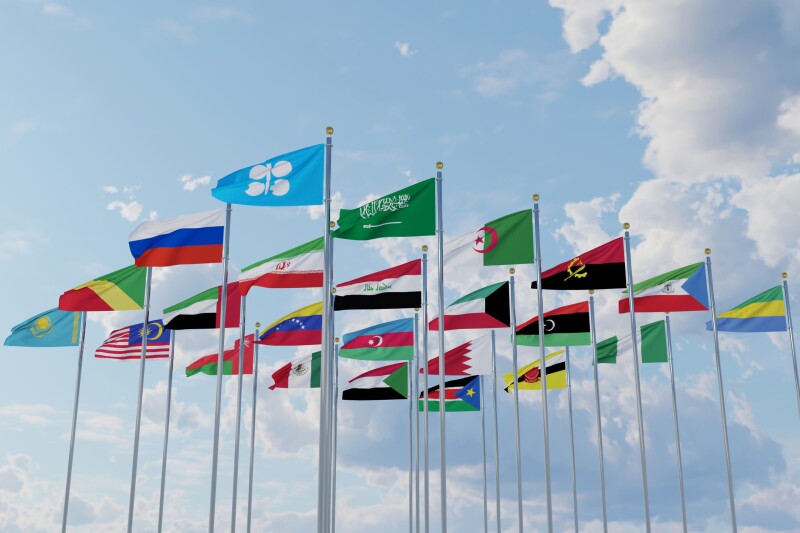
Angola’s decision to exit the Organization of Petroleum Exporting Countries (OPEC) at year-end 2023 underscores the country’s commitment to achieving economic growth by leveraging investment in fossil fuel projects.
The West African country’s goal of boosting and stabilizing crude production to well above 1 million B/D put it on a collision course with OPEC’s latest round of production quotas, Mineral Resources Minister Diamantino Azevedo said in a speech in Luanda.
In November, OPEC+ members voted to cut oil production by 2.2 million B/D at the start of 2024. Angola's quota for 2024 was cut by 350,000 B/D—from 1.46 million B/D to 1.11 million B/D, below the country’s November production of 1.13 million B/D, according to the Platts OPEC Survey.
Angola joined OPEC in 2007, but the cartel’s quota system to control global oil prices “no longer aligns with the country’s values and interests,” let alone its “capabilities and needs,” Azevedo said. Between 2016 and 2020, Indonesia, Ecuador, and Qatar also left OPEC after deciding that membership in the cartel ran counter to their national interests.
Angola’s departure now leaves Saudi-led OPEC with 12 members while the Russia-led group of non-OPEC members allied since 2016 as OPEC+ comprises 10 nations.
Without Angola, the core Saudi OPEC will produce around 27 million B/D, about 27% of global supply, while Russia and its OPEC+ followers will chip in another 16.5 million B/D, according to the US Energy Information Administration (EIA).
The percentage cited by the EIA is based on its own global oil demand estimates projected for 2023.
Small and Medium Indigenous Company Bids Pour In
Angola, Africa’s No. 2 oil producer after Nigeria, has launched a series of licensing rounds and investor roadshows, the most recent of which began on 30 September 2023, offering 12 onshore blocks in the Kwanza and Congo basins that target small and medium-size companies that seek to develop a local workforce, according to the Africa Oil+Gas Report.
As of November, 22 foreign and indigenous companies had submitted 53 bids. Angola’s National Agency of Petroleum, Gas and Biofuels (ANPG) expects to announce the winners on 19 March 2024.
Global majors have long been well represented in Angola, particularly in the offshore, including TotalEnergies, Petronas, ExxonMobil, Equinor, Chevron, and the Azule 50/50 joint venture between BP and Eni.
Angola’s production briefly dipped below 1 million B/D in March 2023, according to data compiled by Bloomberg. The country is targeting, however, a return to the 1.8 million B/D it produced at peak over a decade ago.