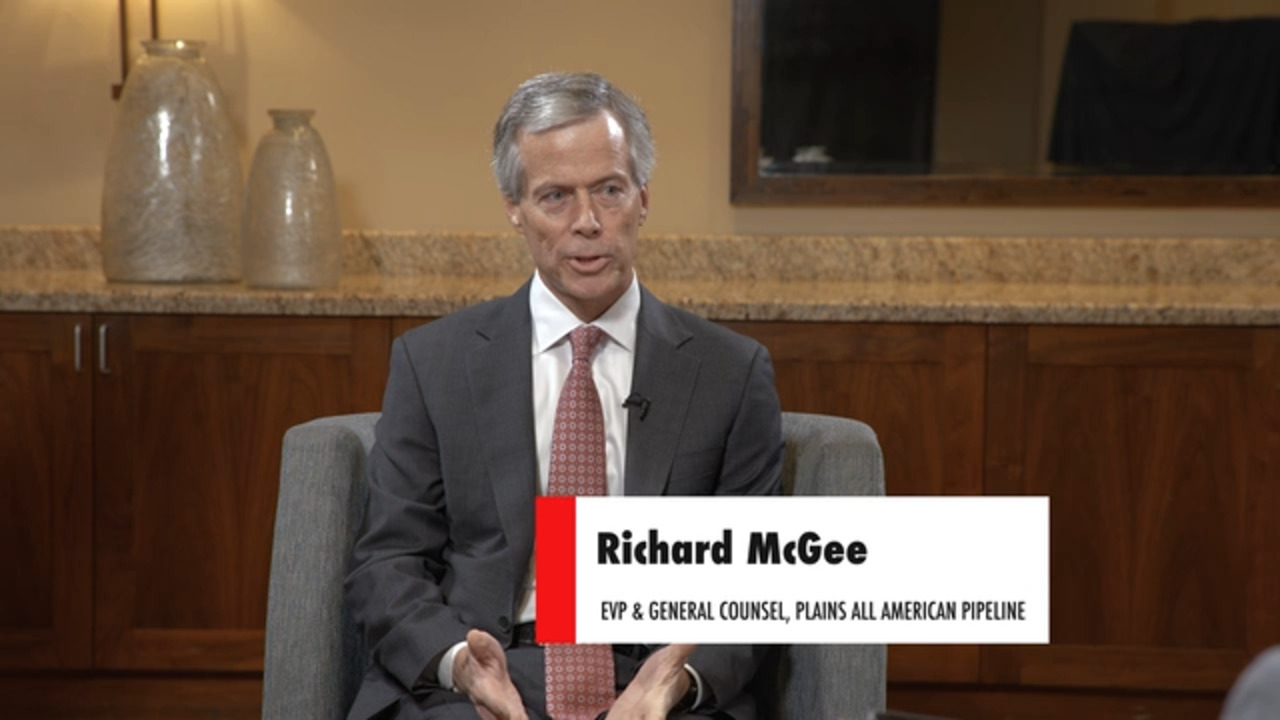
Jordan Blum, editorial director, Hart Energy: How does the [Kay Bailey Hutchinson] Energy Center solve its workforce challenges? We're here at the Kay Bailey Hutchinson Energy Center Symposium in Austin to find out. I'm joined now by Richard McGee, the executive vice president and general counsel at Plains All American Pipeline for this Hart Energy LIVE Exclusive interview. Thank you so much for joining us. We really appreciate it.
Richard McGee, executive vice president and general counsel, Plains All American Pipeline: Happy to be here.
JB: Just wanted to get your take on just why it's so important to be involved with the energy center and be here at the symposium today.
RM: I really look at my participation in the energy center as an opportunity to pay it forward. I've been really blessed over about a 40 year career so far to work with some really smart and interesting people on really interesting projects all around the globe. The energy center is a student-focused organization that's geared and set up to help students be better prepared and to launch their careers. And so by being involved in this center, for me, it's an opportunity to feel like I'm helping somebody else the way that I was helped before. So in that sense, I'm paying it forward.
JB: And what do you see as the role of the energy center, UT and really all of higher education to help solve the workforce issues for oil and gas and I guess the upcoming or current great crew change that's occurring?
RM: The energy industry today, more so than ever, it needs technical and engineering talent. It needs business talent, and it needs legal talent. The university is so strong across all of those areas, and the center provides an opportunity for students to tap into that regardless of which school they're in. If you're in the law school, you can have access to business and engineering classes and vice versa and so on. The other thing that the energy center does is it helps provide a connection for students to this vast network of UT related individuals, company alumni, etc., that are involved in the energy industry. And that becomes a huge family that can help students, help them find their first opportunity once they've found an opportunity grow and evolve in their role, whatever it may be, with whatever company. So I see the energy center really as a great add-on to what the university offers, and the university is in this great position to feed talent into this multidisciplinary game.
JB: What do you see right now as the most pressing gaps facing the industry?
RM: I think it really gets back to this point about where we are today with the energy transition, probably more so than ever, there's a real need for technical talent to unlock the potential of future forms of alternative energy. And I think that's where the university plays a key role now for people who have been involved in traditional energy. You talk about the great crew change. That's one thing and that's happening, but I think if you're a student today and you're looking at where is there going to be an opportunity rich environment, you've got to look at energy. Because with the alternative energy evolving, or energy evolution, there are so many opportunities out there for students to get involved in really interesting work with smart, creative people and help solve problems that are really going to help the globe, frankly, for generations to come. So I would say that's a very attractive thing from a student standpoint today.
JB: Now, there's obviously challenges on the horizon, but business is booming right now. Plains [All American Pipeline] is very involved in the Permian Basin record high production for both oil and gas there. I mean, how pleased are you with how things are going now and for the foreseeable future?
RM: I would say I would describe my thoughts or our company's feelings as we're certainly constructive on the Permian Basin. There is so much resource there that's yet to be tapped. Currently, the production levels are in the 5.8 million barrels a day range. We think that it's going to inch up over 6 million barrels a day by the end of the year, and then, looking forward in probably three-ish year’s time, we think it's very realistic that you could get to 7 million barrels a day in the Permian Basin. The wild card is that there's a lot of resources. Technology will change over the next decade as it has in the past two decades, and that will make a big difference on how much oil is produced from the Permian Basin and what the needs are there from an infrastructure standpoint. So I'd say we're very constructive on the Permian Basin. It's going to be a major contributor to global energy supply for decades to come, multiple decades, not just one decade. So that would be my view is that we're very constructive on the future of the Permian Basin.
JB: Speaking of decades, I mean probably for the last decade or so, Plains has probably been more involved than any other company in building out the long-haul crude pipelines from the Permian. Do you think it'll be much longer before more of those big pipelines are needed again?
RM: In the near medium term, I think the existing infrastructure is sufficient to deal with the production that's coming. You have a lot of pipes that were built during this period that you referenced. There's excess capacity. There are ways to get more capacity out of the existing pipes that are already in the ground. So I don't think there's a big wave of new construction, new greenfield construction of long haul pipes coming out of the Permian in the foreseeable three to four year timeframe.
JB: Well, thank you so much for joining us at the KBH Energy Center for this Hart Energy LIVE Exclusive interview. To read and watch more, please visit online at hartenergy.com.