This year’s selections in history matching and forecasting showcase notable advances in adjoint-based model calibration and deep-learning surrogates for CO2 storage and monitoring. The three featured papers illustrate how emerging computational methods—ranging from gradient-based optimization to data-driven proxies—are reshaping reservoir characterization, uncertainty assessment, and real-time decision support across diverse subsurface applications.
The first paper, SPE 223837, introduces a practical methodology that embeds adjoint-gradient calculations directly into commercial reservoir simulators without requiring access to source code. By externally processing simulator restart files, the workflow enables efficient gradient-based history matching on widely used industry platforms. The study demonstrates accurate and stable adjoint derivations for large, complex field models, offering a scalable and high-resolution approach to model calibration while preserving existing simulation environments.
Paper SPE 228029 applies the Embed-to-Control Observe (E2CO) deep-learning architecture to history matching through the E2CO-HM surrogate. The method adapts a production-optimization proxy to efficiently solve high-dimensional inverse problems and introduces sensitivity analysis on permeability uncertainty. Results show over 100X speedup compared with high-fidelity simulation while preserving strong accuracy in state and well predictions, offering a robust and efficient framework for reservoir-model calibration under moderate geological heterogeneity.
The third paper, SPE 227866, advances real-time CO2-plume monitoring through an innovative deep-learning workflow designed to operate under geological uncertainty. Key contributions include a compressed plume representation using CO2‑onset time maps, a model-selection strategy based on convective time of flight, and a dual variational autoencoder that links well data to plume images. Validated on the Illinois Basin-Decatur Project, the method enables near-instantaneous plume visualization and history matching, providing a scalable tool for monitoring and regulatory assessment.
Together, these papers highlight how adjoint methods and deep-learning surrogates are reshaping modern reservoir engineering. By improving computational efficiency and enabling rapid model updates, they offer practical pathways for more accurate history matching, optimized CO2 storage strategies, and enhanced subsurface monitoring.
Summarized Papers in This April 2026 Issue
SPE 223837 Adjoint Gradient, Commercial Simulator Combine for Efficient History-Matching by Duc Le, Krishna Nunna, SPE, and Amir Shahbazi, SPE, Occidental Petroleum, et al.
SPE 228029 Embed-to-Control Reservoir Surrogate Used To History-Match Geological Models by Usman Abdulkareem, SPE, Ahmed Adeyemi, SPE, and Mustafa Onur, SPE, The University of Tulsa
SPE 227866 Near-Real-Time CO2-Plume Monitoring, Visualization Approach Considers Geologic Uncertainty by Takuto Sakai, SPE, Masahiro Nagao, SPE, and Akhil Datta-Gupta, SPE, Texas A&M University
Recommended Additional Reading
SPE 223887 Fast History Matching With a Fully Customized Physics-Based Data-Driven Flow Network Model GPSNet: Application to a Giant Deepwater Gas Field With Multiple Sands by X. Guan, Chevron, et al.
IPTC 24829 Well-Production-Prediction Method Based on Multifactor Fusion Time-Series Model by Yaqian Zhang, China University of Petroleum, et al.
SPE 221501 Physics-Inspired Machine Learning for Reliable Production Forecast in Unconventional Reservoirs by Hui Zhou, ConocoPhillips, et al.
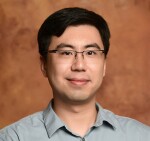
Zhenzhen Wang, SPE, is a lead research scientist and simulation engineer at Chevron Technical Center with 11 years of industry experience. He holds a BS degree from China University of Petroleum, an MS degree from The Pennsylvania State University, and a PhD degree from Texas A&M University, all in petroleum engineering. Wang’s expertise spans reservoir simulation, optimization, history matching, enhanced oil recovery, and pressure transient analysis and rate transient analysis. He has authored more than 30 papers, reviewed more than 120 manuscripts, and serves as an Associate Editor for SPE Journal. Wang has contributed to program committees for the SPE Annual Technical Conference and Exhibition, Western Regional Meeting, and the Unconventional Resources Technology Conference, and received the 2022 SPE Cedric K. Ferguson Medal.