BP, Eni, Repsol, OMV Return to Libya, Ending 10-Year Absence
The Libyan National Oil Company plans to tender 22 onshore/offshore exploration blocks in 2025 as it works to rebuild credibility with foreign oil producers.
Though gifted with Africa’s largest oil reserves, Libya has struggled for more than a decade to stabilize production against political strife.
Credit: Dreamstime.com
Spain’s Repsol has joined a growing cadre of international oil producers that are returning to Libya after a 10-year hiatus, spudding its first exploration well since receiving security guarantees from the Libyan National Army and Libyan National Oil Corp. (NOC) announced a year ago.
Repsol began drilling the A1-2/130 (Muammal Nsr) exploration well on 31 December 2024, in the country’s southwest, 12 km from Libya’s largest oil field, Sharara, as reported by Reuters. The well is slated to be drilled to a depth of 1844 m (6,050 ft).
It is one of six wells in Repsol’s NC115 and NC186 license areas in the southwestern Murzuq basin that the company was scheduled to drill when it announced a resumption of its exploration activities in April in a news release.
At the end of October, Eni and BP initiated exploration activities with the Libyan Investment Co. in Area B of the Ghadames Basin, northwest Libya, starting exploration drilling at well A1-96/3 (Hasheem Prospect) under the 2007 Type IV Contracting Agreement.
Mellitah Oil & Gas, a 50/50 joint venture between Eni and NOC, is overseeing drilling based on its experience in the commissioning and development of the Al Wafa field, according to The Arab Weekly which quoted NOC as saying that a range of promising geological formations will be tested at well A1–96/3, with a final well expected to reach 3147 m (10,327 ft).
Well A1-96/3 is about 35 km from the Wafa field and about 650 km from the capital, Tripoli. Austria’s OMV is exploring in the Sirte Basin, according to NOC.
Akakus, a joint venture of NOC in partnership with Repsol, TotalEnergies, OMV, and Equinor, operates the Sharara oil field which the partners hope to ramp up to a targeted 260,000 BOPD. Sharara’s production capacity is 320,000 B/D, according to Zacks Investment Research.
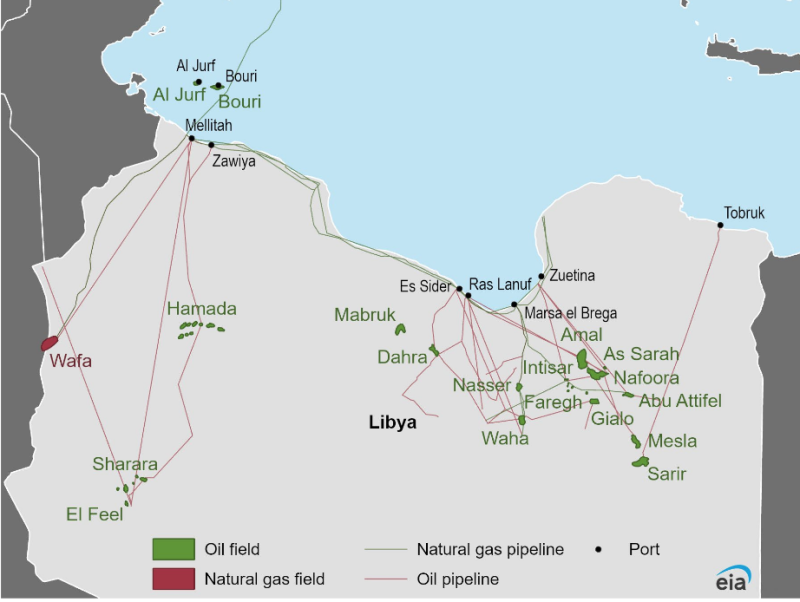
Fig. 1—Libya’s oil and gas fields.
Source: US Energy Information Administration Country Analysis Brief: Libya, December 2024.
Libya’s NOC announced in December its intent to offer 22 onshore and offshore exploration blocks in 2025 to attract foreign investment to boost the country’s energy sector, Zacksreported, adding that Libya’s crude oil production hit its highest levels since 2013 in 2024, besting 1.4 B/D.
The Middle East Observer noted that the “partnership with BP and the Libyan Investment Authority … marks a pivotal moment in rebuilding confidence in Libya’s energy sector, which has been marred by political instability and conflict.”
Though Libya claims the largest of Africa’s oil reserves at nearly 48 billion bbl as estimates published by the US Energy Administration (EIA) suggest, production has fluctuated wildly for years as political stability rocked the country.
According to the EIA’s Country Analysis Brief on Libya published in December, NOC had intended to bolster crude oil and condensate production to more than 1.5 million B/D by the end of 2024, expanding to 2.0 million B/D by 2025. To reach this target, the NOC plans new projects to raise oil production as well as rehabilitate fields that were damaged during the conflicts of the past decade and increase power supply to the fields. To increase its production and offset current declines from older fields, Libya needs to attract more foreign investment and technical capacity, the EIA concluded.