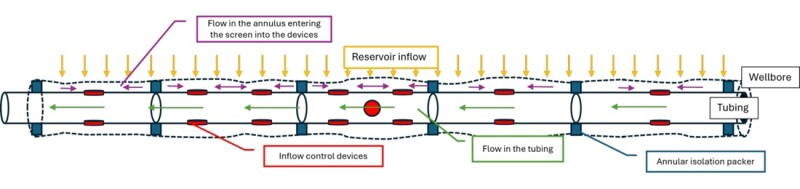
Inflow control technology has been used extensively as part of the lower completion strategy to effectively isolate reservoir sections that are susceptible to unwanted fluid breakthroughs. However, this technology imposes an additional pressure drop, which can limit total liquid production, thereby affecting the drainage strategy and affecting overall energy efficiency.
This paper compares various drainage strategies and well completion configurations on the installation of inflow control technology by considering energy efficiency. The findings indicate that there is a balance between maintaining sufficient reservoir pressure and reducing selective inflow.
Although it is crucial to maintain reservoir pressure, excessive increase in reservoir pressure appears to be disadvantageous to energy efficiency while giving limited increase in hydrocarbon recovery. Another key finding highlights the importance of device characteristics on choking performance and energy efficiency.
The results demonstrate that excessive choking, while beneficial in reducing the production of unwanted fluids, will reduce both net present value and energy efficiency. This indicates that specific device characteristics are suitable for particular drainage strategies.
This abstract is taken from paper SPE 231175 by H.R.D. Sutoyo, Norwegian University of Science and Technology; H. Schümann, SINTEF Industry; and C.F. Berg, Norwegian University of Science and Technology. The paper has been peer reviewed and is available as Open Access in SPE Journal on OnePetro.