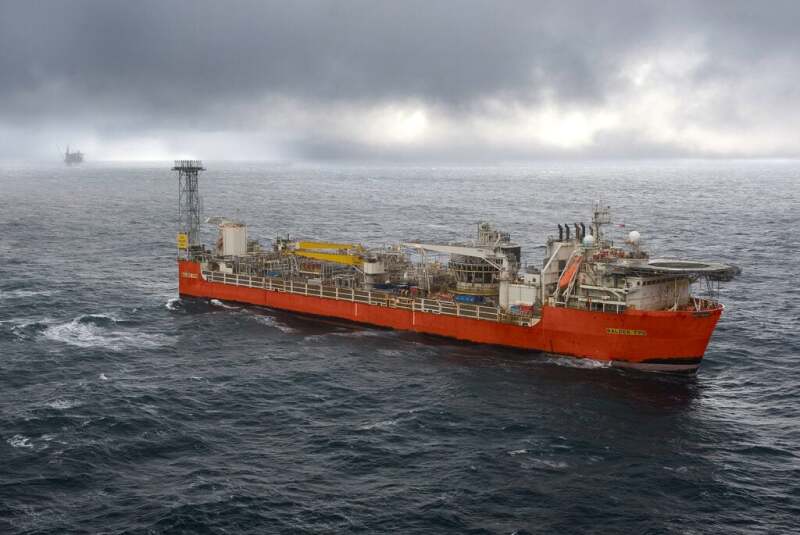
The production unit for the Balder field in the North Sea is expected to go on-stream in the second quarter of 2025 following the staged tow-out of the FPSO.
The FPSO is expected to ramp up to peak production over the course of 3 or 4 months.
Source: Vår Energi
The Jotun floating production, storage, and offloading vessel (FPSO) has reached another milestone on its journey to the Balder field offshore Norway.
Vår Energi announced 13 March that the FPSO had left Worley’s Rosenberg, Norway, yard and is on schedule to start production by the end of the second quarter 2025 and ramp up to peak production over the course of 3 or 4 months.
But before it begins production, the towout will happen in stages. First, the FPSO vessel will undergo inclination tests at Worley’s quayside before being towed to Åmøyfjorden, near Stavanger, for inshore sea trials and anchor-installation work. The vessel then will be towed to the Balder field for installation, hookup of the subsea production systems, and final commissioning.
The Balder development project involved the drilling and completion of 14 new production wells, Vår Energi said.
Balder field, located in 125 m water depth in production license 001 in the North Sea, was discovered in 1967. Production at the Norwegian Continental Shelf field started in 1999. In 2019, Vår Energi announced its Balder Future development plan intended to extend the field’s productive life to 2045 and beyond, and a revised plan for development and operation for the Balder and nearby Ringhorne fields was approved the following year.
The field was previously expected to begin production in 2023, but that slipped to 2024 and then to 2025. Costs for the project also rose by nearly 40% to $4.3 billion due to increased scope of work, continuing impact from global supply chain challenges, the COVID-19 pandemic, and schedule changes.
In announcing its plans in 2019, Vår Energi said the project aimed to recover 136 million BOE.
The project also included extending the operational life of the Jotun FPSO, which was originally deployed on the Jotun field 25 km from the Balder field. The FPSO underwent upgrades and maintenance at the Worley shipyard to prepare it for its new role on the field. During it time at the shipyard, excess gas was injected into the Balder and Ringhorne Øst fields.
Once on site and commissioned, the Jotun will serve as a production host for the area, where Vår Energi said it plans to add new production through infill drilling, exploration, and tieback developments.
Nick Walker, Vår Energi CEO, said in a news release that once the Jotun goes on-stream, production from the field “will be close to quadrupled,” adding about 80,000 BOED gross at peak.
He said the Balder X project has a payback time of about 2 years and includes the sanctioned Balder Phase V project.
According to Vår Energi, Balder X, which incorporates Balder Future and the Ringhorne Phase IV, will develop gross proved plus probable reserves of 150 million BOE.
Vår Energi said that with the Jotun on site, infrastructure in the area can be optimized and the current Balder floating production unit can be sent to shore for decommissioning. Vår Energi plans to electrify the Balder/Grane area to reduce unit production cost and carbon emissions.
Vår Energi said it anticipates having the Balder FPU brought to shore for decommissioning after the Jotun FPSO in onstream.
Source: Vår Energi
The operator also said there are other early-phase projects in the Greater Balder area moving toward sanction, including Ringhorne North, Balder Future phases, and the King discovery, targeting gross contingent resources of more than 70 million BOE.
Vår Energi operates the Balder field with 90% interest on behalf of partner Kistos Energy Norway AS with 10%.