The USGS has said up to 19 million tons of lithium reserves are contained in the briny waters of the Smackover formation in Arkansas.
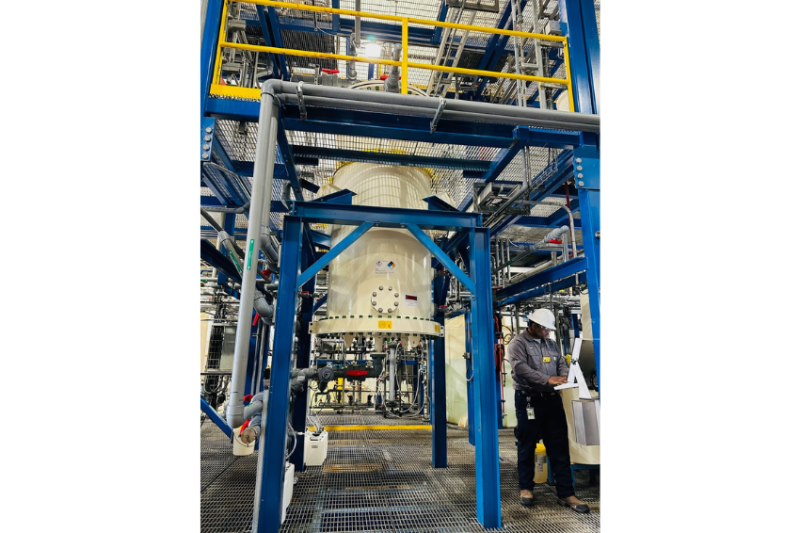
The single column separator inside Standard Lithium’s demonstration plant extracts lithium from salty brine pumped up from the Smackover formation.
Source: Standard Lithium
A study by the US Geological Society (USGS) of a prospective area in southern Arkansas concluded that the region could contain an impressive 5.1 million to 19 million tons of lithium reserves. If this deposit is proven commercially recoverable, the amount of lithium present would meet projected 2030 world demand for lithium in car batteries nine times over.
The study, carried out collaboratively by the USGS and the Arkansas Department of Energy and Environment’s Office of the State Geologist, used a combination of water testing and machine learning (ML) to quantify the amount of lithium present in brines located in the Smackover Formation. Extracting lithium from brines co-produced during oil and gas operations provides an opportunity to extract a valuable commodity from what would otherwise be considered a waste stream.
Samples from Arkansas were analyzed by the USGS Brine Research Instrumentation and Experimental lab in Reston, Virginia, and compared with data from historic samples within the USGS Produced Waters Database of water from hydrocarbon production. The ML model was then used to combine lithium concentrations in brines with geological data to create maps that predict total lithium concentrations across the region, even in areas lacking lithium samples.
Using ML models to map mineral prospectivity is an emerging field, but similar research to predict shallow-groundwater chemistry using machine learning has shown the ability to produce accurate maps of aquifer chemistry.
The top five important explanatory variables for predicting lithium according to the USGS were dissolved hydrogen sulfide (H2S) concentrations in Smackover brines, depth of brine sample, altitude of the top of the Smackover, whether a brine sample was collected from the Smackover or another geologic unit, and thickness of the formation.
Within the model domain, the USGS estimates around 42% of the Smackover contains brines with lithium concentrations of greater than 100 mg/L—a concentration cutoff used for some direct lithium extraction (DLE) technologies.
“Lithium is a critical mineral for the energy transition, and the potential for increased US production to replace imports has implications for employment, manufacturing, and supply-chain resilience,” said David Applegate, USGS director. “This study illustrates the value of science in addressing economically important issues.”
The Smackover extends under parts of Arkansas, Louisiana, Texas, Alabama, Mississippi, and Florida and dates to the Jurassic geological time period. It is known for its rich deposits of oil and bromine. In recent years, the Smackover has also gained attention for potential lithium in brines—high-salinity waters associated with deep salt deposits.
“Our research was able to estimate total lithium present in the southwestern portion of the Smackover in Arkansas for the first time,” said Katherine Knierim, a hydrologist and the study’s principal researcher at USGS. “We estimate there is enough dissolved lithium present in that region to replace US imports of lithium and more. It is important to caution that these estimates are an in-place assessment. We have not estimated what is technically recoverable based on newer methods to extract lithium from brines.”
ExxonMobil, Standard Lithium, and Ablemarle are the three main companies pursuing new DLE projects in southern Arkansas. Standard has the longest-lived pilot project in the area, while ExxonMobil and Ablemarle have both announced intentions to construct a pilot plant.
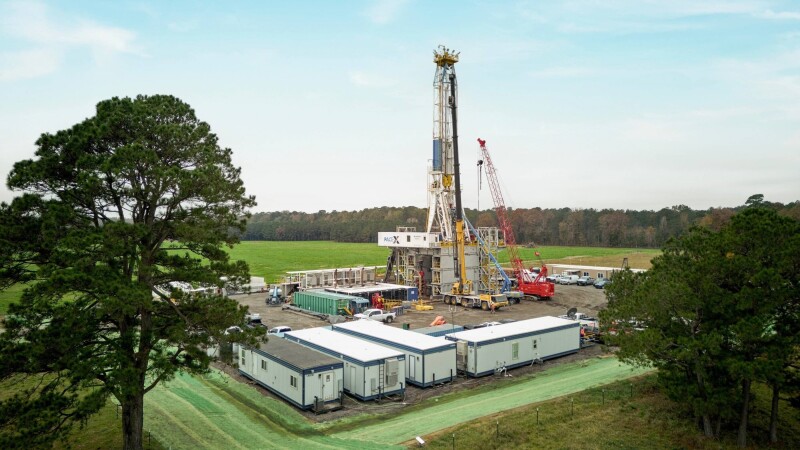
ExxonMobil’s first lithium rig, part of an appraisal program in Arkansas. By 2030, the supermajor aims to produce enough lithium to support the manufacture of about 1 million electric vehicles.
“We’ve been running a demonstration plant now for over 4 years at one of the existing brine-producing plants in southern Arkansas,” explained Andy Robinson, director, president, and COO at Standard Lithium. “Plant's been there for almost 60 years, in fact, extracting bromine from the brine. Over the last 4 years, we've been able to kind of co-locate on one of the existing plants and use their tail brine, which is basically the waste brine, before it gets reinjected back into the formation—the same formation it comes from—for direct lithium extraction.”
One hurdle yet to be cleared for all those that are planning lithium extraction operations in Arkansas is the royalty rate to be paid to landowners. As recently as last month, lithium companies had been lobbying the Arkansas Oil and Gas Commission (AOGC) to accept a 1.82% rate. Landowners countered with 12.5%. That’s a big difference and one that may keep the debate over the proper rate going for a while. The AOGC rejected the 1.82% proposal and asked applicants for more economic information about each project in support of any future royalty applications.
Today, commercial-scale lithium production in the US has been concentrated in Nevada and Utah, but extensive lithium deposits occur throughout the US. Projects pushing toward commerciality are also underway in the Permian Basin of west Texas, California’s Salton Sea, and Kings Mountain, North Carolina.