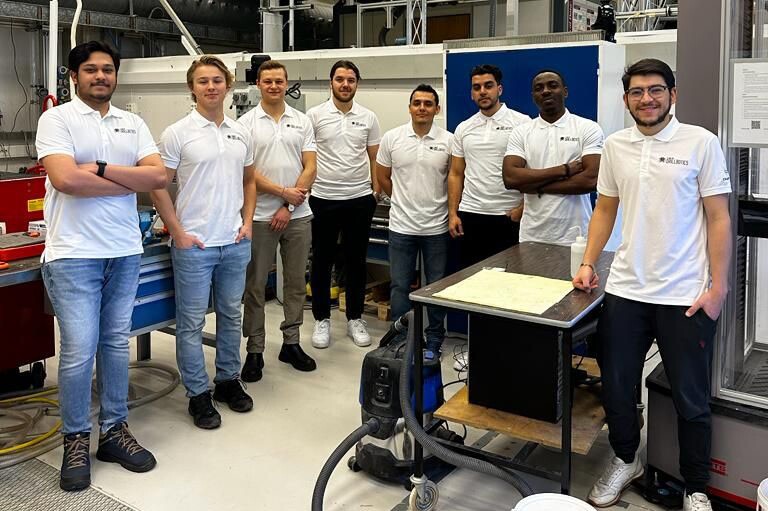
Drillbotics is, simply put, robotic drilling.
Hosted by SPE’s Drilling Systems Automation Technical Section (DSATS), the annual Drillbotics competition involves university teams from around the world vying to present an SPE paper at the IADC/SPE International Drilling Conference and Exhibition.
The final selection in this year’s competition has the University of Stavanger as the winner of the virtual test, introduced during the COVID-19 pandemic, and the Clausthal University of Technology as the winner of the hybrid in-person and virtual test.
2023 Drillbotics Competition
As this year’s contest draws to a close, we look back on the competitors. Thirteen teams registered last fall, coming from seven countries spanning four continents. We had six teams in Group A (virtual rig) and seven in Group B (physical rig). The effort proved too difficult for many teams, with only six submitting a Phase I Design Report. Two of the six were unable to complete their rig and withdrew in the spring.
The finalists competing for Phase II included:
Group A Virtual Test
- University of Mines and Technology (UMaT)–Tarkwa, Ghana
- University of Stavanger (UiS)–Stavanger, Norway
Group B Hybrid In-Person and Virtual Test
- Clausthal University of Technology (TUC)–Clausthal-Zellerfeld, Germany
- Université de Mons (UMons)–Mons, Belgium
UMaT significantly improved their directional drilling model and user interface. They cleverly built a model that would automatically plot a course and build or turn in softer formations for an increased overall rate of penetration. UiS was the first team to take on the new well control option to detect and close in on a kick. They monitored flow in/out and pit levels, included managed pressure drilling techniques, and their model included an algorithm to reduce false negative alerts.
The team from Germany traveled to Belgium to participate at Mons. Both Group B teams built and operated physical rigs to drill a directional well autonomously. As a first-time competitor, UMons focused on building a rig capable of a vertical well and were successful the first time out, which as we all know, is no small feat. TUC improved their miniature RSS by switching from a hydraulic controller to a mechanical one. Their work shortened the BHA with a redesigned downhole tool and bit that allowed up to an 8° build in the small 1-1/2-in. hole. They also created an artificial magnetic field that was strong enough for detection by the miniature downhole sensor.
For the first time in the history of the competition, both winning teams will coauthor the SPE paper to be presented at next year's IADC/SPE International Drilling Conference and Exhibition. The paper will describe the efforts to design and build each teams’ work product and will look at their impact on automated drilling.
History of the Competition
The real prize of the competition is the camaraderie of shared hard work to learn things that are not in textbooks. Teams must demonstrate a knowledge of drilling equipment and techniques and how to recognize and mitigate drilling dysfunctions.
The competition is done in a 1.5-in.-diameter hole using a scaled-down mini-rig about 2 m high. Imagine the difficulty simulating a rotary steerable system (RSS) or a drilling motor plus downhole sensors in a bottomhole assembly (BHA) that can steer within a borehole this small to hit three targets in a rock that is 2×2×1 ft. And one more thing: The competitors must do this hands-free.
This research project prepares the students to join our industry with skills that are much in demand. Team members work in an interdisciplinary environment to communicate with and learn from others. A background in petroleum engineering helps spot drilling dysfunctions and how they should be mitigated, in addition to basic drilling operations. Mechanical and electrical engineering is needed to build the physical rig and to model the response of a virtual rig. Education in machine controls includes understanding response times, alarm systems, and human factors elements for user interfaces. Nearly all teams use some form of artificial intelligence to train and test their automation algorithms. They also learn to create and follow safe operating systems and procedures. Future employers usually give our students high ratings due to this unique combination of skills.
This program began in 2014 but was interrupted in 2020 due to the COVID-19 pandemic. The competition challenge team learned that universities would not allow teams to congregate in classes or labs. For the next year, with COVID-19 restrictions still implemented in many places, the competition moved to a contest involving a virtual rig.
Teams still had to drill a directional well but with a simulated rig and virtual drilling. There was a pushback from teams who still wanted to build and operate a physical rig, so the 2021 competition started awarding the winners of both groups. For 2023, we added a well control option for the virtual competition.
The competition changes every year, with new guidelines issued in September. The teams spend the fall designing their rig and control algorithms and submit a Phase I report by 31 December. Judges review their work in January and select finalists to compete in a Phase II test in late spring.
The committee then meets to select the winners. Judges provide feedback to each team to help them in the next year. The Phase I design report is treated as proprietary information until the end of the final test when all reports are posted online to share the knowledge base. Student presentations, judges’ Q&A, and final tests are all recorded and shared online to facilitate the uptake of this technology.
Future Plans
The Drillbotics Committee has several long-term hopes including using the mini-rigs for additional research beyond the competition. A previous competitor from Norway is doing this now. These rigs are excellent for studying drillstring vibrations and data analytic techniques. Perhaps these rigs could be adapted to using industry communication standards now under consideration to verify and validate third-party applications being developed for drilling automation on full-scale rigs. Future students will likely implement this and more.
Beyond the hard work of the students and professors, we especially want to thank all the sponsors and volunteers who work in the background and are essential to making it all possible. Our Challenge Team sets goals each year, and you can find their names and affiliations in the guidelines. Our sponsors have provided over $360,000 in total funding so far, but we need donations now for next year.
This year we received generous support from Baker Hughes, EnTech Energy Technologies Co. (Saudi Arabia), Equinor, ISCWSA (SPE Wellbore Positioning Technical Section), NOV, Oxy, Patterson-UTI, and ProDirectional Drilling Services.
Previous sponsors can be seen here.
Anyone interested in helping next year may contact us at Competition@Drillbotics.com. Teams need help purchasing materials, and the program needs funds for student travel and consumables. Please lend a hand, if it only means you can help arrange a rig visit for the student teams to get some more field experience or mentor a local school. And, of course, please consider these students as potential employees.
Look for a Drillbotics documentary that is due for release this fall. David Gibson of Gibson Reports and his staff followed students, professors, sponsors, and Drillbotics volunteers around the world to film in labs and at conferences and offices to capture the competition and its impact. We think this visual exploration of the program will encourage more participation.
Let us all congratulate the volunteers, sponsors, and teams who participated this year, especially the finalists and the ultimate winners.