Vertical integration improves capital efficiencies through scale, stability, goal alignment
EQT realizes business and sustainability synergies by taking holistic approach to upstream/midstream spending, technologies
Jan 21, 2026
0 837 14 minutes read
Sarah Fenton, Executive VP of Upstream, EQT Corp
By Stephen Whitfield, Senior Editor
Sarah Fenton is Executive VP of Upstream at EQT Corp.
What do you see as the biggest challenges facing the industry right now?
I think we’d take a more optimistic view to that question. For us as an operator, we’re always looking at our gas demand. Who’s looking for our molecules? It’s not so much just the general demand for natural gas from the industry but EQT-specific gas demand. We’re seeing strong signals right now in our backyard. When we talk about challenges, we think more about the opportunities around the demand for EQT molecules.
Appalachia – where we’re primarily based – is somewhat constrained as a basin. What I mean by that is, the molecules in Appalachia, whether they’re in the Marcellus or the Utica, tend to stay in the basin. There are outlets to get them out to the Gulf Coast or East Coast, but they’ve been minimized or canceled due to regulatory and permitting challenges over the past several years. We’re constantly looking for in-basin demand as one of our sources of growth.
Without that growth, we’re just holding our base production flat, and honestly that’s where we’ve been for a long time: growing through acquisitions, holding that base production flat.
Looking into 2026, at EQT we’ve seen decent in-basin demand growth coming our way from new data centers, new power generation or even LNG. When you combine those demand signals with the resilient upstream business we’ve built for ourselves, it’s a good sign.
How have you built that resilience?
We’ve spent the past couple of years driving our costs down and decarbonizing our operations. In 2024, we announced we had become the first traditional energy company of scale in the world to achieve net zero on a Scope 1 and Scope 2 basis.
On top of that, we’ve done a lot of acquisitions. We’ve underwritten nearly $20 billion in deals in the last six years and have taken a deep dive in understanding our inventory – tier, economics and ranges of outcomes – and that’s really helped us high-grade our inventory.
You mentioned your optimism around demand growth in Appalachia. How optimistic are you about the ability of producers in the region to meet that demand growth?
From EQT’s perspective, I think we’re really set up well to meet that demand. A big reason behind that is our focus on vertical integration: After our acquisition of Equitrans, we became the only vertically integrated operator at scale in the region, meaning that we have an upstream and midstream business working together. This allows us to be in control of our own destiny, so to speak. We can invest across the natural gas value chain.
When we talk about some of the synergies that come from an acquisition, obviously we talk about the back-office synergies, but then there are also real operational synergies.
We have the rights to a lot of acreage in Appalachia and are actively developing about a million and a half lateral feet a year – and now we have a midstream footprint spreading across Pennsylvania, West Virginia, Ohio and all the way down to the Carolinas, which allows us to access different demand centers along that value chain.
When you bring the upstream and the midstream together, you basically align it under one roof, and everybody has the same goals – operational safety and excellence, and capital efficiency. So, when we plan our wells, when we plan the gathering and when we plan these new demand centers, we can do it holistically. And for new demand customers, instead of having to negotiate with an upstream person, a separate gathering company and a separate compressor provider, and so on, you can just talk to EQT – we’ve got the wellhead to sales point covered, operating as one team streamlined.
What does vertical integration mean, then? It essentially means that we can lower the cost to move our gas. We’ve gained in capital efficiency, both on the drilling and midstream sides. This helps us preserve inventory while still meeting demand through cost efficiency – that’s a huge win.
For example, when deciding to spend capital on, say, a group of pressure-reduction projects or drilling new wells to maintain production, we can make the most capital-efficient decision – those pressure-reduction projects are 10-20% more capitally efficient than developing a new well, so we can choose the pressure-reduction projects and preserve our inventory while still delivering the same production.
Can you elaborate on any examples where the midstream business has helped you realize efficiency gains in upstream?
One of the first things that comes to mind is the ability to get ahead of long lead items, like pipes. Getting those contracts in place with our business partners is important. When you think about the contractors, or the other folks that are going to be needed to execute those deals, it takes a long time. When we have midstream and upstream together, we’re aligned under one set of budgets and capital constraints. We can also take that long-term view of where we’re going to spend capital.
We’re realizing more of those synergies on the completions side right now. Completions need a lot of gas and water, and the pipes to deliver it. Our frac fleet is 100% electric. Those electric turbines need a lot of gas, and the frac job needs water. Having both delivered on time and on rate helps to minimize downtime, but having all of that equipment is very expensive. Even if you’re not using it, you’re spending thousands of dollars per hour just to have that equipment and staff on site. The less downtime, the better that is for both the operator in cost savings and the contractor for high utilization rate of the equipment and staff.
When we’re in control of the midstream, you can say, “we’re going to need X amount of water and X amount of fuel gas in two years, so I need to build X amount of pipe for that water and gas.” Planning and permitting for the water and fuel gas supply takes time, and you need to have that supply chain readyto support that. Our ability to plan better with control of midstream construction and operations enables us to improve overall capital efficiency.
From a drilling perspective, we’re working through road and pad builds. You have to build the roads in Appalachia to support the heavy equipment mobilization. We’re a mountainous region here, so that can be an expensive proposition. If building a road or pad in the Permian is a few million dollars or less, in Appalachia that cost could triple or quadruple. That’s a lot of money. Getting ahead of that process and performing long-term planning of pad and road builds alongside our midstream right-of-ways is key to capital efficiency.
There’s also a regulatory aspect. Piping water is hands down the safest, cheapest and most reliable way to move water. In Appalachia, there are some areas where piping produced water is prohibited, which requires us to move our produced water by truck – and that’s expensive and dangerous. On a good weather day, we could probably deliver 10 barrels a minute with trucks – but we frac on the order of 100 barrels a minute. We need to make up for that gap. Having the midstream and the upstream together really helps support a lot of that to align our water and fuel gas supply chain with pipeline planning.
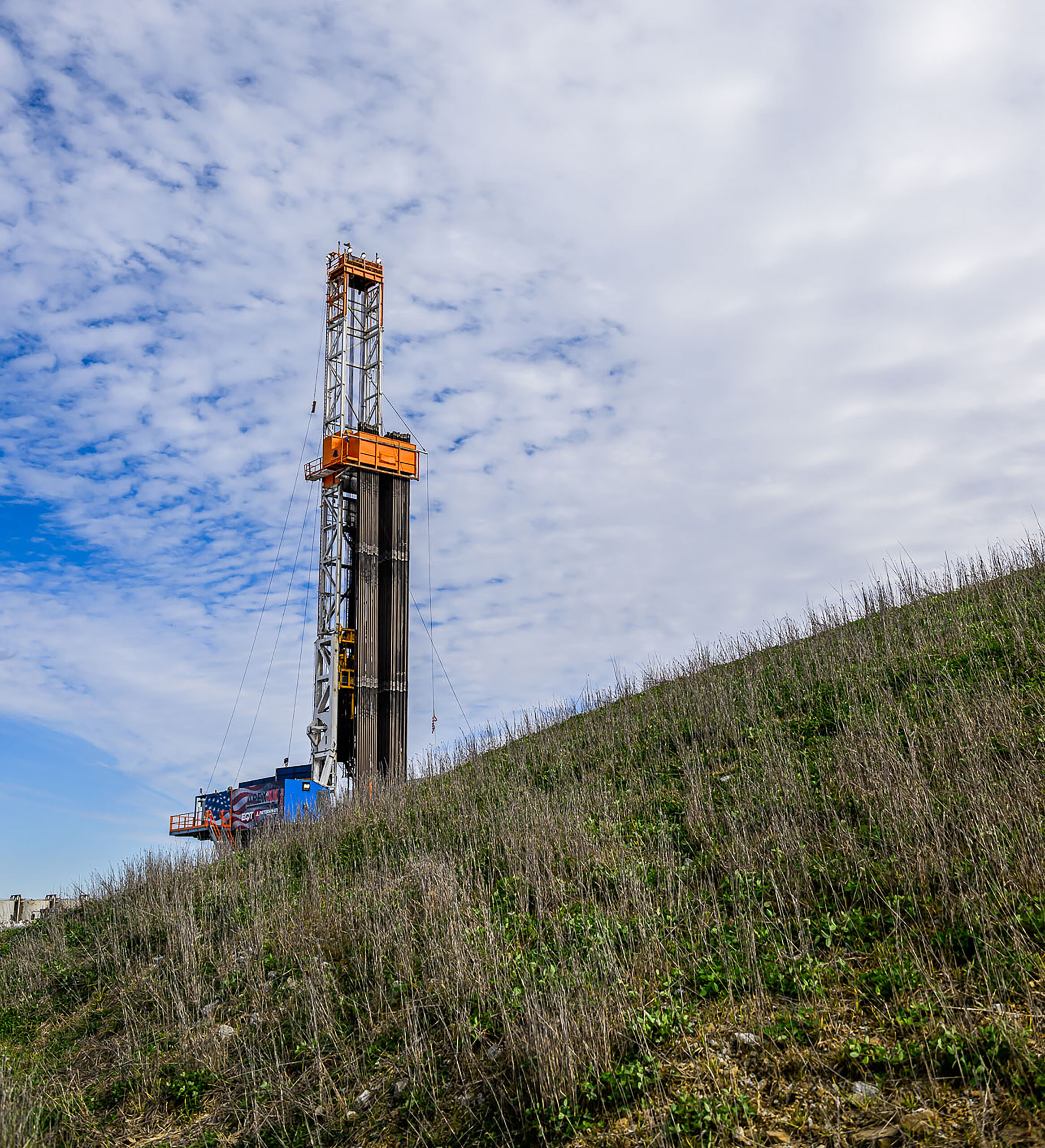
The EQT-operated Patterson-UTI Rig 571, currently working in West Virginia, is pictured. The operator, which is primarily based in Appalachia, is looking to sources like data centers for near-term gas demand growth within the region. (Click the image to enlarge.)
It sounds like you have a lot of constraints working in Appalachia compared with, say, the Permian Basin. Is the kind of vertical integration you’re talking about necessary for doing business out there in the future?
I wouldn’t put it that way necessarily. There are a lot of big players out here that aren’t integrated in the way we are. But when you combine business units, you see the economies of scale.
To give a little context, look at a company like Equitrans before the acquisition. As a midstream company, it focused on capital spending through one lens – the midstream lens. EQT as a sole upstream company was getting to a point where our gas was flowing into higher-pressure systems, which effectively chokes the wells when the gas has to flow against high pressures. We could never get Equitrans to spend that extra money to add system compression, or add one or two additional lines, to keep those pressures down.
Now, since we have an integrated upstream and midstream business, we can make that decision on a more holistic basis. This past year alone, we’ve seen $60 million in capital synergies, with an anticipated $250 million over the next few years. For example, spending money to add central compression allows us to save millions on drilling wells. Those savings wouldn’t mean anything to a company that’s just a midstream company. But because we’re able to optimize the whole system now, we can see those cost savings.
Also, we can look at growth projects that we might not realize today. There may be a water or gas system that could set us up to meet demand in a few years. We can look into how those projects might make the entire business, not just upstream or midstream independently, more capitally efficient. That’s synergistic.
You mentioned EQT having a 100% electric frac fleet. In an era where we’re looking to reduce our emissions footprint however we can, do you find electric fleets as a “must-have” for completions?
I wouldn’t necessarily call it a “must-have,” but it’s just good business. We’re a large natural gas producer, and we want to be able to use our product, whether that’s heating tanks, electrifying our compressor stations or electrifying our frac fleet. Using our product as a fuel is important.
Frac is one of those heavyweight services that uses a lot of gas and electricity. We want to be the one to provide that. Obviously, it’s cheaper for us to use our own gas instead of buying it from somebody else.
Additionally, the carbon emissions associated with electric frac fleets compared with conventional diesel fleets are better. It’s just good business from a cost and emissions standpoint.
That electrical equipment is also easier to maintain and has better uptime, which translates to improved costs. Our mantra in upstream is safety, cost and performance – that’s all day, every day. When we have safer operations, that translates into higher-performing operations and more efficiency, which ultimately translates into a lower cost per foot.
You mentioned EQT’s work in reaching net zero. Was e-frac the key component to help you realize that?
It was one of the key components, but we’ve done other things, as well. We’ve taken a deliberate approach to this, with a heavy focus on reducing emissions at the source. For us, this means abatement.
One of our flagship efforts was the full-scale replacement of more than 8,000 natural gas pneumatic devices across our entire operating footprint. This was a pretty low-cost project that drove a step change in the reduction of our emissions and emissions intensity. We affectionately called this “The Pneumatic Device Replacement Blitz,” because we wanted to achieve emissions goals within a certain amount of time – in under two years – but we did it in under 18 months, safely. We are pretty proud about that. In fact, we wrote a white paper about it because we want others in the industry to replicate that playbook.
We also participated in the Appalachia Methane Initiative. As part of that effort, we’ve done nearly 15,000 aerial surveys over 20,500 square miles to map our emissions. We’ve used advanced monitoring systems to track our emissions in real time. We have to make sure that we have a trusted source for reporting all of the emissions.
We’re also an equity investor in Context Labs, which I would describe as transparent, traceable and auditable carbon accounting for emissions. Context Labs is working closely with KPMG, a large auditing firm, as we develop the software and the tools to report all of this.
When you combine the aerial surveying with our electric frac fleets, our pneumatic device replacement and now Context Labs, you have that full-cycle view on carbon emissions reporting.
Of course, there are residual emissions that we can’t eliminate yet, so we focus on local projects. One in which we’re actively involved is the soil monitoring technology and tree planting and restoration efforts in West Virginia. This is leveraging the University of West Virginia and the Forestry Service of West Virginia to generate carbon offsets that have real environmental value and community benefits.
The common thread with all of this is that we treat all emissions reductions as something that’s good for business. Rather than just engaging in a reporting exercise, we measure, we act, we verify and we keep iterating to improve that. That’s what has allowed us to reach net zero Scope 1 and 2 emissions for upstream, and that’s how we plan to stay there while continuing to grow the business.
In what ways do you think operators and drilling contractors can work together more efficiently?
I would actually broaden that question. It’s not just drilling contractors but all of our upstream service providers, which is not just drilling and completions but all the services we use in the field. We’re pretty intentional in calling them business partners instead of service providers.
And what a difference two words can make – service provider vs business partner, and that’s indeed how we feel. Let’s be real: They’re the ones that make it happen in the field. They’re the ones that are out there doing the work
For us, the win-win really comes from three things: scale, stability and alignment. EQT can bring the large-scale development. We have a visible, stable and multiyear development schedule. This schedule feeds our development plan, it feeds our capital allocation, and it feeds reserves. I don’t know if other operators can say the same thing, but that lets our partners increase utilization of their people and their equipment.
In return, we benefit from lower costs and better performance, because they can justify investing in technology, training and continuous improvement around our longer-term program.
Looking at the wells being drilled in the industry today, do you think we’re getting as much out of them as we can? If not, what technologies do you think can help us improve that?
As engineers and scientists, we are never satisfied. We always want more from our wells. There are two big levers to achieving well performance gains: improving recovery factors and improving uptime. With recovery, modern stimulation techniques have allowed us to recover about half of the gas in place in the past 50 years. That means there’s another half that’s still there. We’re leaving a lot of gas in the ground.
The question is, how do we increase that recovery factor, or pull the recovery factor up in as short amount of time as possible?
There are new downhole diagnostics that are going to be critical tools that really let us understand what we call our stimulated rock volume, or SRV, and how fractures are growing, how the parent/child and offset interactions are playing out, and how that might impact our well designs. If we can have better subsurface insight, it will allow us to tailor spacing, completion designs and even redevelopment strategies so that each dollar of capital recovers more molecules.
The second lever for us is uptime, or how often your well is flowing. You start with whether the flow meter’s spinning or not. You always want the meter spinning when you’re flowing your wells. For us, nearly all of our producing wells are in a very mountainous region over three states, so checking flow requires improved telemetry so that we can read our wells in real time out in the mountains.
We also leverage edge devices to do this. Having real-time SCADA systems allows us to avoid significant delays, so we can get that real-time analysis and real-time changes, vs minute, hour or daily delays. Modern predictive models will allow us to operate more remotely and anticipate equipment issues before they turn into downtime events, but we are not there yet.
This is an area of AI we’re exploring. AI is in its infancy, and we’re trying to understand new ways to apply it to improve that uptime. If I know that three weeks out, this well is going to go down on liquid loading, or the tubing is getting a little thin on this well, or we’re going to have a hole in tubing, I can get a work order going, materials ordered and a workover rig ready before that well ever goes down. That’s one of the goals.
As you go through the journey of figuring out where AI fits in the oilfield, what particular areas of interest do you hope to address?
We see AI as a force multiplier for our engineers and scientists, not a replacement for them. I think the real value is in faster, more data-driven, predictive decision making. The way we think about AI right now is, rather than boiling the ocean, we’re breaking it down to the simple, repetitive things. Where can AI do the housekeeping for us? We don’t want to do laundry and we don’t want to do dishes; we’d rather paint or garden. So how can we have AI do the dishes and the laundry for us?
To bring these analogies to the oilfield, how can we monitor thousands of wells, thousands of compressors, all the different pieces of equipment, and look for that one thing that’s going to drift outside of normal?
We want AI to be constantly watching, so when the dishes are starting to get dirty, it gives us a timely warning and makes suggestions on what to do about it. Then our people can step in and make the decision on how to act, using smart engineering judgment. There could be different AI models that optimize parameters in real time to minimize vibration, stick-slip, bit trips or rate of penetration. We’re not there yet, but those are some examples.
For completions, obviously we’re looking at pattern recognition across thousands of stages. That’s not only the pressures and rates of treating the stages, but some of the real-time information that we receive from the geosteering tool can tell us about the rock so they can recommend pump schedules or fluid systems or problem zones. Those are some topics we’re trying to leverage AI for in completions, but they are still in their infancy.
In all of these cases, AI is just surfacing issues earlier, laying out some of the options, and then our teams of engineers and scientists can choose the path that best balances safety, reliability and economics. We are just at the beginning of figuring that out, and the team is digging into what it will take to truly become agentic.
Lateral lengths are continuing to grow in several unconventional basins, with 3- and 4-mile laterals quickly becoming the norm. What is your view on this trend? Do you think the industry will continue finding ways to lengthen its wells?
I think we will go farther. What limits us right now is the rig and the frac technology. As long as the rig and technology are high performing, we’ll continue to drill longer. It’s the same on the frac side: The longer the laterals are, the more purposeful you have to be on how you design the toe of the frac to get a good frac-off and a good stimulation.
The equipment that you have on the surface – whether it’s 10,000-psi equipment, or the 15,000-psi equipment we’re pumping now, or the 25,000-psi equipment we’ll eventually need in the future – we’ll continue to improve the technology so that we can reach those long laterals.
Going longer in the same wellbore always improves cost per foot because you spread those costs of the pad, the surface location, the road construction and the vertical section – the one-time costs, more or less – over more productive footage. You’re preventing waste and minimizing surface impact while also efficiently developing the reservoir. As long as you can safely drill, complete and produce those really long laterals, and the regulatory framework around drill and spacing units evolves with the technology, that trend is going to continue.
On the drilling side, as the rigs continue to improve with their technologies, the faster and more responsive our directional and geosteering tools can be, the better real-time data we get for in zone. We want to stay “in zone” over those miles, leveraging smart geosteering techniques.
On the completion side, we’re going to need higher pressure-rated equipment, and we’ll need to improve our materials to manage frictional pressure losses. Frictional pressure is the enemy in fracking. Developing fluid technology that allows you to minimize friction so that you can maximize pressure down there will be another huge component. DC