Skoltech Pioneers In-Situ Hydrogen Production Process
The process developed by Moscow’s Skolkovo Institute of Science and Technology shows promising results in the laboratory, suggesting a novel method to produce hydrogen from natural gas reservoirs while trapping carbon in permanent storage.
Skoltech researchers testing their in-situ gas-to-hydrogen process in a laboratory reactor.
Credit: Skolkovo Institute of Science and Technology
What if natural gas could be converted at the molecular level into hydrogen inside the reservoir and brought to the surface, leaving carbon dioxide and carbon monoxide permanently trapped below ground? A research team at the Skolkovo Institute of Science and Technology (Skoltech) in Moscow says it’s possible.
In a paper published in the academic journal Fuel in May 2024, researchers at Skoltech described laboratory tests of a thermocatalytic process to convert methane (CH4) into a gas mixture of hydrogen (H2), carbon monoxide (CO), and carbon dioxide (CO2).
If developed at an industrial level, the process would enable hydrogen to be produced directly from a reservoir without releasing greenhouse gases into the atmosphere because carbon products would remain trapped underground.
So far, Skoltech researchers have converted up to 45% of total gas volume in a laboratory reactor into hydrogen at 800°C with an optimal steam-to-gas ratio of 4 to 1.
Credit: Skolkovo Institute of Science and Technology
Elena Mukhina, a senior research scientist at Skoltech Petroleum, wrote in the paper that her team has successfully converted methane via steam methane reforming initiated by in-situ gas combustion in a reservoir with zero oil saturation in laboratory reactors.
“In the experimental model, different rock porous media were utilized, and the process parameters such as temperature and the steam-to-methane ratio were varied,” Mukhina wrote. “The outcome reveals a range of variations, each yielding different concentrations of hydrogen produced depending on these adjustable parameters.”
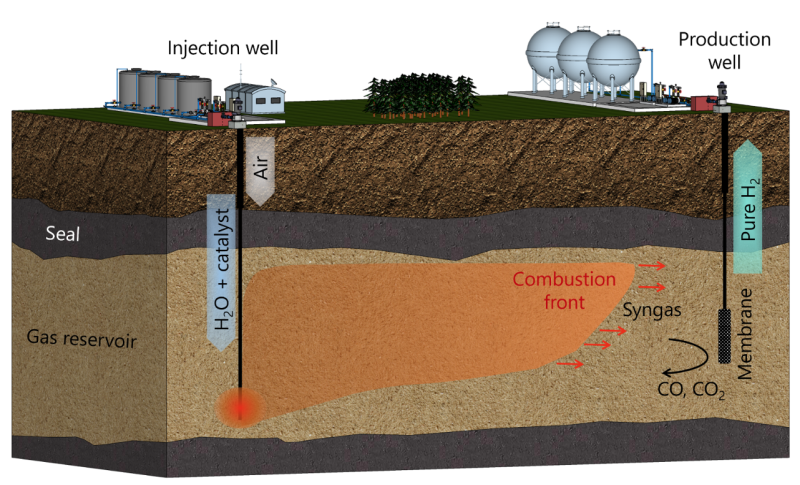
Fig. 1—The process of hydrogen production from gas fields.
Credit: Mukhina et al./Fuel (2024).
Commenting in a Skoltech news release, Mukhina pointed out that the process is “based on well-established technologies that have not previously been adapted for hydrogen production from real gas reservoirs.”
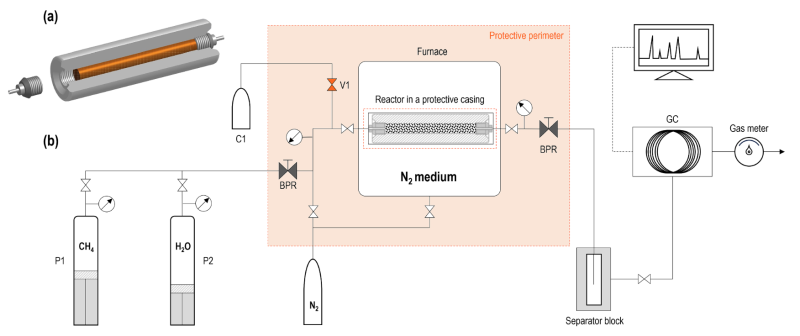
In the laboratory, researchers placed crushed rock in a reactor, pumped in methane along with steam and a catalyst, and then oxygen. Pressure inside was maintained at a level typical of gas reservoirs (80 times higher than atmospheric pressure), according to the paper published in Fuel.
Hydrogen is finally recovered from a production well through a specialized membrane that selectively permits the filtration of hydrogen while impeding other gases, including CO2, which remain confined within the rock.
So far, Skoltech researchers have converted up to 45% of total gas volume in a laboratory reactor into hydrogen at 800°C with an optimal steam-to-gas ratio of 4 to 1. The researchers chose 800°C as the ideal temperature because it is easily achieved in natural gas combustion and does not need to be artificially maintained, according to the published results.
In some experiments using porous alumina, the hydrogen yield reached 55%, but the higher efficiency is attributable to the fact that alumina is inert and so doesn’t react with surrounding elements.
In contrast, natural rock contains more active minerals that can react with the components of the gas mixture and affect the hydrogen yield, the research indicates.
Fig. 2—(a) 3D model of the reactor used in the experiments; (b) a simplified scheme of the experimental setup.
Credit: Mukhina et al./Fuel (2024).
Mukhina said that technologies are still in the research phase as applied to gas but her team’s evaluation of a similar oilfield technology has advanced to “preliminary numerical modeling” which if successful could lead to “a pilot launch (as) the next step.”
Porous media of oil reservoirs featuring residual oil saturation leads to a well-known process of oil upgrading, with hydrogen being one of the byproducts, the paper points out.
Calgary-based Proton Technologies has employed its own method to extract hydrogen from the mature heavy-oil field it operates in Saskatchewan, and hopes to prove its efficiency by licensing its technology to other operators.
But in the area of direct hydrogen production from gas fields, Skoltech’s research seems so far to be the cutting edge. Supported by the Russian Science Foundation, Skoltech researchers have yet to engage in any formal collaborations though contacts have been established with the Iranian Renewable Energy Department for possible joint work “in the coming year,” Mukhina said.
Three of Mukhina’s coauthors in the Fuel article have joined with colleagues from Lukoil-Engineering LLC in reporting the same research in SPE 214036 presented at the Gas & Oil Technology Showcase and Conference last year in Dubai.