Africa To Overtake Europe in Geothermal Capacity by 2030
An estimated $35 billion in investment is expected to pour into geothermal projects in Kenya and Ethiopia through 2050.
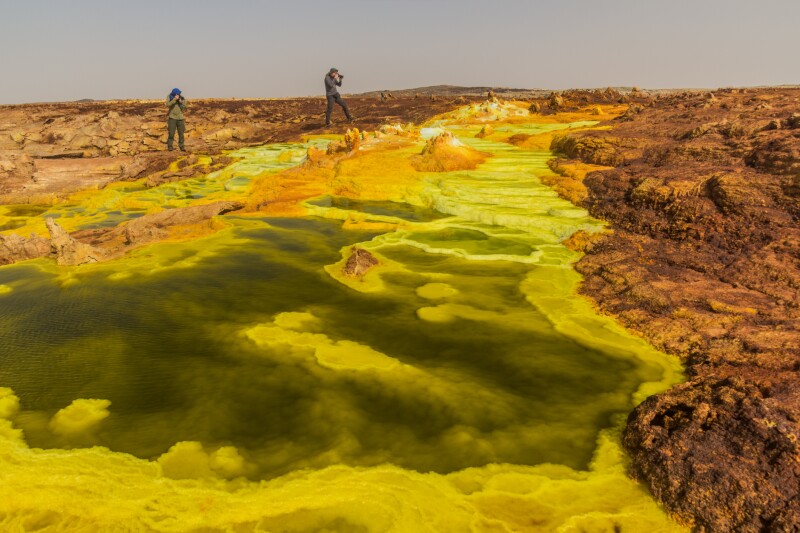
The Danakil Depression where tectonic plates collide on the Ethiopian, Eritrean, and Djibouti border, creating a landscape of sulfurous hot springs, lava beds, and hypothermal pools.
Credit: Dreamstime
Africa’s installed geothermal energy capacity is on track to surpass that of Europe by 2030, driven by a projected $35 billion in investment targeted at Kenyan and Ethiopian projects in the East African Rift through 2050, Rystad Energy reported in a recent analysis.
Though Africa is home in 2023 to only about 1 GW of geothermal capacity—half of Europe’s total—projects already announced will more than double the continent’s total installed capacity over the next 7 years. Add in projects not yet announced, but vital to hitting government targets, and capacity could even triple by 2030, according to Rystad.
Geothermal power entered Africa’s energy mix in 1952 when the Democratic Republic of Congo (DRC) commissioned the Kiabukwa power plant. At the time, the DRC was the third country in the world to build a geothermal facility.
Today the spotlight falls on the East African Rift where numerous colliding tectonic plates create conditions for a seemingly endless supply of geothermal energy.
Kenya, Ethiopia, the East African Rift: Blessed by Nature
By 2050, Kenya and Ethiopia are expected to account for nearly 90% of the 13 GW in geothermal energy generation capacity that Africa is expected to have in place by then. In contrast, Europe’s installed capacity is expected to be half as much—5.5 GW by mid-century, according to Rystad’s analysis.
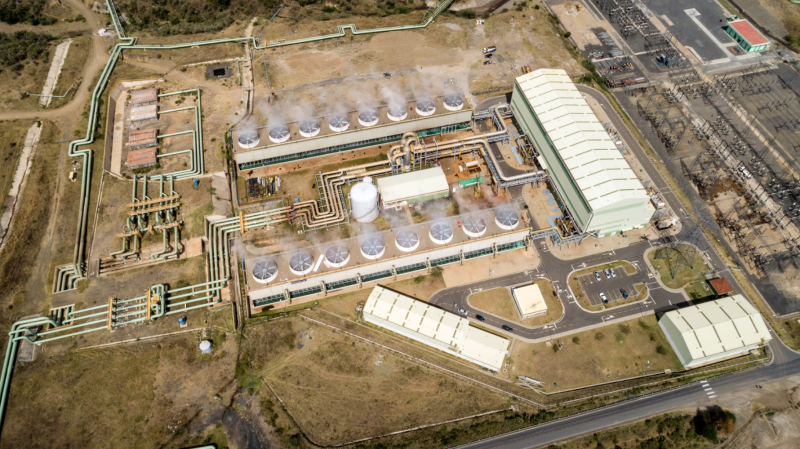
Kenya’s Olkaria geothermal facility—Africa’s largest geothermal plant—was described in a paper presented at the SPE Nigeria Annual International Conference and Exhibition in Lagos in July (SPE 217214).
Considered to be one of the largest geothermal facilities in the world, Olkaria boasts a total installed capacity of 720 MW, about 51% of Kenya's total installed capacity, the paper’s authors point out.
The facility’s four plants, Olkaria I, Olkaria II, Olkaria III, and Olkaria IV, utilize steam drawn from wells drilled to 3000-m depth in the Olkaria geothermal resource in the East African Rift.
The reservoir is two-phase … “hosted within 0.9–1.65-million-year-old fractured trachyte and rhyolite rocks at depths of between 600 meters and 3000 meters,” according to a description on the Kenya Electricity Generating Company’s (KenGen) website. Wells produce 25% dry steam which is piped to the power plant; separated water is reinjected.
The Kenyan government funded 70% of Olkaria with support from the Japanese International Cooperation Agency (JICA), the German Development Bank (KfW), and the European Investment Bank (EIB). JICA provided a $123 million loan, while KfW and EIB provided $60 million and $80 million, respectively.
The project’s success made Kenya a leader in African geothermal energy development, with a total installed capacity of over 1,600 MW. The country’s Geothermal Development Co. (GDC) now seeks to grow by developing new projects:
Menengai Geothermal. As of 2023, GDC has drilled 53 wells with a potential of 169 MW. According to its website, the company will develop Menengai in five phases, targeting 465 MW of geothermal steam equivalent long term.
Baringo-Silali Prospect. GDC is currently drilling geothermal exploration and appraisal wells on the Paka and Korosi prospects which are part of the Baringo-Silali project. So far, 11 exploration and appraisal wells in Paka field have been drilled with two more wells in progress. On the Korosi prospect, GDC has successfully tested four wells.
Suswa Prospect. Surface studies have been completed and various government requirements put in place. GDC estimated the potential of the prospect at 750 MW.
East African Neighbors Helping Neighbors
Kenya’s GDC and KenGen provide drilling and other services to their East African Rift neighbors which are prioritizing geothermal projects—like Ethiopia where hydropower comprises 88% of the country’s energy mix, leaving the power grid vulnerable in times of drought or other extreme weather.
“We continued to cement our geothermal regional footprint through implementation of drilling contracts in Ethiopia and Djibouti while prospecting new growth areas in Rwanda, Democratic Republic of Congo, and Comoros,” KenGen CEO Abraham Serem said in the company’s 2022 annual report to shareholders.
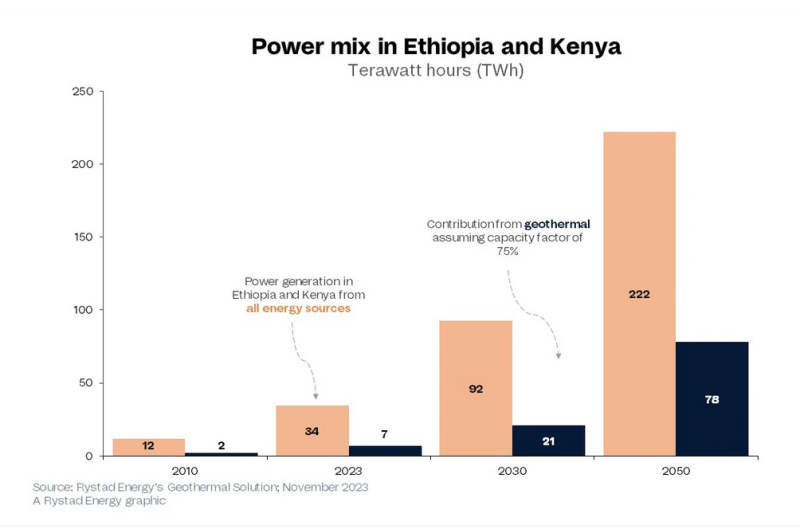
The power supply in Kenya and Ethiopia is expected to increase sixfold from 2023 to 2050, rising from 34 to 222 TWh. Rystad Energy projects that geothermal supply from the two countries will rise well above 10 GW by 2050, potentially reaching as high as 12 GW.
In Ethiopia, geothermal energy powers only one of the country’s 22 power plants—Aluto Langano, which produces 7.3 MW of power, according to the Ethiopia Electric Power Company. Drilling began there in 2021.
Ethiopian authorities are eyeing up to 17 geothermal projects in hopes of reaching a target of 35,000 MW installed capacity for domestic needs and for export, according to the website Think GeoEnergy.
Aerial view of Kenya’s Olkaria geothermal facility—Africa’s largest geothermal power complex.