EIA: Led By Permian, US Oil Output to Grow by 500K B/D in 2025
Rig counts are down since 2023, but well productivity is marching forward.
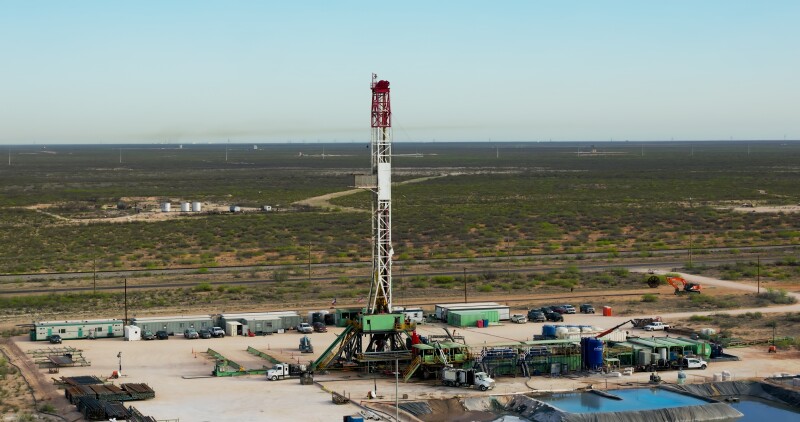
A drilling rig near Pyote, Texas, in the Permian Basin.
Source: Getty Images.
The US is on track to produce an average of 13.7 million B/D of crude oil in 2025—an increase of approximately 500,000 B/D over this year’s projected average.
The forecast comes from the US Energy Information Administration’s (EIA) latest short-term energy outlook report.
The report highlights that the growth in productivity is expected despite the ongoing decline in the number of active drilling rigs across the US.
This is largely because the engine of US growth, the prolific Permian Basin shared between Texas and New Mexico, continues to power ahead.
The Permian is home to nearly double the number of rigs in operation compared to the rest of the Lower 48 states combined—313 rigs in the Permian vs. 165 elsewhere, according to the EIA. At the beginning of 2023, those numbers stood at 352 and 242 , respectively.
EIA data also show that as of July new Permian wells were generating a combined 433,000 B/D in their first month of production, which was more than enough to offset declines from older wells.
Natural gas production is following a similar trend, with new wells in the region yielding 780,000 MMscf/D in their first month.
“Growing well productivity suggests that operators in the Permian are successfully implementing more advanced drilling and completion techniques, including longer lateral lengths, optimized well spacing, and enhanced fracturing designs,” the EIA concluded.
US monthly production trends shown over a 12-month period.
Source: US Energy Information Administration.
The EIA forecasts a 430,000 B/D increase in Permian oil production from 2023 levels, reaching 6.3 million B/D by the end of this year. With further productivity gains anticipated, Permian output could slow but is still expected to rise by another 300,000 B/D in 2025.
In terms of Permian sales gas, the EIA said a rise of 1.9 Bcf/D over this year along with a 1.0 Bcf/D rise next year, brings the region’s total to 25.8 Bcf/D—or 23% of all US gas output.
The forecast also shows the Permian quickly gaining ground on the top gas region in the US, the Appalachian Basin, which is on a slight downward trend toward 34.7 Bcf/D.
The figure represents a drop of 2.0 Bcf/D for Appalachian gas production since the end of 2023 while the Permian is on pace to add 2.4 Bcf/D over the same span.
The EIA points out that the surge in Permian gas is largely the result of rising associated gas from the basin’s oil wells.
“We expect crude oil prices will remain sufficiently high to support growth in crude oil production and associated natural gas production in the region,” the report added.
It also appears that there are not many bottlenecks standing in the way of these projections.
The EIA said there are several takeaway projects at various stages of development including a new Enbridge-operated 120,000 B/D pipeline coming on next year. Additionally, a new 580-mile pipeline called the Matterhorn Express is set to begin delivering up to 2.5 Bcf/D of Permian gas to the Houston area later this year.
The projections are mixed for the other two major oil basins in the US.
The Eagle Ford Shale in south Texas should see production decline from 1.16 million B/D in 2023 to 1.1 million B/D in 2024, a 5% decrease. However, the trend may reverse in 2025 as the EIA forecasts a 4.5% increase to 1.15 million B/D.
North Dakota’s Bakken Shale is already on the rebound with oil production increasing almost 5% from 2023 to an average of 1.28 million B/D in 2024. That figure may grow another 3% next year to 1.32 million B/D.
The EIA also expects the Federal Gulf of Mexico to see a mixed trend, with production shrinking by 3.7% from 1.87 million B/D in 2023 to 1.8 million B/D in 2024. A recovery of 2.8% to 1.85 million B/D is forecast in 2025.