New BP Wells Boost Gas Production in Egypt’s West Mediterranean Offshore
By boosting gas supplies to Egypt’s home market, Cairo can return its focus to developing an LNG export hub.
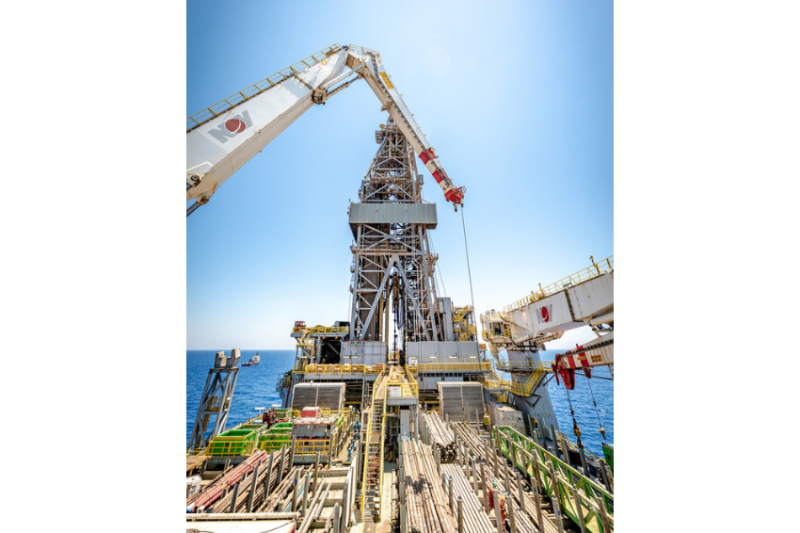
The Valaris DS-12 drillship during operations at the Raven field offshore Alexandria in Egypt’s West Nile Delta area.
Source: BP
BP’s two newly completed gas wells at the Raven field offshore Alexandria in Egypt’s underdeveloped West Nile Delta (WND) area, following subsea commissioning, will offer a much-needed boost to the country’s flagging gas production.
Egypt’s Ministry of Petroleum reported that the Valaris DS-12 drillship expedited infill drilling at Raven in mid-January, completing the campaign 3 months ahead of schedule. The ship has moved to the King area where BP is exploring for gas in the Lower Miocene, expecting results in late February, according to Egypt’s state information service.
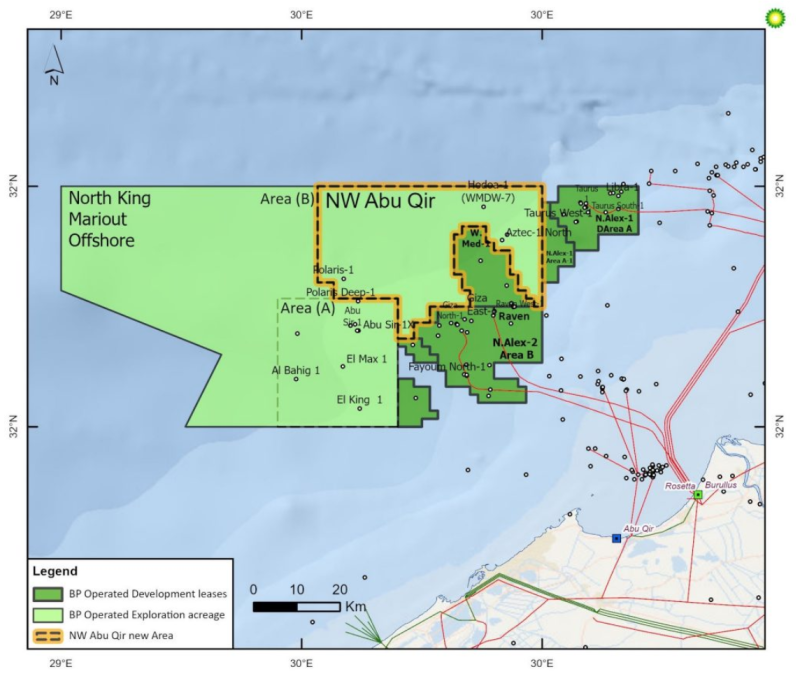
Raven is the fifth of five fields brought on stream since 2017 in the North Alexandria and West Mediterranean Deepwater offshore concessions as part of the WND development to supply gas to Egypt’s domestic market.
BP’s newest wells, West Raven-4 and West Raven-5, are expected to increase the field’s production by 200 MMcf/D of gas and 8,000 bbl of condensate in 2025, according to Egypt’s Ministry of Petroleum.
Energy Crisis Upsets LNG Exports
Cairo wants to reverse gas production declines that hit record lows in 2024, causing electrical blackouts and a government shakeup that led to the appointment in July of a new minister of petroleum.
As the energy crisis pushed Egypt’s LNG imports to their highest levels in 6 years, the country had to again shelve its ambitions of creating an Eastern Mediterranean LNG export hub and instead import LNG to supply domestic demand.
BP (82.75% operator interest) and European independent Wintershall Dea (17.25% working interest) partner in WND which includes 25 wells and three deepwater long-distance subsea tiebacks to shore, designed to eventually deliver 900 MMscf/D of gas at peak and 30,000 B/D of condensate.
The BP-operated Raven gas field and North King exploration acreage offshore Egypt.
Source: BP
Prior to BP’s Raven wells, Shell brought online two of three wells drilled in late 2024 as part of Phase 10, adding 86 MMcf/D to production at its West Delta Deep Marine project, and bringing the project’s total output to 286 MMcf/D.
Egypt plans to get back on track with its long-term LNG export strategy by boosting exploration. To that end, it has earmarked 15 new agreements (covering a minimum of 46 wells) for signing in 2024 and 2025 that offer up to $20 million in signing bonuses on minimum investment commitments of $748.5 million, the African Energy Council reported.
On the exploration side, ExxonMobil already struck gas in January at its Neferatari-1 exploration well in Egypt's frontier Herodotus basin which the US Geological Service estimated could contain 286 Tcf of technically recoverable gas resources.
ExxonMobil spudded Neferatari-1in December 2024 in the North Marakia Block 5 miles offshore—its first-ever Egyptian wildcat. Its partner QatarEnergy bought a 40% working interest in the block from the US supermajor in March 2022.
QatarEnergy on the March
In January, QatarEnergy announced that it was expanding its Egyptian footprint with an agreement to acquire a 23% working interest from Chevron in the North El-Dabaa (H4) block, 10 km offshore in water depths ranging between 100 and 3000 m.
Chevron holds a 40% operator interest in North El-Dabaa (H4); other partners include Woodside (27%) and Egyptian state-owned Tharwa Petroleum Co. (10%).
“This agreement demonstrates our commitment to the oil and gas sector in the Arab Republic of Egypt and further strengthens our partnership with our valued partner Chevron,” Saad Sherida Al-Kaabi, the Minister of State for Energy Affairs, the President, and CEO of QatarEnergy, said in a news release.
In November 2024, Chevron drilled the Khendier-1 exploration well, also in Herodotus basin, but later declared a dry hole, according to regional energy media.