ExxonMobil and Guyana are negotiating which unexplored offshore reserves will be returned to the Guyanese government.
This became known after negotiations between ExxonMobil and the authorities of Guyana.
Guyanese authorities worry about ExxonMobil’s oil and gas hegemony
When oil was discovered in Guyana, no one thought that there would be so much of it.
Now every schoolchild knows that Guyana and Suriname are located in the oil and gas basin of the same name, which contains up to 14 billion barrels of oil and 0.9 trillion m3 of natural gas.
Even I. Sechin mentions Guyana as a country with the potential for long-term growth in oil production.
ExxonMobil slowly began to buy up oil and gas subsoil areas, including those on the shelf.
ExxonMobil subsidiary confirms almost $11 billion investment in Guyana as of December 2022.
The total assets of the Central Bank of Guyana are 2.9 billion US dollars.
That is, the assets of EEPGL are almost 4 times the total assets of the Central Bank of Guyana.
The Guyanese authorities began to act:
- decided to create a national oil and gas company;
- decided to update the Petroleum Law in the country to regulate:
– storage and transportation of hydrocarbons through pipelines in the oil and gas sector,
– geological storage of carbon dioxide (carbon dioxide) within the framework of CCS projects,
– this will reduce the carbon footprint of the country’s expanding oil and gas industry.
- began negotiations with ExxonMobil on the return of unused subsoil plots.
– consortium led by ExxonMobil:
– in 2023 – must return 20% of undiscovered subsoil plots in accordance with the original production contract, which was concluded in 2016,
– including parts of the 6.6 million acre (26,800 km2) oil and gas bearing Stabroek Block and 2 other blocks that have not yet been put into operation.
- Guyanese authorities are going to resell these areas to other operators in order to:
– accelerate the economic development of the country,
– reduce ExxonMobil’s dominance in energy production,
– boost oil and gas production ahead of demands to cut carbon emissions to zero by 2050
ExxonMobil position:
- the company complies with local laws;
- is in negotiation with the Government of Guyana regarding these requirements, both in terms of timing and areas.
ExxonMobil and its partners Hess and CNOOC produce about 375,000 barrels per day of oil from 2 offshore platforms (OS).
The group has approved a total of $45 billion to triple production by 2027 from 5 oil platforms.
Mining contract details
The deadline for relinquishing the 20% unexplored portion of the Stabroek block is October 2023.
The Guyanese government agreed to an extension of up to 1 year, citing difficulties during the COVID-19 pandemic that prevented some work.
The consortium may return some areas as early as Q3 2023.
The Group separately intends to accelerate the launch of the 3rd oil production vessel Prosperity by September 2023, which will bring the total production to 600 thousand barrels per day of oil and gas in early 2024.
Guyana and the US-China group are also negotiating the return of about 20% of the unexplored areas of the group’s 2 other blocks, Kaieteur and Canje, which have not yet begun production.
The returned blocks of subsoil can either be included in a competitive auction or directly negotiated with other governments under bilateral oil exploration agreements.
The Production and Sharing Agreement signed between Guyana and ExxonMobil in 2016 allows exploration licenses to be renewed.
But this requires that at least 20% of unexplored or undeveloped territories be returned during the renewal.
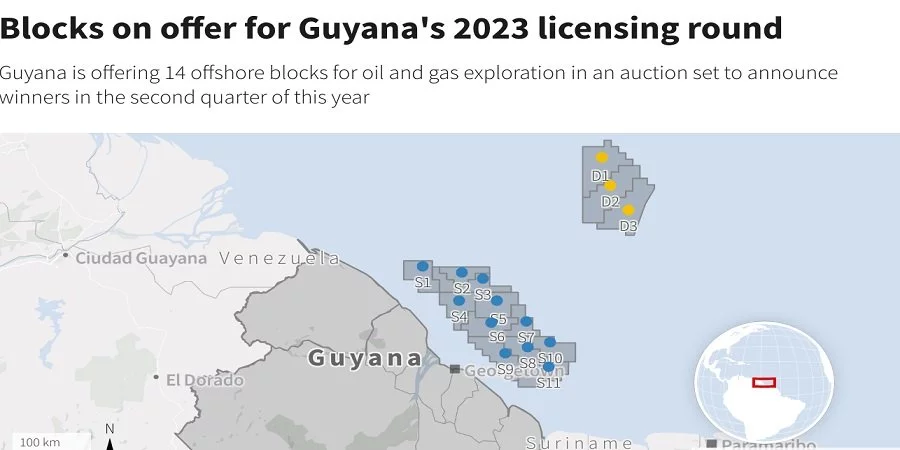
Guyana plans to hold its first competitive oil block auction in August 2023, which is expected to attract new operators to the country.
The country will offer 14 offshore blocks outside of ExxonMobil’s sites.
Source


 by
by