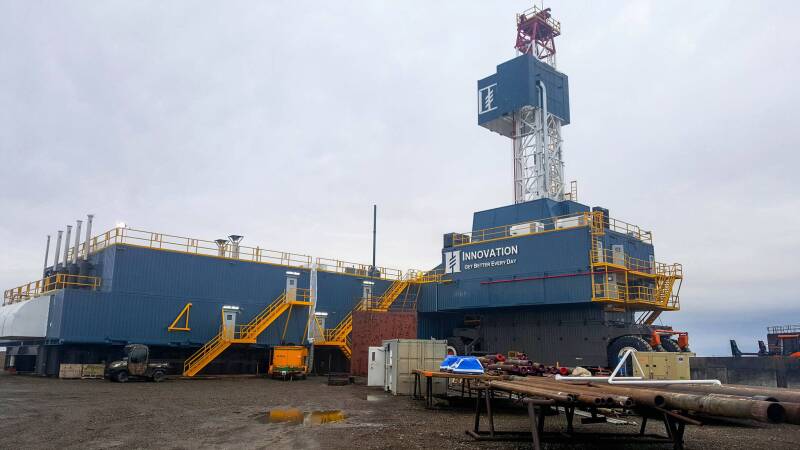
It is estimated that Alaska’s famed North Slope holds many billions of barrels of viscous and heavy oil and now there appears to be an affordable way to get much of it out of the ground.
This is according to recently shared details of a 2-year-long polymer-flood project led by petroleum engineering researchers with the University of Alaska Fairbanks (UAF) and technical staff with Houston-based independent Hilcorp.
Launched in 2018 at Hilcorp’s 35,000-acre heavy-oil field in Milne Point, the enhanced oil recovery (EOR) approach was a first for the North Slope.
The project scope involved injecting a mixture of polymer and seawater into the heavy-oil reservoir (called the Schrader Bluff sandstone) via two existing injection horizontal wells. Two existing horizontal wells were used for production.
The public-private collaboration reports that the polymer flood generated a twofold increase in recovery over the waterflood operation that was started 2 years prior. This was achieved with what researchers describe as a low rate of polymer utilization.
Whereas the waterflood was estimated to achieve 19–21% recovery rate, the polymer flood is expected to net up to 39% of the oil in place by 2050.
By 2035, modeling from the privately held Hilcorp showed that by 2035 the EOR project may yield an incremental increase of 5.9 million bbl vs. the 2.9 million bbl it expected under the waterflood.
Late last year, a Hilcorp executive informed Alaskan media that the polymer flood had resulted in about 630,000 bbl of crude over what was expected under the waterflood conditions.
Polymer Economics Outcompete Waterflooding
In SPE 210000, presented earlier this month at the SPE Annual Technical Conference and Exhibition, authors from UAF and Hilcorp shared an economic evaluation of the pilot test.
According to their base economic forecast, the Milne Point polymer flood should result in an incremental recovery factor of 15%, which translates to nearly $43 million in added value over the life of the project.
“In addition, each dollar invested yields $5.05, and each barrel of oil produced over the project duration costs about $8.35 to produce,” reads the paper.
The authors go on to explain the economic model used “is highly sensitive to the oil price” and a wide range of prices from $20/bbl to $80/bbl were tested. They said even at $40/bbl prices, all the economic simulations predicted “a positive and robust” net present value as the result of the polymer flood.
One input the authors argued is far more predictable are the cost inputs to its model which include the purchasing and transport of the polymer for around $1.50 per pound. Other project costs include an additional $100,000 annual spend in maintenance over a traditional waterflood operation and a one-time charge of $3 million for the polymer-injection equipment.
Models show that during the early period of the EOR project, each pound of polymer should yield one additional barrel of oil. By the late period, or around 2050, incremental oil production is expected to drop significantly at which point it is likely to take about 6 pounds of polymer for each additional barrel.
One of the project’s other highlights includes that after polymer injections began, the test pad’s water cut dropped from 70% to less than 20%.
A Beacon of Hope for Declining Region
Hilcorp became Alaska’s largest operator after buying BP’s entire Alaskan business in 2019 for $5.6 billion, a deal that included acquiring 100% interest in the Milne Point field.
Under Hilcorp’s operatorship, which began in 2014 with BP still holding interest, the Milne Point field has been considered a beacon of hope for the depleting North Slope region.
In 2018, the field averaged about 21,000 B/D but by early 2019 saw output increase to 32,000 B/D. Months after the start of the polymer flood that year, Hilcorp announced its 2020 target for Milne Point was 40,000 B/D.
Now after establishing a clear success, the researchers from UAF have recommended that polymer flooding be expanded in the North Slope to exploit the region’s vast reserves of viscous and heavy oil.
Such an expansion might already be unfolding.
The pilot project’s results were so good in the early goings that a competing operator, Italian supermajor Eni, launched its own polymer-injection project after monitoring the progress of the Milne Point activity.
This is according to a project status report from 2019 that said the outcome of the Eni polymer injections was unknown. The update from 2 years ago added Hilcorp had already set into motion plans for additional polymer floods of its own at three other well pads.
It is estimated that several fields in the North Slope contain a combined 30 billion bbl of heavy oil, which represents only 6% of the state’s average output of about 448,000 B/D. Production in the state peaked in 1988 at just over 2 million B/D.
It is under this backdrop that the development of heavy-oil fields has found support from the Alaskan state government which this year announced $5 million in new funding for the next phase of the Milne Point polymer-flood project. More than $7 million in funding granted by the US Department of Energy was used to launch the pilot phase.
For More Reading
SPE 210000 Economic Evaluation of Polymer-Flood Field Test in Heavy-Oil Reservoir on Alaska North Slope by Cody Keith, Xindan Wang, Yin Zhang, and Abhijit Dandekar, University of Alaska Fairbanks; Samson Ning, Reservoir Experts, LLC/Hilcorp Alaska LLC.