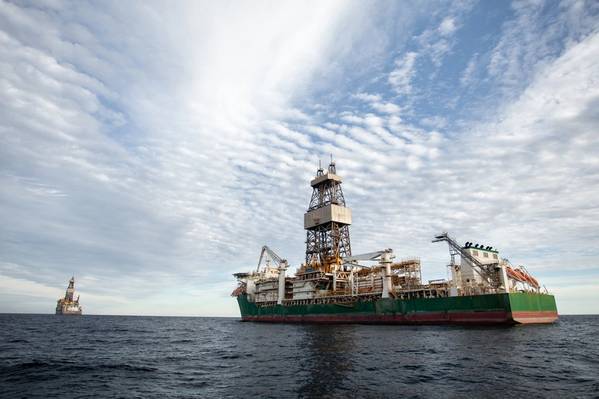
Rigs drilling beneath the deep waters of the Gulf of Mexico will drive U.S. oil industry growth this year and next as onshore production slows due to lower prices and maturing shale fields, and analysts and consultants expect the trend to continue as new technology and friendly regulations attract investment offshore.
The offshore oil and gas sector took a backseat to shale in recent years because drilling at sea requires years of construction work and higher upfront investments. Entry costs were lower for shale production and returns quicker, so rapid expansion in shale made the U.S. the world's top oil producer.
Now, technological improvements allow for high-pressure offshore drilling while U.S. President Donald Trump has brought in industry-friendly regulations. With the most prolific shale areas depleting in giant fields like the Permian, shale producers must shift drilling to less productive areas at higher prices.
Technology Unlocks 'Significant Deepwater Reserves'
"We believe that offshore production will play an increasingly larger role in filling the global energy demand," said Paul Goodfellow, chief executive officer of U.S. offshore producer Talos Energy in a June strategy call.
"Questions are starting to arise about the continued long-term economic viability of onshore basins... At the same time, technological advancements have unlocked significant deepwater reserves," he added.
Offshore production accounts for about 15% of total U.S. output and is likely to drive growth for the U.S. oil industry this year. Initial investment costs offshore may be high, but Talos said break-even prices can dip as low as $20 per barrel, compared to an average of about $48 onshore. Break-even costs per barrel rise once dividends, debt payments and other expenses are included.
Talos said its offshore drilling projects for the second half of 2025 remain economically attractive at an average oil price of about $35 per barrel.
The U.S. Energy Information Administration projected U.S. Gulf of Mexico output will rise by 100,000 barrels per day to 1.89 million bpd in 2025 after dropping by 70,000 bpd last year.
Output is set to climb to 1.96 million bpd in 2026. In October, the agency raised its forecast for crude oil production in the region it calls the Gulf of America, citing a faster-than-expected ramp up of production.
In comparison, U.S. onshore production, excluding Alaska, is expected to grow by 190,000 bpd to 11.22 million bpd this year, its lowest growth since 2010 except for two years of decline during the COVID-19 pandemic, EIA estimates. Onshore production is estimated to decline to 11.10 million bpd in 2026.
In April, the U.S. Interior Department boosted estimated oil and gas reserves in the Gulf of Mexico, which it calls the Gulf of America, by 1.30 billion barrels of oil equivalent (boe) over its 2021 estimate, bringing the total reserve estimate to 7.04 billion boe.
New Equipment Can Withstand Higher Pressure Underwater
U.S. oil prices dipped as low as $55 a barrel this year. Shale producers, who can turn their wells off and on more quickly, shut in some output. Oil prices have mostly traded well below $70 a barrel since April as OPEC+ has boosted its supply in a drive to improve market share. Prices also have been pressured by economic uncertainty due to Trump's trade policy.
Some analysts anticipate offshore gains could outpace onshore growth as early as this year. Consultancy Energy Aspects expects U.S. offshore crude production to grow 200,000 bpd from the end of 2024 to end of 2025, while onshore output is set to drop by a similar level.
Deepwater areas once considered off-limits can now be drilled thanks to equipment now capable of withstanding pressures up to 20,000 per square inch (psi), compared with 10,000 psi and 15,000 psi drilling executed before.
Beacon Offshore Energy LLC, a Houston-based private offshore producer, began production at its Shenandoah field off the coast of Louisiana in July, using technology that can extract oil under higher subsea pressures.
Beacon ramped up the Phase 1 wells to deliver about 100,000 bpd last week and said it hopes the technology will facilitate development of similar fields.
Chevron Sees Offshore Output Up 50% in Two Years
Chevron last year produced first oil from its Anchor project in the Gulf using similar technology.
"U.S. production will continue to reach record levels... with growth in offshore production increasingly supporting U.S. domestic supply," Chevron said in an emailed statement.
The company's production in the Gulf will reach 300,000 barrels of oil equivalent per day (boepd) in 2026, climbing 50% over just two years, the company said, noting the region had produced some of the highest-margin barrels in its portfolio.
"High-pressure drilling technology allows us to reach new depths and unlock access to resources that were once unreachable," Chevron said, adding that 20% of its exploration opportunities in the Gulf could utilize 20,000 psi technology.
Technologies that can safely tap ultra-high pressure fields could put up to 5 billion barrels of previously inaccessible crude into production, analysts have said.
Last month, BP BP.L reached a final investment decision on its Tiber-Guadalupe project in the U.S. Gulf, citing the area's significance to its global strategy. The project is expected to start up in 2030 and produce using technology that can manage pressures of up to 20,000 psi.
Easing Regulations
While fewer projects are set to start production after 2026, Trump's plans to spur U.S. fossil fuel production should benefit offshore drilling in the longer-term.
The U.S. government has proposed to hold a sale of oil and gas drilling rights on 80 million acres (32.4 million hectares) in the Gulf of Mexico in December with lower deepwater royalty rates to boost industry participation and lower production costs.
Trump also signed the "One Big Beautiful Bill" Act on July 4, requiring at least 30 offshore oil and gas lease sales in the Gulf of America over 15 years.
Lower royalties will push down break-even costs further, encouraging marginal projects and boosting cash flow for companies that could be invested back into drilling, said Energy Aspects analyst Jessie Jones.
"The general posture of the administration towards the industry makes it a little bit easier to access capital, makes investors feel more comfortable," said Wood Mackenzie analyst Miles Sasser.
(Reuters - Reporting by Arathy Somasekhar in Houston; Editing by Liz Hampton and David Gregorio)