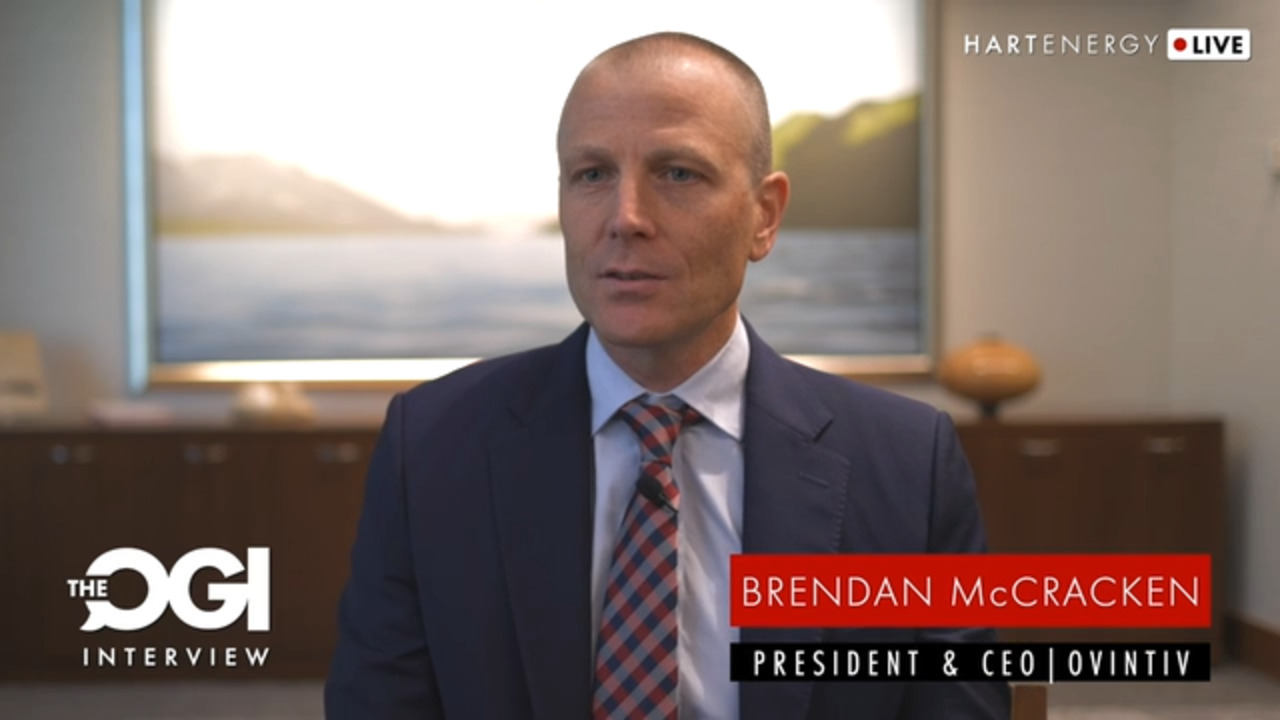
Chris Mathews, senior editor of shale and A&D, Hart Energy: From drilling some of Alberta's first gas wells to growing into one of the largest multi-basin producers in North America. From Midland up to the Montney, let's take a deeper look at Ovintiv. This is your OGInterview with Hart Energy LIVE and Brendan McCracken, president and CEO of Ovintiv.
Brendan, Ovintiv has been quite active the past few years. You've grown a lot in the Permian, you exited the Bakken. How has it been managing through the changes since taking over as CEO?
Brendan McCracken, president and CEO, Ovintiv: Yeah. Hi, Chris. Super happy to be here and represent Ovintiv today. You know, I'm glad you started with the history of the company. It's such an incredible, deep and rich history of making the products that fuel our world and dates back, as you said, 140 years. And you know, the through line of that corporate history has been this theme of innovation where we've just had this quest to continuously reinvent and improve on what we do.
And as you said, we've been very active over that time, but also most most recently in repositioning the portfolio and setting us up for the future.
CM: You talk about changes to the portfolio and you recently closed a major acquisition in the Permian Basin. Can you walk us through some of the reasoning behind that expansion?
BM: Yeah, absolutely. It really roots back to the strategy that we've been pursuing for several years now, which we call durable returns. And it's this idea that generating fantastic instantaneous returns, which our company is doing today, is one thing. But what's really valuable is the ability to generate those returns durably over the long term. And we've really identified three key ingredients that we need to do that. And it really starts with the rock. It starts with having access to a deep and high quality premium inventory.
And then the second ingredient in that durable returns recipe is having the culture and the expertise in our team to convert that resource to free cash flow at a really high return on invested capital.
And then the third piece is to be disciplined with our capital. We live in an industry that's very capital intensive. You know, if we stop spending capital next year, our revenues are down by 35% just because of the natural decline of our production. And so we have to be very disciplined to not let capital leak away into unproductive uses. And so we set that durable returns strategy in place several years ago and set about to capture a great deal of incremental premium inventory and really set ourselves apart from the direction that the rest of the industry is going there. We've been enormously successful in that mission, both with smaller bolton transactions over the last several years, but more recently, with a big transaction in the Permian where we added 800 premium return locations.
And then we've built the culture and the expertise in our team that is really unparalleled at converting that resource to free cash flow. And again, that through line and history of innovation is really serving us well here. And then we've created a really disciplined model for how to allocate our capital and ensure that those returns are flowing through to the bottom line and through to our shareholders.
CM: You also exited the Bakken as part of the Permian deal. I'm curious, why did that move make sense for Ovintiv in the portfolio?
BM: Yeah. Again, it really aligns back to our strategy here of having a portfolio that's got those deep and high quality return options. And one of the things that we do every year we've done so for over 15 years is a piece of work that we call the North American resource assessment, where we go in great detail and build a basin model for for every producing basin in North America.
And we build a scenario where we develop those basins out through full life. And so one of the things that falls out of that work is a really robust understanding of where the remaining premium, undeveloped resources and one of the things that we found with our Bakken asset is it was getting more mature and we had fewer remaining locations to develop there. And for us, it was a subscale position as well. So it was a challenge to make it compete for capital out in time in our portfolio. And so it made sense to rotate out of that and deepen our position in the Permian where we had already a very large scale and deep inventory and we just added to it and made it even better with the acquisition.
CM: Do you think this trend of Permian consolidation is going to continue as ps look for inventory depth in the future?
BM: Yeah, I think if you stand back and you look at what's been happening in the play type and shale has been at the front end of the supply cost curve globally for quite a number of years now. And so the play is beginning to mature. We're into what I refer to as the middle innings phase here of the play. And what we're seeing is industry wide, more consumption of inventory than renewal. So what I mean by that is the organic renewal of inventory into these shale plays is not enough to match the consumption that the industry is drilling wells at every year. And what we set out to do is to really swim against the tide, and that's where we've been enormously successful over the last several years to be deepening our inventory in a meaningful way at the same time as the industry is going in the other direction. And we think again, rooting back to the durable return strategy. We think that really sets us apart and sets the company up for success going forward.
And so we do think that is one of the governing functions of the drive for M and A and consolidation that we're seeing, we're seeing the industry wake up to that phenomenon and certainly combinations are coming as a result. And so we're just glad that we kind of got out ahead of it and at this point, we're pretty internally focused on executing on the assets and the portfolio that we've put in place.
CM: Ovintiv also has a large footprint in the Montney play in Alberta and British Columbia in Canada. Why do you see so much upside in the Montney?
BM: Yeah. And this is a really exciting piece. I think it's an understanding that it is slowly building in the industry as we look across that resource model and look at where that premium resource is. Everybody I think can answer what the largest remaining oil resource basin is. It's the Permian and I think everybody would kind of get that on the tip of their tongue.
But I don't think a lot of people would realize what the second largest remaining oil resource basin is, and it's actually the Montney. And of course, the Montney is well known for its gas resources, but it's actually the second largest remaining oil resource in North America.
And we've got huge footprints and acreage in both the oil side of the play and the gas side. And it's one of the things that really is exciting about our portfolio as we look forward and we see really constructive opportunities for Montney gas and oil through the rest of this decade. And so that's a legacy position for us. We've got the transportation and market access that you need to make high returns in the Montney as well as as the high quality acreage and inventory that goes with it. And the team that, you know, really leads that play from an innovation perspective.
CM: Brendan, thanks so much for your time.
BM: Thanks, Chris. Appreciate it.
CM: That's been your OGInterview with Hart Energy LIVE. You can learn more about at hartenergy.com.