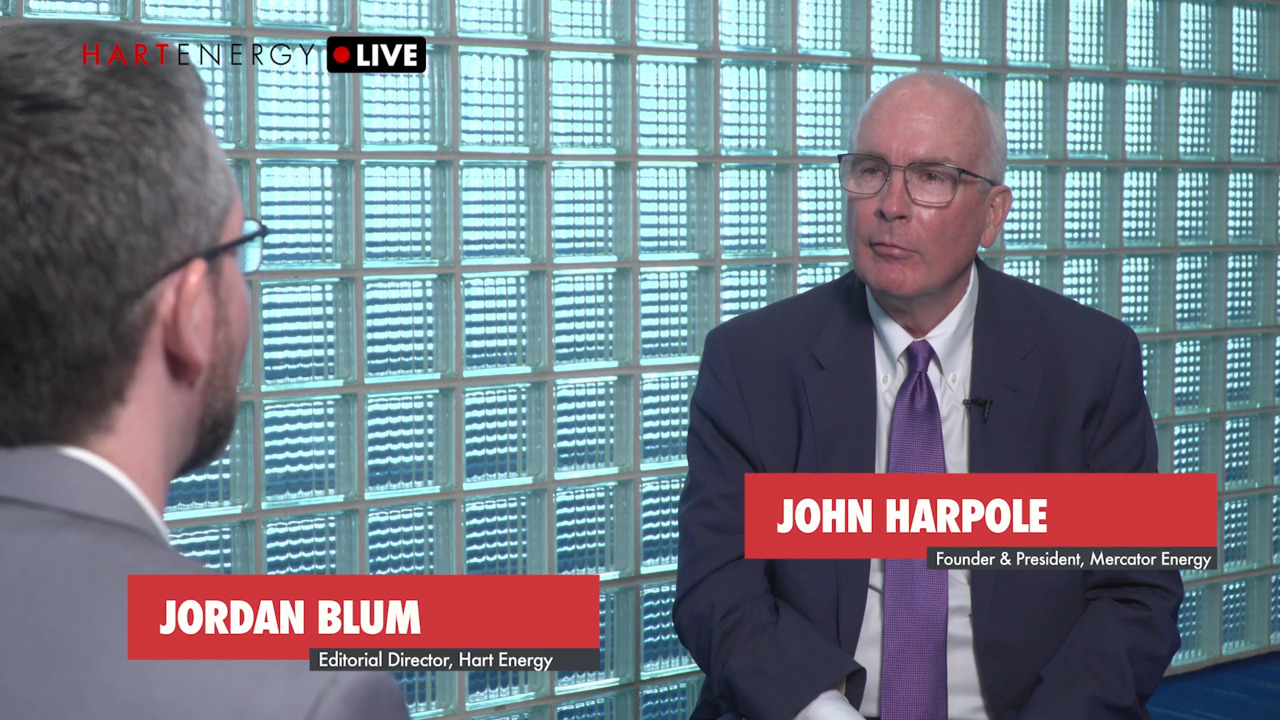
Jordan Blum, editorial director, Hart Energy: We're here at NAPE in downtown Houston. I'm joined by John Harpole, the president and founder of Mercator Energy. Thank you so much for being here. First, I just wanted to get right into it. We have now the LNG pause from the Biden administration. I just wanted you to elaborate a bit on what that means for the industry versus what impacts things in the short-term considering there is a lot of infrastructure under construction right now.
John Harpole, founder and president, Mercator Energy: It's clear that this administration has put concerns about climate change over concerns about our allies. In July, the summer following the Russian invasion of Ukraine, we actually exported by volume more LNG out of the U.S. than Russia was importing by pipeline. A completely huge change in the sense that 17 Bcf of gas per day disappeared from the market because of gas departure from the European supply situation. And yet it was backfilled by U.S. LNG and arm’s length transactions market. The market responded, and I would argue that for the third time in a century, we saved the European continent from tyranny. So this pause has so many different effects, both, for me, morally, ethically, economically, and really just the message that it sends to an ally that maybe you can't count on us. The real amazing thing is that our president hasn't done anything to dissuade the world from the notion that the United States surreptitiously took out the Nord Stream pipeline.
So imagine you're a fertilizer plant or chemical plant in Europe, and the U.S. took out Nord Stream gas supply and is now also saying, “we're going to put this on a tether and hold it back.” To me it smacks too much of what happened in the early days of trying to put the coal industry out of business, and it's the message that is being sent by the current president. In the short term, let's just say for the next year or two, it probably is not a huge impact on the physical capability to deliver because we have so many facilities that are in line to deliver. But if you are a bank that's looking at an investment in an LNG export facility, or honestly an investor that is looking to back a company like Chesapeake, does it put a pause or a question in your investment decision? And that's honestly what I'm most worried about. This should not be a political game.
We should immediately take the Department of Energy out of the equation of permitting and assign all of that responsibility to defer the Federal Energy Regulatory Commission so that we distance ourselves from the politics of this game in terms of exporting the greatest, cleanest resource that we have here in the U.S.
JB: So in that vein, even if this is a relatively temporary pause for political reasons and more, it could be putting a chill on future investment long-term allies.
JH: It's not a good thing. It's not a good thing to put out that kind of doubt. We all want the catch word sustainability, predictability, the elimination of volatility as it relates to energy and certainly, I think the low-income folks are probably highest on that scale of people that we should protect from that. Germany is going through the de-industrialization of its country right now, and they're the industrial powerhouse of Europe. So imagine what this sends to the boardrooms of all the fertilizer plants, steel plants, chemical plants, that this may be in doubt down the road. So, I don't think you can overestimate the impact that it has on the decisions that so many investors or owners of industry are going through right now.
JB: Switching gears just a bit, can I get you to touch on the U.S. domestic production where you are most bullish on gas production and feeding LNG for the foreseeable future?
JH: Well, we have seen a 40% uptake in the last calendar year in production. 40% of the growth of production in the U.S. has come out of the Permian and the Marcellus. We had all argued, and I think Nick from Chesapeake would agree, that the Permian is semi bulletproof because really it is associated gas, and it is really the oil price that drives that. So the only thing keeping more Permian gas from getting to the Gulf Coast for export are pipeline approvals and pipeline proposals. I think that we need to do a better job of making sure that utility commissions and utilities support the expansion of the infrastructure for gas pipeline distribution and transportation. In light of their, especially the investor-owned utilities, commitment to this net zero notion by 2050.
You cannot simultaneously increase the demand for natural gas through peaking natural gas fire generation plants and then also not endorse and support the infrastructure required to get that gas to those markets to make what they call an “energy transition” and for it to actually work and be realized. I'm very nervous about the stability of our already very fragile electric grid and the ability for the natural gas industry as a whole, from the wellhead to the burner tip, to meet that peak day demand that is going to occur for electric generation to meet the inability of renewable energy, wind and solar, to be dispatched to those needs. We all know that they're not dispatchable generation resources. So that is a major concern.
JB: Since you were talking with Chesapeake Energy, how do you feel about the Haynesville going forward with a lot of consolidation there with Chesapeake and Tokyo Gas as well?
JH: Nick Dell’Osso speaks about the marginal cost to produce, and I think there are different parts of the Haynesville that make more sense than other parts of the Haynesville. Often times people ask me, “John, how many years of natural gas production do we have out there?” And I say, “well, I picture it visually as we have this much natural gas on the producer shelf of $3, at $4 we have this much gas, at $5 we have this much gas.” And it all obviously relates directly to the reserves that are available to the price that is out there. Consider for a moment that in Asia and Europe, the price for natural gas is five to six times higher than what it is here in the U.S. and that is obviously the reason why we have seen the dramatic growth in LNG exports and we're scheduled to see a near doubling of our 12 Bcf/d to 14 Bcf/d of capacity for export happen over the next 36 months. What shelf do you think gas will be on price wise? And I think that's the answer for the Haynesville. It certainly has a place to play.
JB: Definitely a big question mark going forward.
JH: No doubt.
JB: Well, thank you so much for joining us here at NAPE and Houston. I really appreciate it. To read and watch more, please visit online hartenergy.com.