Nasdaq
CALGARY – Canada’s Trans Mountain oil pipeline expansion (TMX), which will nearly triple the flow of crude from Alberta to Canada’s Pacific Coast beginning early next year, will shake up North America’s supply by diverting barrels now mainly delivered to refiners and exporters in the U.S. Midwest and Gulf Coast.
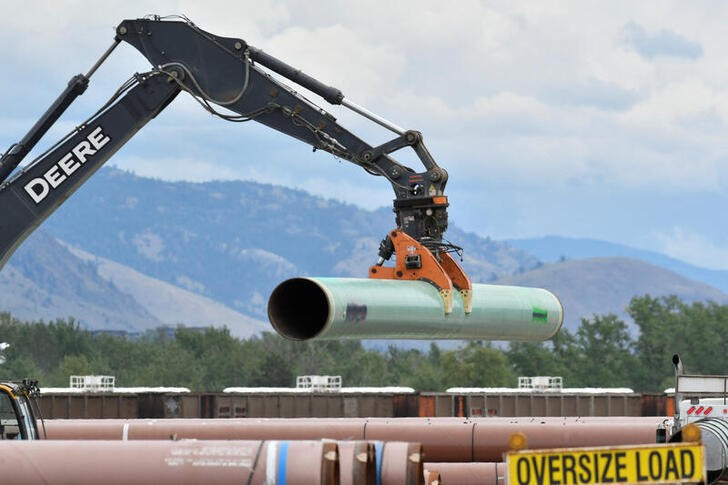
Source: Reuters
Its startup could add as much as $2 per barrel to prices paid by U.S. Midwest oil refineries that sit along Canada’s existing main oil-export route. Plants that benefited from discounted oil include those operated by BP BP.L, Citgo Petroleum, Exxon Mobil XOM.N and Koch Industries’ Flint Hills Resources, analysts said.
The long-delayed and controversial Canadian government-owned C$30.9 billion ($22.81 billion) TMX project is set to begin shipping crude early next year, although it could face up to nine months delay due to a last-minute proposed route change.
Once it starts operating, Canada will be able to ship an extra 590,000 barrels per day (bpd) to Pacific ports for delivery to U.S. West Coast and Asia refiners, where demand for heavy sour crude is expected to climb in the longer-term.
FEWER BLOWOUTS
Canada has supplied the Midwest with all of its crude imports since 2019, according to a Reuters analysis of Energy Information Administration data. That has left Canadian oil producers vulnerable to deep price discounts or “blowouts” whenever pipelines become congested or rupture.
Pipeline operator Enbridge ENB.TO, which ships the bulk of Canada’s 3.8 million bpd of crude exports to the U.S., expects to see flows on its Mainline system drop by up to 300,000 bpd once TMX opens.
Last December, a spill on TC Energy’sTRP.TO 622,000 bpd Keystone pipeline drove the Canadian heavy crude discount to U.S. oil to more than $33 a barrel, more than double its typical discount.
Having more Canadian export pipeline capacity means crude bottlenecks building up in the Alberta storage hub Hardisty should happen less often, reducing volatility and keeping prices steadier.
“For a decade the U.S. Midwest could count on that kind of blowout every year or two,” said Rory Johnston, founder of the Commodity Context newsletter. “That’s less likely now.”
The start-up of TMX could add a “buck or two” to the cost of a barrel for Midwest refiners, he estimates.
GULF COAST RE-EXPORTS SHUT OUT
TMX also will make Canadian crude “re-exports” from the Gulf Coast less viable, squashing a trend that has gained in momentum in recent years, and increasing shipments of Canadian oil to China, said Matt Smith, lead oil analyst for the Americas at Kpler.
So far this year, over 200,000 bpd of Canadian crude has been re-exported from the U.S. Gulf Coast, up from about 73,000 bpd in 2019, Kpler data showed. China is currently the leading destination for these Canadian re-exports, taking in 194,000 bpd in August.
Heavy Canadian crude will still make it to the U.S. Gulf to be used by refiners there, Smith added, and the region could also see an uptick in Latin American crude being displaced from the U.S. West Coast by TMX barrels.
($1 = 1.3549 Canadian dollars)
(Reporting by Stephanie Kelly and Nia Williams; additional reporting by Laura Sanicola Editing by Marguerita Choy)

