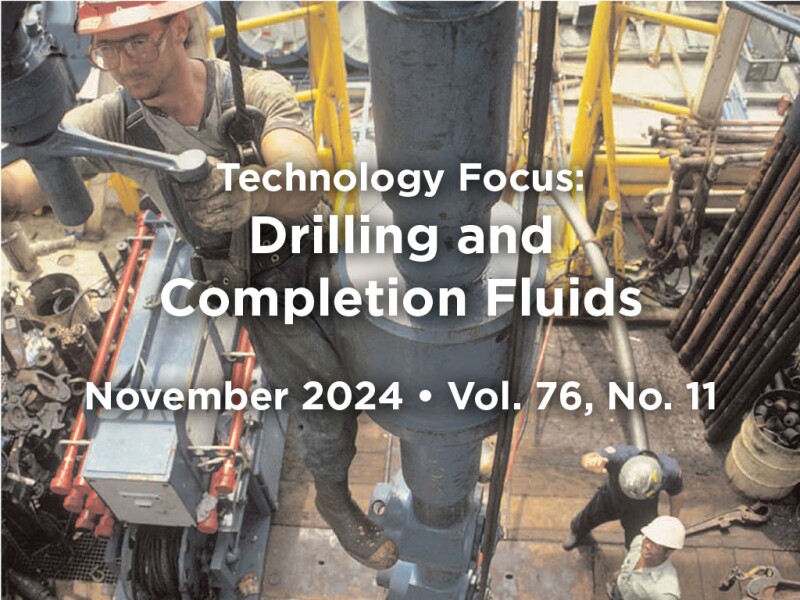
This year’s primary selections for the Drilling and Completion Fluids Technology Focus reflect now-well-established industrywide emphases on machine learning (ML), automation, and the achievement of successful drilling of CO2 storage wells. Enhanced methods of modeling and monitoring allow time and cost savings while surpassing safety goals and furthering efforts to optimize CO2 storage.
Paper OTC 35433 discusses a study centered on accurate gel-strength estimation. The authors leverage ML techniques, particularly the use of artificial neural networks, to develop predictive models for forecasting the gel strength of synthetic oil-based mud systems at both 10-second and 10-minute intervals, surpassing the precision and speed of techniques based on traditional rotational viscometers.
In a similar vein, paper SPE 216322 seeks to bypass traditional manual methods of monitoring drilling fluids, its authors describing a novel online system that measures 10 key parameters continuously. They write that the system has been field-trialed across 200 wells with results that highlight the system’s reliability, with continuous operation for over 125 days.
Finally, paper SPE 217711 involves evaluating the effects of an influx of CO2 into drilling fluids, a key task in the drilling of CO2 storage wells. Concentrating on oil-based drilling fluid, the presented study describes the development and integration of models for properties of drilling‑fluid/CO2 mixtures into an existing software suite.
Recommended-reading papers include an investigation of the use of microwave power in recovering oil from contaminated drill cuttings, reduction of the carbon footprint of drilling fluids, and sedimentation behavior of particles in fibrous sweep fluids. As always, the long-sighted ambition of such research, and the skill applied in its pursuit, reflects the commitment to excellence embodied by the authors of technical papers presented at SPE conferences.
This Month’s Technical Papers
Machine-Learning Approach Predicts Gel Strength of Drilling Fluid While Drilling
Study Assesses Effects of Carbon Dioxide on Drilling-Fluid Performance in CCS wells
Real-Time Monitoring and Control System Enhances Drilling-Fluid Management
Recommended Additional Reading
SPE 217140 Microwave-Assisted Technique for Oil Recovery From Oily Sludge Shale Drilled Cuttings by A. Agi, Universiti Malaysia Pahang, et al.
OTC 34667 Successful Decarbonization of Drilling Fluids by Using Highly Efficient Technology and Reduced Chemical Usage, Logistics, and Casing Sections by Gerardo Jardinez, Pemex, et al.
SPE 218631 Application of Machine-Learning Method for Modeling Settling Behavior of a Spherical Particle in Fibrous Drilling Fluids by R.M. Elgaddafi, Australian University, et al.
Chris Carpenter joined SPE in 2001, starting his career as an associate editor and then managing editor of SPE’s peer-reviewed journals. In 2013, he joined the staff of the Journal of Petroleum Technology as technology editor. He is responsible for Technology Focus feature synopses of selected SPE conference papers and is liaison for the JPT Editorial Review Board. He has also served as an adjunct professor of English for several Texas community colleges since 2001. Carpenter holds a BA degree in history from Hendrix College, an MA degree in English from Texas A&M University, and an MFA in writing from the University of Arkansas. He can be reached at ccarpenter@spe.org.