Kuwait Petroleum To Boost Oil Production Capacity 33% by 2040
Kuwait Petroleum’s managing director of planning and finance said that more investment will be needed to keep Kuwait’s mature oil fields flowing while production is brought on stream.
KOC discovered reserves estimated at 3.2 billion BOE at Kuwait's Al-Nokhatha offshore field in July 2024.
Credit: Kuwait Oil Company (KOC)
Kuwait Petroleum Corp. (KPC) aims to raise its domestic oil production capacity 33% by 2040 while boosting operational efficiencies to lower cost per barrel and reducing emissions to stay on track to net zero.
In a podcast interview ahead of 2025 CERAWeek by S&P Global, Bader Al Attar, managing director of planning and finance at KPC, discussed how the company will invest to balance production growth with emphasis on sustainability to keep Kuwait’s 90-year-old oil industry producing for as long as demand for crude remains.
Since 2005, KPC and its subsidiary, Kuwait Oil Co. (KOC), have reduced flaring from 17% to just 0.5%. As part of their ongoing efforts to lower their carbon footprint, they are using carbon capture technology to enhance oil recovery. Additionally, they are integrating solar power and advanced monitoring and management systems into their operations, as explained by Al Attar in a podcast with Atul Arya, the chief energy strategist at S&P Global.
Strong Long-Term Oil Demand
Al Attar said, “… oil and gas will be playing a big role by the year 2050 … and we think that the last companies standing and producing by that time will be the ones with low costs per barrel as well as the low carbon footprint. To that end we see KPC as best positioned.”
In its latest World Oil Outlook, released in September 2024, OPEC projected strong medium-term growth in oil demand, expecting it to exceed 120 million B/D by 2050. This increase will be primarily driven by non-OECD countries, with India playing a key role.
Petrochemicals will account for the largest incremental increase in oil demand during OPEC’s forecast period at 4.9 million B/D, followed by road transportation (4.6 million B/D), and aviation (4.2 million B/D), according to the report.
“We are aspiring to grow our upstream production (capacity) domestically to reach 4 million B/D to 2035 and maintain that until 2040,” Al Attar said, noting that Kuwait is bound by OPEC production quotas when releasing oil into the market.
Attar said that Kuwait is targeting its nonassociated gas production at 2 Bscf/D by yearend 2040, refining capacity to 1.6 million B/D, and petrochemicals output to 14.5 mtpa, more than three times its current 4.5 mpta of petrochemical output but achievable through possible M&A opportunities.
With the May 2024 commissioning of the Al-Zour refinery, Kuwait has already boosted refining to 1.4 million B/D, Attar said, adding "there will be a little more (capacity) coming with upgrades to the refinery; I would say we are here" in terms of Kuwait's having reached its refining goals.
Offshore Development Key to Success
In January, Kuwait’s state news agency KUNA announced KOC’s discovery of an estimated 800 million bbl of medium-density oil and 600 billion scf of associated gas at the Al-Jlaiaa offshore field.
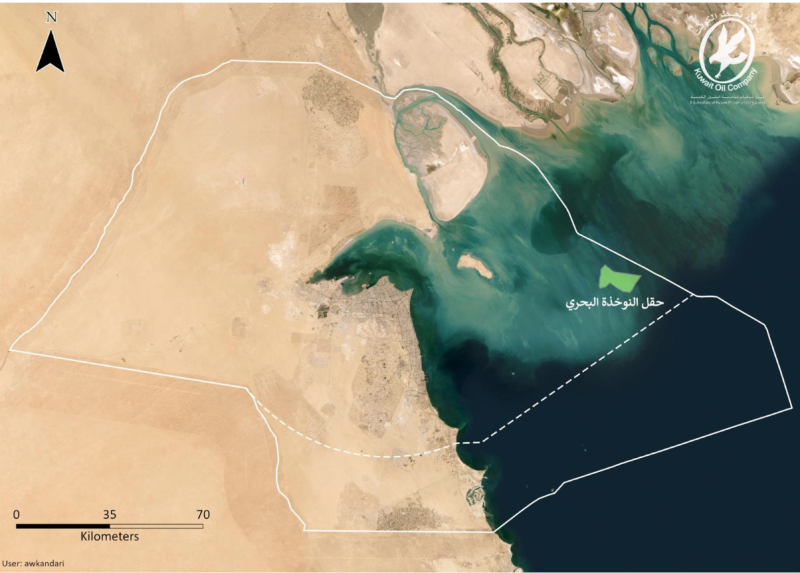
The news followed an announcement in July 2024 of the discovery of an estimated 3.2 billion BOE of reserves in Kuwait’s Al-Nokhatha field 45 miles east of Failaka Island near the undemarcated maritime boundary with Iran.
Both resulted from Kuwait’s extensive exploratory survey project currently ongoing in a 6000-km2 area to find new hydrocarbon reserves offshore, a quest that will make or break Kuwait’s aim of meeting its 33% production increase target, according to The Arab Gulf States Institute in Washington, DC.
Development of such offshore discoveries is critical to meeting Kuwait’s 4 million B/D target because to raise “or even maintain stable production levels, declines in mature onshore fields need to be compensated with new projects, especially if OPEC+ is able to raise production targets over the next few years,” the Institute reported in July.
Moreover, increasing production “would be crucial for Kuwait to demonstrate higher capacity to secure a larger (OPEC quota) as the United Arab Emirates has done,” the article pointed out.
In 2024, Kuwait held 8.27% of global oil reserves, according toOPEC’s annual statistics bulletin.
Location of Kuwait’s Al-Nokhatha offshore field discovered in July 2024.
Credit: Kuwait State News Agency KUNA
Synergies To Fuel the Energy Transition
Asked about Kuwait’s energy transition strategy, Al Attar said, “we have been on this journey for quite some time,” noting that Kuwait has reduced gas flares to 0.5% from a 2005 high of 17% and “we will keep it around those levels” because it “keeps the environment clean and makes economic sense.”
For example, KOC is capturing carbon emissions to increase recovery at Minagish field in western Kuwait, he said.
Other examples including using solar power to produce electricity for facilities and field operations including powering electrical submersible pumps in western Kuwait.
KPC is also considering business models, Al Attar said, “where maybe we partner with companies that can do this project for us but at the same time to sell us the power to use in our fields for much less price than what we are paying now to generate electricity.”
Kuwait plans to invest just under $100 billion over the next 5 years, with about half allocated to the domestic upstream sector. Around 12% will be directed toward international upstream, 20% toward domestic downstream, and 3% for international downstream. Additionally, 10% will be dedicated to petrochemicals and the rest applied where needed, Al Attar said.
“Our upstream reservoirs are getting more and more mature, and we see that the stage of maturity of these reservoirs is requiring more and more capital to invest not only to keep production levels where they are but also to grow to where we aspire to the numbers to be,” he said.
Kuwait today produces three grades of crude, depending on the reservoir— traditional Kuwait export crude, heavy oil in the 16 to 18 °API range, and a light crude produced in deeper horizons, Al Attar said.