Experts speaking at CERAWeek 2025 lauded industry's shift from focusing on the energy transition to prioritizing oil production.
US Secretary of Energy Chris Wright speaking during the opening session of CERAWeek 2025.
Source: CERAWeek by S&P Global
In the wake of the new US administration and a series of executive orders, the oil and gas industry has shifted its focus away from the energy transition and toward increased oil production.
“We are unabashedly pursuing a policy of more American energy production and infrastructure, not less,” newly appointed US Secretary of Energy Chris Wright said in the opening plenary talk of CERAWeek by S&P Global.
During the session on 11 March, experts described themselves as "realists," adopting an approach focused on "reality" to address energy needs.
Wright, the former CEO of Liberty Energy before becoming Secretary of Energy, vowed to execute a “180-degree pivot” on energy policy, referring to the previous administration’s approach as being “focused myopically on climate change, with people as simply collateral damage.”
Although he acknowledged that greenhouse gas emissions from fossil fuels were contributing to global warming, Wright said “there is no physical way” solar, wind, and batteries could replace the “myriad” uses of natural gas.
Amin Nasser, president and CEO of Saudi Aramco, echoed Wright’s view during his speech later in the program.
“New sources add to the energy mix and complement existing sources. They do not replace them. That's why the current strategy of immaturely switching to immature alternatives has been so self-destructive,” Nasser said.
In addition to the $10 billion already invested in energy transition and climate change initiatives, he noted that global climate action will require an estimated $6 trillion to $8 trillion more annually.
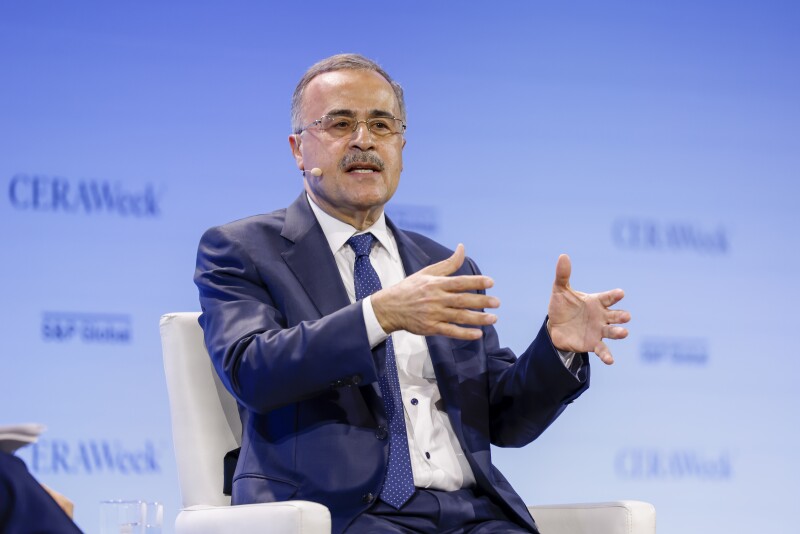
Aramco President and CEO, Amin Nasser, at CERAWeek 2025.
Source: CERAWeek by S&P Global
“Alternatives have barely made a dent, even with EVs … the total penetration of EVs is still only 4%, and with wind and solar combined, is also less than 4% of global energy supplies—then we are barely 4 miles into a 100-mile journey.”
After years of ambitious ideas about energy transition, Chevron CEO Mike Wirth agreed that a more measured approach might be preferable.
“We're seeing some reality come back in the conversation. For years, my message has been leading a balanced conversation about affordability, reliability, and the environment, and focusing only on climate leads us to ignore the first two,” he said.
Oil Demand
Nasser said he expects oil demand to grow by 1.3 million and 1.5 million B/D this year, reaching approximately 106 million B/D in a balanced market. He noted that demand growth will continue as people in developing nations, particularly in the Global South, gain access to and consume more energy.
“60% of the growth that we've seen last year came from the Global South," he said. “One billion people have consumed 40% of [global] energy, with 6 billion consuming the remaining 60%.”
As these regions grow in prosperity and gain greater access to items like cars, air conditioning, and artificial intelligence (AI), which is expected to significantly impact energy demand in the coming years, both the percentages and the total amount of energy consumed are likely to change, Nasser said.
Artificial Intelligence
When speaking about the impact of AI, Wright said it is only at the “tip of the iceberg.”
“It takes massive amounts of electricity to generate intelligence. The more energy invested, the more intelligence produced,” he said. “Since the demand for energy is unlimited, since the demand for intelligence is unlimited, so will be the demand for energy.”
Nasser stated that new energy sources are unable to meet this massive demand, emphasizing the continued need for conventional sources. He described the current plan as a "fast-track to dystopia, not utopia," and jokingly remarked, "There’s more chance of Elvis speaking next than the current plan working."
Nasser believes that emphasizing three core principles could strengthen global energy policy.
Three Core Principles
“First, all sources must play a growing role in meeting rising energy demand in a balanced, integrated manner,” said Nasser. This includes investments in new and alternative energy sources to complement conventional energy.
Secondly, he said, the model must genuinely serve the needs of developed and developing nations alike. Global electricity consumption is expected to double by 2050 due to electrification in sectors like transport and industry, as well as the rise of new demand centers such as AI-driven data centers and electric vehicles consuming a large share of that growth. He noted that the transportation sector (including road, shipping, and aviation) currently accounts for about 60% of global oil consumption.
Lastly, he said the strategy must be about delivering real results.
“This does not mean stepping back from our global climate ambitions. Reducing GHG (greenhouse gas) emissions must still get the highest possible priority … but the future of energy is not only about sustainability. Security and affordability must share the stage.”
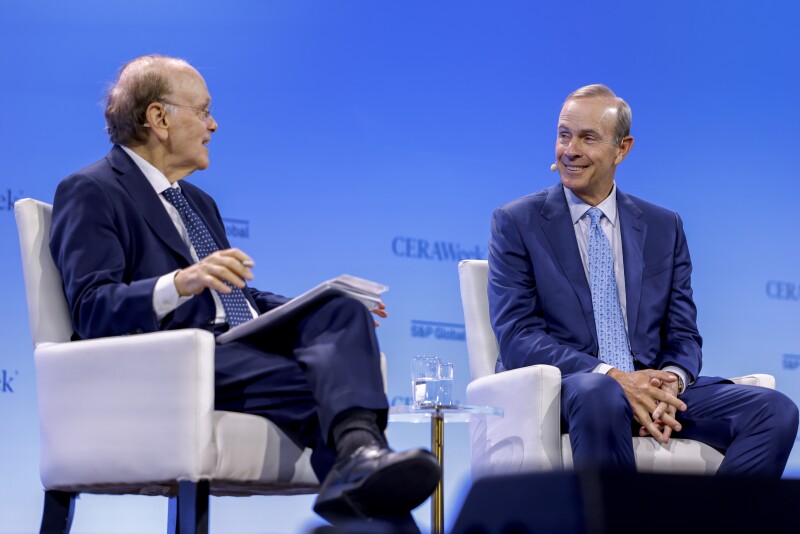
Chevron CEO Mike Wirth (right) taking questions from Daniel Yergin at CERAWeek 2025.
Source: CERAWeek by S&P Global
Wirth shared similar views with Nasser, expressing his frustration with the constant back-and-forth of energy policy and his desire for a more stable approach.
“Swinging from one extreme to another is not the right policy approach,” Wirth told the audience. “We have allocated capital that's out there for decades, and so we really need consistent and durable policy.”
His comments come as no surprise as the Chevron CEO expects to increase output in the Gulf of Mexico over the next few years to 300,000 B/D, up from 200,000 B/D last year. He added that Chevron will soon reach 1 million B/D in the Permian Basin.
“We need to see some of this in legislation so it’s more durable and not at risk of being swung back in another direction by a future administration.”