人工举升

为全金属螺杆泵开发的状态指示器

本文提出了一种拟议的条件指示器,该指示器可估计全金属螺杆泵在运行中任何点所经历的磨损,并考虑井下运行条件的影响。

未来泵磨损性能的估计
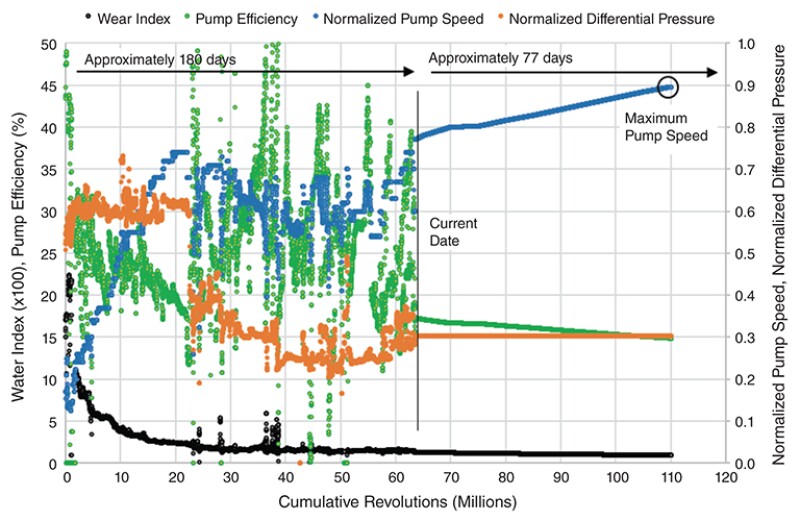
图 1-案例研究 5,显示了基于外推 PWI 和估计的未来泵运行条件对未来泵磨损性能的估计。

全金属螺杆泵 (AMPCP) 经常用于石油和天然气应用,以向地面产生高温流体,但在运行过程中会出现加速磨损,导致泵整个使用寿命期间的容积效率降低。在完整的论文中,作者提出了一种拟议的条件指示器,该指示器可估计 AMPCP 在操作中任何点所经历的磨损,并考虑井下操作条件的潜在影响。所提出的状况指标还可以外推到未来并用于估计 AMPCP 的潜在剩余使用寿命 (RUL)。

介绍

AMPCP 由金属定子和转子组成,与标准弹性体 PCP 相比,这使得它们能够在更高温度的流体中运行。由于定子和转子之间存在金属对金属的接触,AMPCP 通常会比弹性 PCP 经历更加速的磨损,从而导致泵效率降低和泵的整体寿命缩短。

虽然泵效率降低可能是由于泵磨损造成的,但也可能是由操作条件的变化引起的,例如泵压差增加或泵速降低。

SPE_logo_CMYK_trans_sm.png
成为 SPE 会员继续阅读
SPE 会员:请在页面顶部登录才能访问此会员专享内容。如果您还不是会员,但发现 JPT 内容很有价值,我们鼓励您成为 SPE 会员社区的一部分,以获得完全访问权限。
原文链接/jpt
Artificial lift

Condition Indicator Developed for All-Metal Progressing Cavity Pumps

This paper presents a proposed condition indicator that estimates the wear experienced by an all-metal progressing cavity pump at any point in operation and takes into consideration the effects of downhole operating conditions.

estimation of future pump-wear performance
Fig. 1—Case Study 5, showing the estimation of future pump-wear performance based on the extrapolated PWI and estimated future pump operating conditions.

All-metal progressing cavity pumps (AMPCPs) are frequently used in oil and gas applications to produce high temperature fluids to surface but can exhibit accelerated wear during operation that results in decreasing volumetric efficiency over the pump’s life. In the complete paper, the authors present a proposed condition indicator that estimates the wear experienced by an AMPCP at any point in operation and takes into consideration the potential effects of downhole operating conditions. The proposed condition indicator also can be extrapolated into the future and used to estimate the potential remaining useful life (RUL) of an AMPCP.

Introduction

AMPCPs are composed of a metal stator and rotor, which enables them to operate in much higher temperature fluids compared with standard elastomeric PCPs. Because of metal-on-metal contact between the stator and rotor, AMPCPs typically experience more accelerated wear than elastomeric PCPs, resulting in reduced pump efficiency and shorter overall pump life.

While decreasing pump efficiency can be a result of pump wear, it also can be caused by changes in operating conditions, such as increasing pump differential pressure or decreasing pump speed.

×
SPE_logo_CMYK_trans_sm.png
Continue Reading with SPE Membership
SPE Members: Please sign in at the top of the page for access to this member-exclusive content. If you are not a member and you find JPT content valuable, we encourage you to become a part of the SPE member community to gain full access.