Japanese energy firms are seekly US liquefied natural gas (LNG) supplies with many signing long-term offtake agreements while others, such as Tokyo Gas, are eyeing strategic investments to become part of the North American gas value chain from exploration and production to liquefaction and global LNG marketing.
Japan’s largest power generator, JERA, announced on 12 June in Washington, DC, its finalization of several 20-year agreements to procure up to 5.5 mtpa of LNG under sales and purchase agreements with Next Decade Corp. and Commonwealth LNG, as well as with heads of agreement with Sempra Infrastructure and Cheniere Marketing LLC.
JERA had previously inked offtake contracts totaling 3.5 mtpa from Freeport LNG and Cameron LNG, plus a 1.0-mpta agreement with Venture Global CP2, according to its press release.
Tokyo Gas Shuffles Shale Stakes
In April, Japan’s largest city gas supplier, Tokyo Gas, through its US subsidiary TG Natural Resources (TGNR), purchased together with Castleton Commodities International, a 70% stake in Chevron's east Texas gas assets which extend into the Haynesville Shale formation near Louisiana. Castleton holds 7% of TGNR.
This acquisition will add more than 250 gross locations to TGNR’s existing Haynesville inventory based on an assumption of four wells per section. The acreage is relatively underdeveloped and currently supported by shallower production, which helps reduce parent-child well interference, according to a press release by TGNR and Tokyo Gas.
The sale for $75 million in cash and a $450 million capital carry to fund future Haynesville development builds on TGNR’s $2.7 billion acquisition in 2023 of Rockcliff Energy from Quantum Energy Partners, which overnight quadrupled production to 1.3 Bcf/D from 330 MMcf/D, given the block’s location adjacent to TGNR’s existing blocks, according to Tokyo Gas.
Tokyo Gas has confirmed it is also “actively pursuing” a stake in Woodside Energy’s Louisiana LNG liquefaction and export facility to realize its broader strategy of not only securing US gas supply but of creating an integrated US gas value chain.
While a deal has yet to be struck, Tokyo Gas has reshuffled its upstream US shale gas assets to position itself for what it believes to be the inevitable. In February, the Japanese utility, through its TG Eagle Ford Resources subsidiary, signed a heads of agreement to sell its 25% stake in an Eagle Ford Shale gas project in south Texas to Shizuoka Gas for $130 million and laser-focus its resources on its east Texas and north Louisiana assets.
Now seated among the largest shale gas producers in Texas and Louisiana, TGNR has acquired through the Chevron deal another 71,000 net contiguous and largely unexplored acres in Panola County, Texas.
In an April report, Denver-based East Daley Analytics noted that the newly acquired acreage is among the last remaining undeveloped tracts in the region. It offers optimal well spacing and could extend TGNR’s drilling inventory for more than 20 years, while also aligning with Tokyo Gas’ strategy to strengthen its presence in US shale plays near export terminals.
Chevron’s Twofold Power Move
As part of the agreement, Chevron “retained a 30% nonoperated working interest in a joint venture with TGNR and an overriding royalty interest in the assets” while the divestment supports the US supermajor’s plan to optimize its global portfolio by shedding $10–15 billion in assets by 2028, according to a Chevron press statement.
“The transaction is anticipated to generate over $1.2 billion in value to Chevron at current Henry Hub prices through the multiyear capital carry, retained working interest, and overriding royalty interest,” Chevron said, adding that it “expects to maintain future upside through the joint venture structure while accelerating development of a noncore asset through a capital efficient approach.”
TGNR will operate and develop Chevron’s former assets.
According to its website, TGNR owns more than 410,000 net acres and produces net volumes of more than 1 Bcfe/D (approximately 5% liquids) primarily from the Haynesville and Cotton Valley formations in east Texas and northern Louisiana. The company operates more than 2,400 producing wells and maintains over 1,600 miles of gathering systems and related midstream infrastructure.
US as Swing LNG Producer
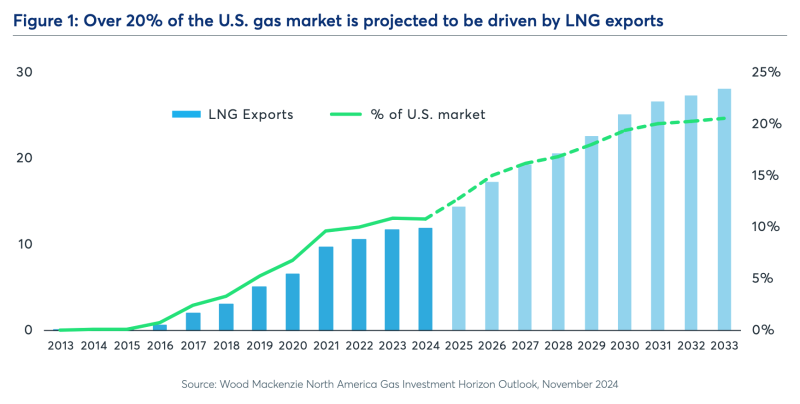
Global research and consultancy firm Wood MacKenzie noted that the US—already the world’s largest LNG exporter—“is set to double its exports by 2028,” and given this “dominant position, combined with the increasing linkages between gas markets that LNG exports create … the US is increasingly the swing producer globally.”
Feed gas for US LNG production currently represents approximately 13% of total US domestic demand, according to the firm.
Mitsubishi To Offtake Canadian LNG; Mitsui Expands US Shale Assets
Meanwhile, Mitsubishi Corp. expects in July to become the first Japanese company to offtake Canadian LNG at scale as the $14-billion, 14-mtpa LNG Canada facility moves toward full commercial operation by year-end 2025, NikkeiAsia business media reported on 13 June, citing its own sources.
Mitsubishi, which holds a 16.6% interest in the Cameron LNG facility in Louisiana, invested $2.1 billion for 15% (2.1 mtpa) in LNG Canada, whose other partners include Shell, Petronas, PetroChina, and Korea’s Kogas.
In the US, Mitsui is invested in upstream in the Marcellus Shale in Pennsylvania and the Eagle Ford Shale in Texas. Mitsui grabbed a 92% stake in the unconventional Hawkville gas field in the Eagle Ford in 2023 and a year later acquired the 46,500-acre Tatonka shale-gas asset, also in south Texas, to be developed after 2026, according to a company statement.
Japan currently imports 10% of its LNG supply from Russia’s Sakhalin projects which will begin to expire in 2026. Japanese companies involved in those contracts are, however, negotiating to extend the agreements, according to local media reports.