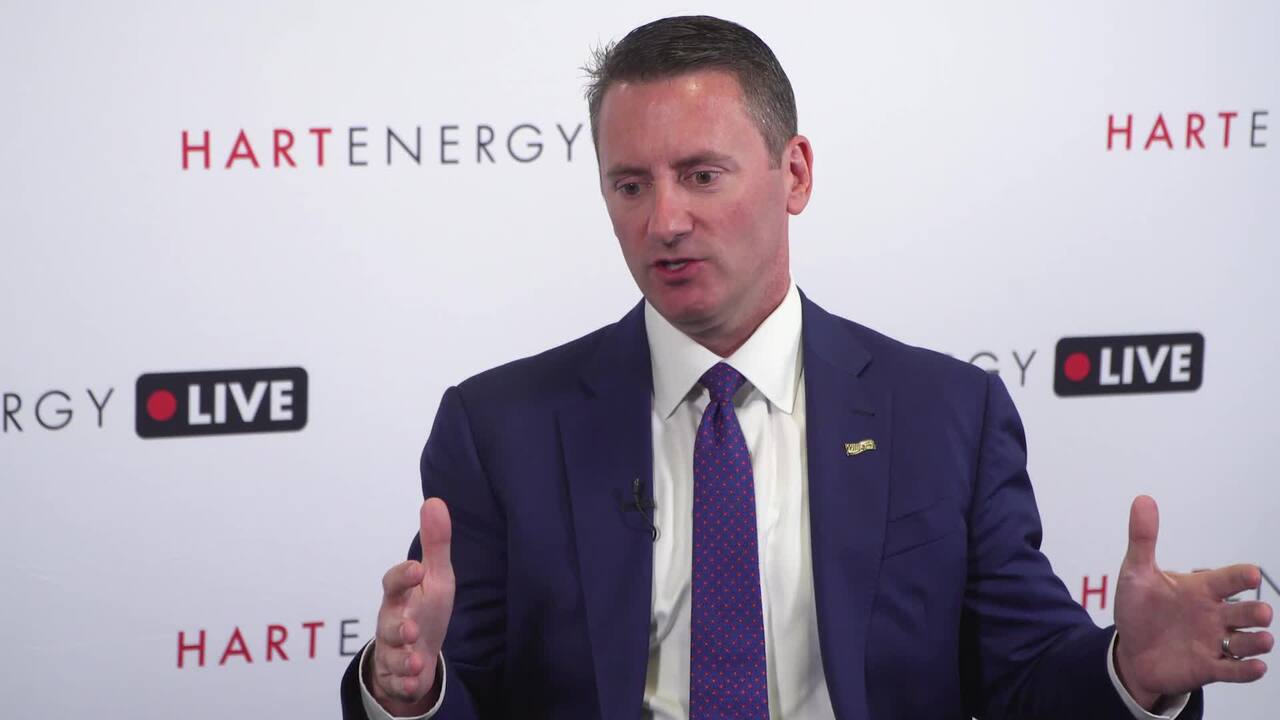
I am Jordan Bloom, editorial Director at Hart Energy, and we're here at Hart's America's Natural Gas Conference in Houston for this Hart Energy Live Exclusive interview. I'm joined by Chad Zamarin, Williams Cos.' executive vice president of corporate strategic development. Thank you so much for joining us.
Chad Zamarin: Thanks, Jordan.
JB: So now we were just talking about how Williams is getting more into carbon capture and storage (CCS), getting closer to those LNG hubs. Can you just elaborate a bit on what Williams is doing in the carbon capture space and how it's such an integral role for midstream to fill?
CZ: Yeah, sure. So we have a great asset base in the Haynesville basin. We gather over 5 Bcf/d of natural gas in the Haynesville, and we are targeting that production for a large part of it to provide gas for LNG exports along the Gulf Coast. And we're in the process of developing an extension of our gathering system to move about 2 Bcf/d of gas from the Haynesville to the LNG markets. And alongside that project, we're developing the capability to capture CO2 in the Haynesville basin, put that CO2 in the same pipeline that we move natural gas through, move the CO2 down to the southern end of the pipeline, remove the CO2, put the CO2 permanently underground. And move the natural gas to LNG terminals so that we can export it to friends and allies around the world. And so we think it's a great example of how the existing infrastructure is really critical to scale up the next generation of energy technologies like carbon capture and sequestration.
JB: So utilizing those existing facilities as well, I mean, is this just the beginning of Williams getting more and more into CCS and other projects?
CZ: Yeah, I think so. I mean, if you think about CO2, we know how to move products through pipelines. We know how to store products underground. I mean, we store over 3 Tcf of natural gas underground every year, and so we know how to move these products. And so for CO2, it's really just the challenge of can you aggregate enough CO2 to support the infrastructure needed to capture the CO2 and move it through pipelines and ultimately inject it and store it permanently underground. And so we do, we're looking across our footprint at where can we bring our capabilities. Again, we're very good at large complex infrastructure solutions. We're very focused on natural gas, but our services [are] providing environmental and economic benefits, and so how can we leverage that capability to do more? CCUS is something that we're focused on.
JB: Very good. You mentioned the Louisiana Energy Gateway and NextGen Gas. Can you explain why low carbon natural gas is so important to kind of fuel that LNG export growth?
CZ: We call it NextGen Gas, and that really is a term that refers to the wellhead to water and the wellhead to burner tip value chain of the natural gas business. We want to make sure that we can shine a spotlight on how we can manage emissions through that value chain so that we can really focus on the benefits of natural gas around the world. I mean, natural gas is an incredibly powerful decarbonization tool. We've proven that here in the United States. Over the last 15 years, it's been the single largest contributor of driving down emissions here in the U.S. primarily through displacing coal for power generation. But the fact of the matter is the world will burn more coal this year than any year in the history of the planet. So we've got to make sure that we can address concerns with the natural gas value chain, demonstrate that we have very low well-managed emissions through that value chain so that we can really focus on the massive benefits that we can drive with natural gas: providing energy, affordability, energy reliability and security. And really importantly, displacing higher carbon emitting fuels like foreign coal and driving down emissions, like we did in the United States. We need to do that all around the world.
JB: Very good. Yeah. So with this next wave of LNG export growth in the us, clearly a lot more gas infrastructure is going to be needed. Can you talk about the needs and challenges that are going to go into getting all that done?
CZ: Yeah. So what we've seen across our system is that as you increase electrification. And we are ourselves investing in new technologies. We believe in all the above energy ecosystem. So solar, wind are going to play an important part in the energy economy of the future, and electrification is going to play an important part. But as you increase the penetration of electrification and solar and wind, you also increase the intermittency of the energy that we depend on. The only way that those systems will continue to work reliably is to have natural gas as that intermittent backup that can provide the resource that we need when the sun sets, when the wind slows down. That's what happens today in Texas. It happens in Oklahoma. We have a great wind resource in Texas and Oklahoma, but as the wind slows down, the only reason why our energy system continues to work reliably is because natural gas consumption increases to fill that void.
And so we've got to invest in – as power demand continues to increase electrification increases, LNG demand increases – we've got to have a robust build out of natural gas infrastructure to maintain reliability. And it is a challenge. I mean, we just saw a major pipeline get approved in the United States, the Mountain Valley Pipeline. It took eight years. It took way more investment than was expected. It took an act of Congress. It took the Supreme Court of the United States weighing in to make that project go. We can't have that be the process for getting infrastructure built in the United States. We've got to get back to building if we want to unleash the benefits of natural gas both here at home and on the global stage. We've got to address permitting reform and be able to build pipelines and infrastructure to bring it to market.
JB: Great. Yeah, when you're talking about an act of Congress, usually you're not speaking literally.
CZ: This is literally. It took an act of Congress and so we've got to fix our permitting process.
JB: Well, thank you so much for joining us today for this Hart Energy Live Exclusive interview. To read and watch more, please visit hartenergy.com.