Global Implications and Challenges of Electrification
This update highlights efforts to electrify oil and gas assets and deliver clean energy to remote, underserved communities. But the big question remains: Can we really achieve net zero emissions by 2050?
Source: Natali Mis/Getty Images.
Electrification is widely seen as crucial for decarbonization. To be successful on a global scale, a mix of complex challenges require coordinated efforts across the diversification of the energy mix, technology development, infrastructure investment, policy support, and regional planning.
The International Energy Agency’s (IEA) Net Zero Emissions by 2050 Scenario suggests electricity should account for nearly 30% of final energy consumption by 2030, up from an estimated 20% in 2023, to progress to net zero.
Are net zero emissions achievable by 2050? SPE President Olivier Houzé delves into the IEA’s three main energy transition scenarios in this month’s vodcast and column. Among his conclusions: “Beyond 2050, the anticipation is a decline of around 50% for oil and 25% for gas in the following 20 years. The one thing everybody agrees on is that no one really knows.”
The following updates offer a glimpse at efforts to electrify oil and gas assets and bring clean energy solutions to remote and underserved communities.
Norway’s Offshore Success
Electrifying upstream oil and gas production facilities using renewable energy or otherwise flared natural gas could reduce emissions by more than 80%.
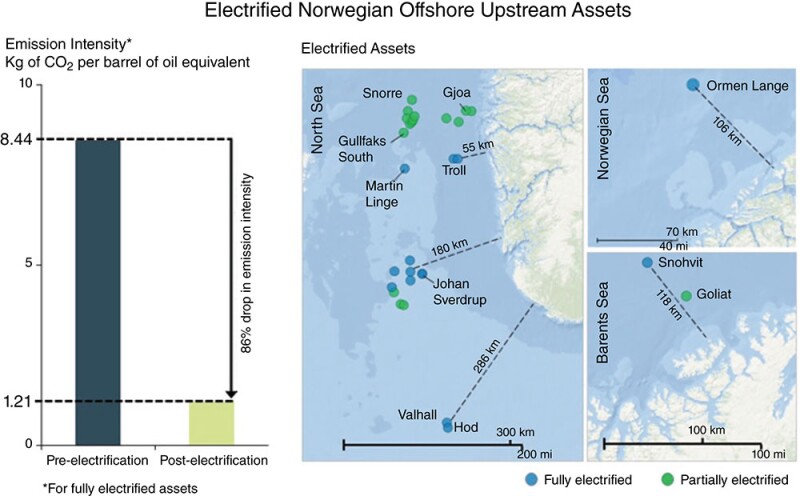
Rystad Energy’s recent analysis highlighted Norway as currently leading the way, thanks to its wealth of renewable resources and production sites’ proximity to them. Electrification of rigs and other assets on Norway’s Continental Shelf (NCS) has resulted in a drop from 8.4 kg to 1.2 kg CO2/BOE—an 86% reduction in the same assets’ emissions before electrification.
Norway’s literal powerhouse is hydroelectric energy, tallying more than 1,500 hydropower plants, normally producing 133 TWh annually, or 96% of the country’s total power production. This supply has made the transition of many of its offshore facilities to cleaner energy more feasible than in other regions of the world, particularly for power-from-shore projects such as Troll A, Martin Linge, and Johan Sverdrup. As of 2 years ago, Norway had seven fields fully or partially electrified from shore.
Onshore Electrification—Drilling With Clean(er) Energy
Other players in the industry grapple with less advantageous scenarios, facing hurdles such as facilities located far from renewable energy sources, which may be limited, and inadequate grid infrastructure.
SPE 218649, presented at the SPE Conference at Oman Petroleum & Energy Show in April, discussed using electrical utility power in drilling operations. The authors noted that a drilling rig typically consumes 6 to 50 MWh of energy per day, averaging around 20 MWh. Diesel-powered rigs emit about 1.0 metric tonne of CO2e/MWh, totaling roughly 20 metric tonnes of CO2e per day. In contrast, grid-powered rigs emit about 0.39 metric tonnes of CO2e/MWh, less than half the emissions of diesel-powered rigs.
An example from the paper illustrates how incremental changes can reduce emissions intensity, even when the solution is a step toward “cleaner” energy, though not yet fully aligned with ideal clean energy standards.
Comparing drilling operations in North Dakota, where 57% of the state’s power generation uses coal, to Texas where 18% uses coal, the authors noted that the “emissions intensity on a North Dakota rig tied to the grid is higher than that of an electrified rig working in Texas but is still notably lower than the intensity of an average drilling rig powered by a diesel generator, which is approximately 1.0 metric tonnes CO2e/MWh.”
The proximity of NCS oil and gas assets to Norway’s hydroelectric-powered grid is advantageous to electrification of those assets. Johan Sverdrup is approximately 112 miles offshore. In comparison, US Gulf of Mexico assets range from 500 ft to 350 or more miles offshore.
Source: Rystad Energy.
Broader Implications and Challenges of Electrification
The upfront costs of electrification are substantial, especially for entities in remote areas with limited grid access. This challenge affects not only the oil and gas industry but also efforts to bring electricity to underserved communities.
A paper presented at the SPE Nigeria Annual International Conference and Exhibition in August (SPE 221709) studied the viability and impact of solar mini-grid systems for electrification of rural communities in Sub-Saharan Africa where approximately 600 million people lack electricity, and around 690 million lack access to clean cooking stoves. The authors wrote, “In Nigeria, about 45% of the population, more than 90 million people, do not have electricity, with 60% of these individuals residing in rural areas. Nigeria also has one of the lowest per capita electricity generation rates globally, with an installed grid-connected capacity of about 13,000 MW but an average actual output of just 4,000 MW.”
The authors included a table showing a cost summary including capital, the cost of installation, and other specifications for an 87.5‑kWp (kilowatt peak) solar-power system. They calculated a levelized cost of electricity of 47.1 cents/kWh over the system’s estimated lifetime of 25 years—approximately six times that of a US residential solar system and roughly three times more than an average US residential utility rate of 16 cents/kWh (although this varies significantly by state and region).
In the end, achieving a more electrified and sustainable energy future depends on a combination of factors: strategic investment, robust infrastructure, accessible energy resources, collaboration among key stakeholders, ongoing technological innovation, and supportive policy frameworks.