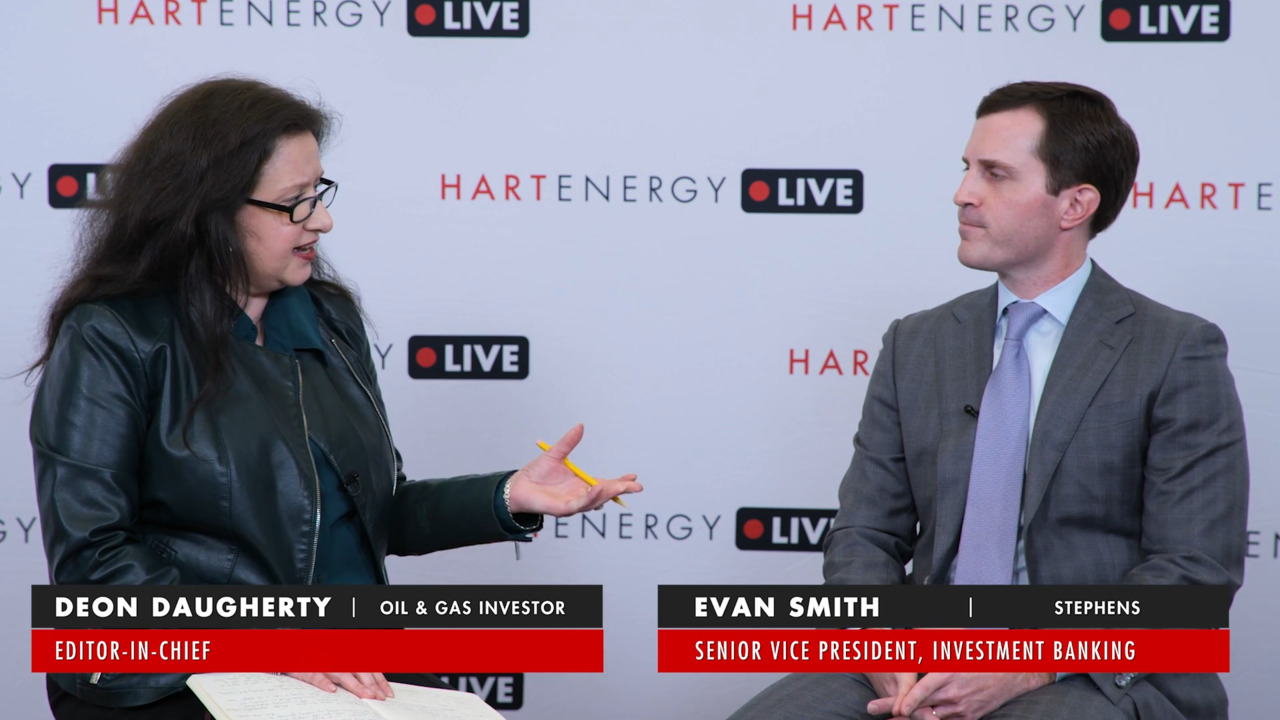
Deon Daugherty, editor-in-chief, Oil & Gas Investor: We are here at DUG Appalachia Conference & Expo in Pittsburgh today discussing family offices with Evan Smith, senior vice president for investment banking at Stephens, which has had a family office coverage group for close to 10 years. Tell us a little about that growth within that group.
Evan Smith, senior vice president for investment banking, Stephens: Yeah, it's really been fascinating. I mean, like you said, we established this group almost a decade ago really because we're a family office ourselves and [we] wanted to kind of establish a network that we could have and keep track of family offices who are putting money into all sorts of industries. But specifically for me, interest in energy. It's grown out quite a bit, we now cover around 350 families, all shapes and sizes, all backgrounds: U.S., European, all across the world. And it's grown out to a group that I'd say probably one-third are interested in oil and gas. And again, they write check sizes anywhere from 10 million to multiple hundreds of millions. So a really broad group of investors that are seeking to put capital to work, and I think it's helped us out a lot in our processes.
DD: So these were families that have created their wealth from other industries. What sort of spaces do they come from and find oil and gas?
ES: It's really all of them. But lately within the oil and gas space, we've seen groups who are from outside of the energy sector, so they made money in real estate or tech, you name it. And they've realized the value proposition in energy and a lot of the dynamics that are going on here and now and they've made a firm decision to commit capital to the space and they have really tried to be active here of late.
DD: You mentioned that there are several families that are not U.S. based. Where do they come from and is that new to family office investing?
ES: Yeah, for us, a lot of them have been more in Europe. I think a lot of that had to do with what happened in Ukraine and some of the European energy crisis. So they've realized the importance of energy to our global economy and know that it'll be around for a long time longer than a lot of people think, and they've made a decision to put their money in that space.
DD: So when they want to invest in oil and gas, what sort of deals or assets are most appealing to these offices?
ES: It is all shapes and sizes. I'd say broadly speaking, it's deals that are probably a little lower risk. They're very concerned about preservation of capital, making their money back. I think generally speaking, they're more concerned about ROI (return on investment) versus IRR (internal rate of return). So they would rather hold something for 20 years and make a 3, 4, 5 times [in ROI] versus a one year hold that you make a 50% IRR. So I mean, there's a lot of different deal types. There's groups that like drilling deals, there's groups that like PDP (proved developed producing) deals generally. Family offices like that compounding yield, so we see a lot of PDP deals. And you've seen a lot of the bigger deals that have been done from family offices. You've seen kind of more value type of deals. So a deal in the Uinta to a deal in the D-J Basin, non-Permian deals where you could potentially get a better value for your money.
DD: And I think you alluded to this just a moment ago when you were talking about investing or they invest for a long period of time, so that might be one of the ways in which they differ from investing with traditional private equity. But what are some of the others? What separates them?
ES: Yeah, I think it's a number of things. It's certainly the term; that they can hold things for a very long time. Stephens has held an oil and gas investment since the 1950s, so that's obviously different from private equity. They're probably a little bit more passive than private equity. They're not going to be in your office making decisions, which is good. They can move a little quicker. So there's generally a shorter amount of people in between the people doing the evaluating and the decision makers, so you can move quicker than some institutions. [There] are a number of things, but those are the ones that stand out.
DD: Well those seem like advantages for the E&Ps. Are there challenges though? Are the terms different such that maybe they're more stringent or anything like that?
ES: The terms generally look like a private equity deal. A lot of the people that those family offices have hired came from private equity or they've hired people on that used to work in private equity or principal investing. So the terms look a little similar. I'd say some of the challenges are maybe they're not a long-term investor in energy, so they haven't been through the cycles. They might be a little more fickle, depending on the group, obviously. But a lot of these family offices may kind of change their mind or have read something and maybe they thought they wanted to do investment, but that changed and they ended up not doing a deal. I guess clearly that could happen in private equity too. When it's just one main decision maker, it can be a little more strenuous when it gets down to the end of the deal.
DD: Okay. That's fascinating and a crucial topic, totally of interest right now in the energy capital raising world. Thank you, Evan, very much for joining us. Thank you for your participation on the panel today. It was really terrific.
ES: Absolutely. Thanks for having me.