EIA: New Projects Poised To Add 231,000 B/D to US Gulf of Mexico Output by 2025
Using a new model, the federal agency said deepwater operations will drive the region's production to 1.9 million B/D next year.
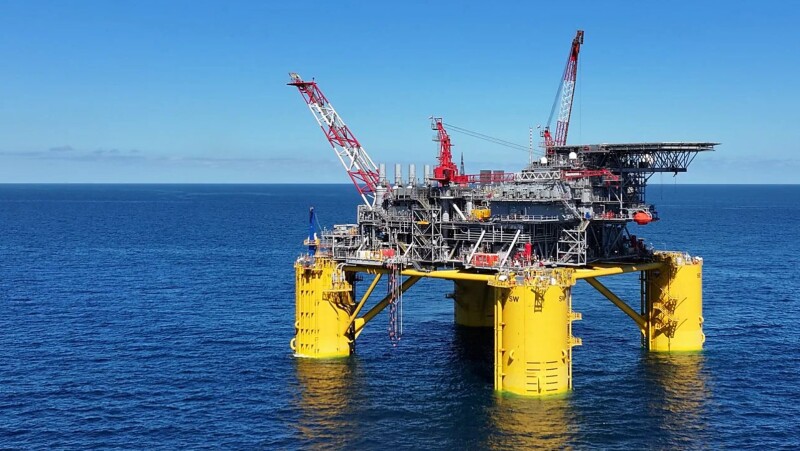
The Whale platform in the Gulf of Mexico is expected to achieve first oil production later this year.
Source: Shell.
The US Energy Information Administration (EIA) forecasts that crude oil and natural gas production in the US Gulf of Mexico (GOM) will rise through 2025, following an update to its modeling approach.
According to its latest projections, GOM oil production is expected to average 1.8 million B/D in 2023, increasing to 1.9 million B/D in 2024. Natural gas output is projected to stay flat at 1.8 Bcf/D over the same period.
The EIA forecast is supported by the anticipated startup of 12 new fields over the next 2 years.
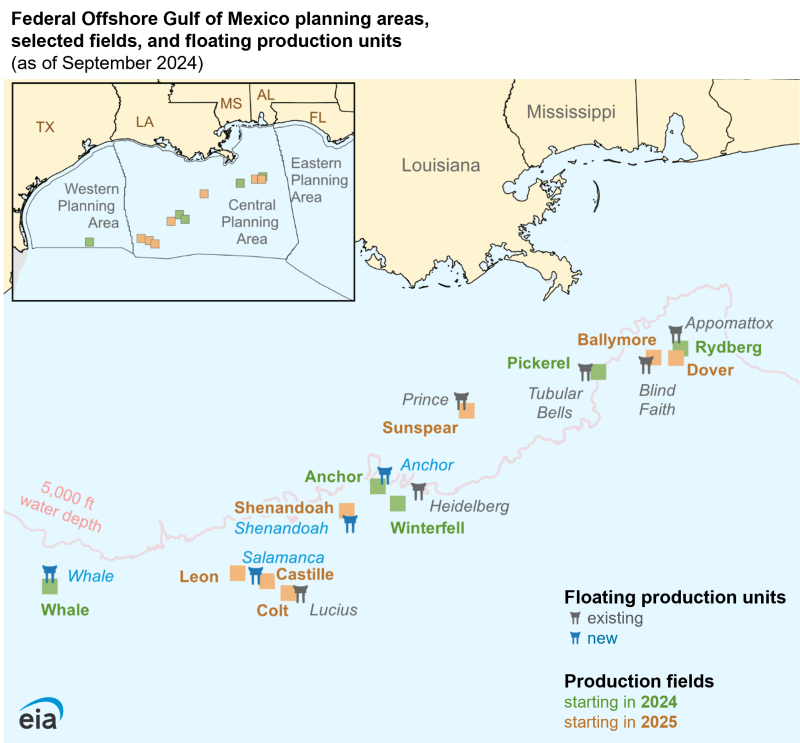
Seven of these are subsea tiebacks to existing floating production units (FPUs). The remaining five fields will tap into four new FPUs, including the LLOG-operated Salamanca FPU which is set to produce from two fields.
Crude production from these new developments is expected to add about 22,000 B/D by the end of this year, with an additional 231,000 B/D expected to be flowing as projects ramp up through 2025, according to the EIA.
Three subsea tiebacks commissioned this year are on pace to account for 42,000 B/D of the 2025 projection.
Shell’s Rydberg, connecting to the operator’s Appomattox platform.
Beacon Offshore Energy’s Winterfell, tying back to Occidental Petroleum’s Heidelberg platform.
Hess Corp.-operated Pickerel linking back to the company’s Tubular Bells floating spar.
Source: US Energy Information Administration.
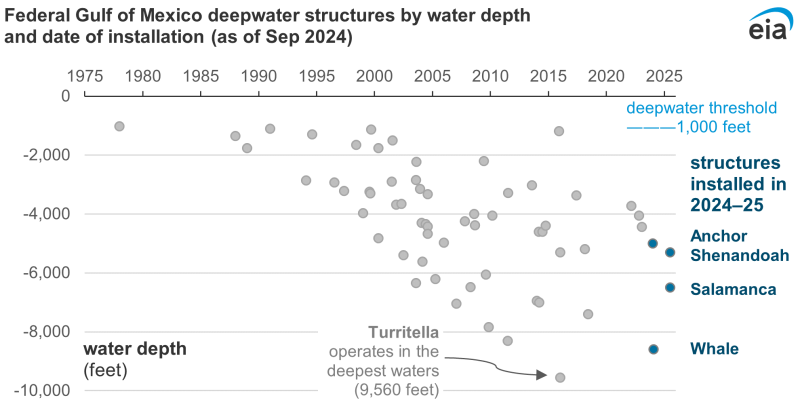
Chevron's deepwater Anchor field began production in August at a water depth of 5,000 ft from an FPU with a capacity of 75,000 B/D oil and 28 MMscf/D of natural gas. The project marks the first deployment of 20,000-psi rated equipment, paving the way for similar high-pressure projects in the region.
Shell’s Whale project, expected to be the largest field starting production in late 2024, will operate from an FPU at a depth of 8,600 ft and is forecast to produce 85,000 B/D. Several other developments are anticipated to add more than 56,000 B/D by 2025.
All of the new projects underscore the continued dominance of deepwater operations in the GOM.
According to the US offshore regulator, the Bureau of Ocean Energy Management (BOEM), deepwater wells accounted for nearly 94% of the region's crude production and 80% of natural gas output in 2023. The BOEM defines deep water as areas with water depths of 1,000 ft or greater.
The EIA highlighted that its latest forecast utilized automated decline curve analysis for over 3,000 wells which it said offers a more detailed and precise modeling approach compared to its previous field-level analysis approach.
The EIA report published this month aligns with a study released earlier this year by Enverus Intelligence Research, which said deepwater projects using multistage hydraulic fracturing will help maintain GOM production at nearly 2 million B/D through the end of the decade.