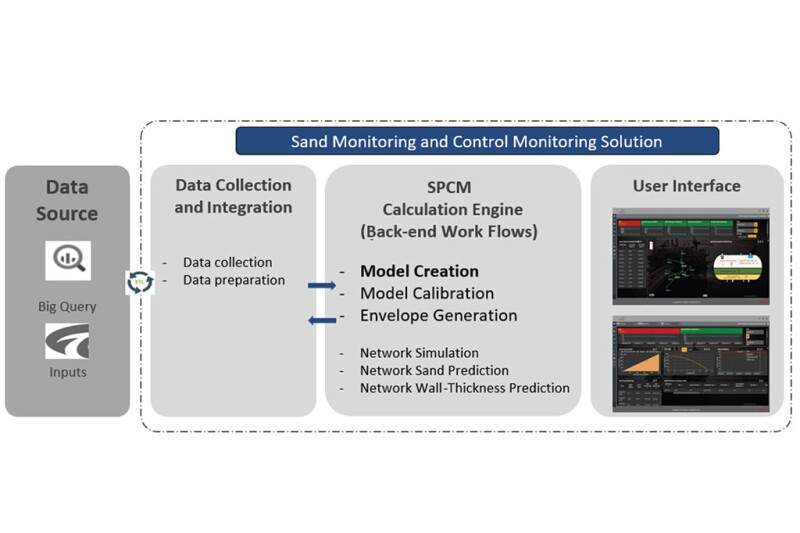
The objective of the study described in the complete paper is to increase operational efficiency by using a sand-prediction model to estimate sand production per well based on current operating conditions and to calculate a sand-operating envelope for each well to guide planning and management. The authors found that the simplified representative elementary volume (SREV) approach to sand prediction and control monitoring (SPCM) resulted in an improvement in operational efficiency by reducing time spent on manual analysis and decision-making through dashboards with predictive results. The reader is encouraged to review the complete paper, which contains detailed work flows that include associated equations and steps.
Study Objective
- Implement SREV approach
- Use a sand-prediction model to estimate sand production per well based on current operating conditions
- Estimate sand accumulation from the wellhead to the inlet separator dynamically
- Predict wall thickness of the main flowlines from the wellhead to the production and test manifold
- Forecast sand production when considering changes in reservoir conditions
- Use an automated work flow to run the network model and obtain flow conditions, generate the well’s sand-prediction model based on well design and reservoir information, and calibrate the well’s sand-production models based on the latest validated test or sensor data
- Implement Web-based interfaces
Study Area
The Zawtika gas field is in the Gulf of Moattama, Myanmar. A total of 123 wells and 11 platforms was used in the study.