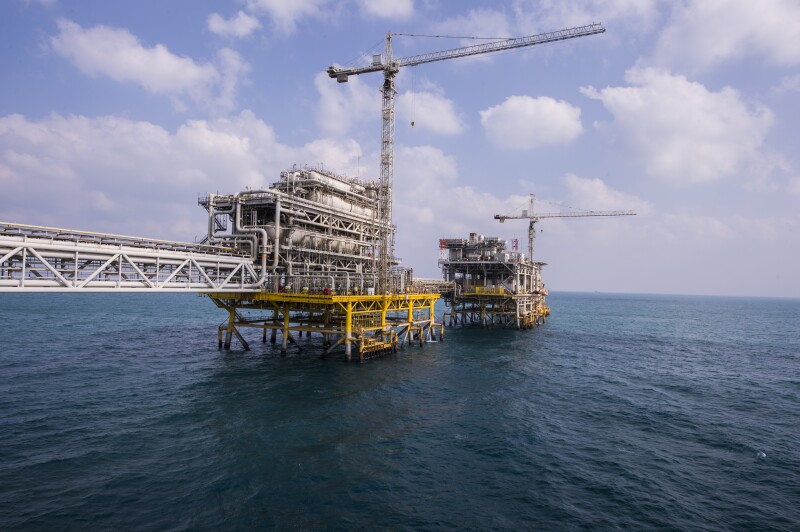
Strong global demand is driving a revival of the offshore oil and gas industry which is on pace to see its biggest growth in a decade over the next 2 years.
This is according to a new report from Rystad Energy that estimates at least $214 billion of new investment money will flow into offshore greenfield projects by 2025.
The Oslo-based energy research firm said if annual capex tops $100 billion this year and next, it will mark the first time that has happened 2 years in a row since 2012 and 2013.
Amid all the new spending, Rystad is expecting offshore oil and gas to represent 68% of global production from now to 2024, which is up sharply from a 40% share held between 2015–2018.
The firm added that offshore projects will account for about half of all sanctioned work over the next 2 years which compares to about 29% from 2015–2018. This comparison period was used by Rystad since it predates the impact of the COVID-19 pandemic on the industry.
“Offshore oil and gas production isn’t going anywhere, and the sector matters now possibly more than ever," Audun Martinsen, head of supply chain research for Rystad Energy, said in a statement.
He continued, "As one of the lower-carbon-intensive methods of extracting hydrocarbons, offshore operators and service companies should expect a windfall in the coming years as global superpowers try to reduce their carbon footprint while advancing the energy transition."
For service providers, the higher activity levels will translate into a 16% annual increase of $21 billion in supply chain spending. Rystad highlighted that this would mark another decade-high growth figure for the offshore sector.
Some of the regional findings from Rystad’s analysis:
- The Middle East will for the first time ever spend more on offshore projects than all other regions. Rystad said offshore capex in the region will swell from $33 billion in 2023 to $41 billion by 2025. The growth will be led by “mammoth projects” in Saudi Arabia, Qatar, and the UAE.
- In Europe, the UK will see $7 billion in offshore spending this year, a 30% year-over-year increase. Norway is expected to see its offshore portfolio absorb more than $21 billion, which is up by 22%.
- South America’s projected spending is comparable to that of the big European players. Brazil’s offshore fields will consume $23 billion this year while Guyana’s blossoming Staebrok block will see about $7 billion of investments. Despite the activity in both countries, including 16 FPSOs on order for Petrobras, Rystad said capital outlay for offshore work will slow in South America after 2025.
- In North America, operators will invest up to $17.5 billion while $7.3 billion is slated to support Mexico’s offshore sector.