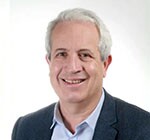
Ali António Hernández Guitian
Everything changed for Ali Hernandez Guitian in 1987. While working for Intevep, the R&D branch of Venezuelan oil company PDVSA, he was informed he would be transferred to a newly minted gas lift research unit. He admits he knew nothing about gas lift at the time. A colleague gave him a quick explanation and a copy of Herald Winkler’s Camco “Blue Book” (Camco’s gas lift manual, 1962), which he tucked into his carry-on luggage because he was flying from Caracas to Maracaibo that night.
“I sat at the gate, opened the book, and read the first page, where a beautiful pressure-depth diagram was shown,” recalled Hernandez Guitian. “That was it, I could not stop reading. I was one of the last passengers to get on board. I sat next to a guy that looked at the book and told me, in English and with an American accent, “That is a pretty good book.”
He was Steve Fotiades, the Camco of Venezuela general manager at that time. I closed the book and started asking all kinds of questions about gas lift valves and mandrels.
“That was my unforgettable first day.”
Hernandez Guitian spent the next 23 years with PDVSA before moving to SLB as a training instructor for a 2-year period. He would spend much of his time since then in the Middle East working as a gas lift consultant for Soghan Energy, Axis Well Technology, and ADNOC, among others.
Throughout his career, Hernandez Guitian was involved with the development of analytical and operational tools including new mechanistic models for the dynamic behavior of gas lift valves for continuous flow; functional relationship for liquid fallback prediction and the dynamic behavior of gas lift pilot valves for intermittent gas lift; design of a new type of insert chamber capable of handling high formation-gas/liquid ratios; and a new mechanistic model for gas chamber pumps.
He also served as chairman of an API task group for the development of RP 11V10 (Recommended Practice for Intermittent Gas Lift).
He has authored (or coauthored) 15 technical papers on artificial lift as well as authored a book entitled, Fundamentals of Gas Lift Engineering: Well Design and Troubleshooting, published in 2016—something he calls his greatest contribution to the artificial lift community.
“Putting together all my gas lift knowledge and experience in a textbook, rigorously written for college students and professors, from which future generations of PE students can learn analytical and field techniques on gas lift, I think is my most important, enduring contribution,” he said. “The results from my work, as well as the ones from so many other gas lift experts, companies, and scholars, are condensed in that book.”
When it comes to advice for young engineers looking to get into the artificial lift business, his advice is simple: Follow your heart.
“My dear friend Dr. Herald Winkler told me several times that his best advice was to do the things you really love to do and then everything else will follow,” he said.
Hernandez Guitian received his bachelor’s degree in mechanical and aerospace engineering from the University of Delaware in 1980, where he graduated cum laude. In 1982, he would receive his master’s degree in mechanical and aerospace engineering from the same school.
Louis Ray
Louis Ray was simply looking for work after he graduated college, and it was the oil field that offered up an opportunity. In July 1970, he went to work for Shell Oil and immediately became involved in rod pumping analysis.
For the first half of his 50-year oilfield career, Ray filled roles ranging from roustabout to senior operations specialist—all for Shell. He retired from the supermajor in 1996 and moved to the contractor side, landing at Weatherford in early 1997 where he spent the next 20 years serving as a senior trainer and field optimization specialist. He provided field and classroom training on a variety of subjects ranging from the basics of rod pumping and rod pumping optimization, dynamometer card interpretation, to detailed rod lift analysis using Weatherford’s host and design software.
Over the course of his career, Ray has taught thousands of people in the US, Canada, and 13 other international countries on the benefits and use of rod lift optimization hardware and software and interpretation of the calculated downhole dynamometer pump card.
After leaving Weatherford in 2017, Ray formed The Dyno Master LLC to continue to provide on-demand basic rod pumping and dynamometer card interpretation training.
“In the 70s and 80s and with the introduction of computers, analysis/design software, rod pumped control (RPC) and automation in general, I was able to help operating personnel accept and use new technology often not well understood,” said Ray. “Later in my career (both domestic and international), I was responsible for instruction in the basics of rod pumping, in the use of host analysis/design software, and in the interpretation and use of surface and downhole dynamometer cards—all to better understand rod pumping conditions, leading to optimized rod pumped wells.”
Ray led the Dynamometer Interpretation portion of the ALRDC conference for 12 years and served as the occasional leader of other rod pumping sessions for the conference.
Now retired, he enjoys playing golf and being an active part of the local community of his hometown, Winnsboro, Texas.
He received an associate of arts degree from Tyler Junior College in 1967 and followed that with a BA degree from East Texas State University in 1969.
Francisco Alhanati
Alhanati spent the lion’s share of his 40-year career between two countries—Brazil and Canada. He started his oilfield journey as a production engineer with Petrobras, watching over the well operations both onshore and offshore. He would soon move to the Petrobras R&D center in Rio de Janeiro where he was involved in projects related to gas lift design and troubleshooting methodologies for subsea wells, the implementation of the first subsea ESP system, as well as the evaluation of novel subsea separation and boosting systems.
In 1997, he moved to Canada and joined C-FER Technologies where he was actively involved in launching the ESP Reliability Information and Failure Tracking System (ESP-RIFTS) joint industry project in 1999.
Alhanati is a coauthor of the chapter on PCP systems in the SPE Petroleum Engineering Handbook.
He cites his contribution to the understanding of the performance envelope for rotary gas separators in ESP applications back in the mid‑1990s as one of his most relevant contributions to the advancement of artificial lift.
“I also contributed to the understanding of instabilities in wells operated with continuous gas lift, of axial loads in PCP applications, and of the performance of jet pumps in multiphase conditions,” he added. “I believe I also had an important role in the industry’s sharing of knowledge related to ESP systems’ reliability through my involvement in a multiyear, industrywide JIP, the ESP-RIFTS.”
While at Petrobras and C-FER, he taught several courses on artificial lift, ESPs, and graduate courses at the University of Campinas (Unicamp) in Brazil, where he also supervised several MSc students in their thesis work.
“Stay curious and involved in the technical community of your particular discipline,” he advises younger professionals in the business. “Tell yourself that there is always something else of value to learn. Read a lot. Share information openly.”
Alhanati received a BS degree in civil engineering from Instituto Militar de Engenharia in 1980 and a master’s degree in mechanical engineering from the Universidade Federal do Rio de Janeiro in 1989. In 1993, he earned a PhD in petroleum engineering from The University of Tulsa.
James Hall
Most artificial lift specialists considered experts in the field are degreed engineers. Hall does not hold an engineering degree. He obtained three degrees from Nicholls State University in Thibodaux, Louisiana, in the 1980s—associate of science in petroleum services technology, associate of science in petroleum safety technology, and a BS in petroleum services technology.
Hall’s gas lift story was about being at the right place at the right time—on more than one occasion. He started his journey in the oil field as a day laborer in 1976. As a production operator for Conoco in the US Gulf of Mexico, he was tapped by an office-based gas lift specialist to be his “eyes and ears” on site while the crew carried out an optimization project on the West Delta 94-V production platform. The project doubled the platform’s production.
Hall’s lack of an engineering degree did not impede his progress until he reached senior engineering technician status with Conoco. “Conoco would not allow someone who did not have an engineering degree to have an ‘Engineer’ titled position, “ he explained.
Soon after, during a wave of layoffs, the operator outsourced certain skill sets, including Hall’s. After 17½ years, he found himself unemployed.
He would move from Conoco to Halliburton/Camco, then ultimately to Shell in 1998 and begin his self-proclaimed “golden age” of gas lift. While working for Shell R&D, Hall was given the opportunity to develop tools to improve the operator’s global gas lift operations.
“A chance encounter resulted in my being offered the role of gas lift subject-matter expert by Shell Services International,” said Hall. “They were developing and deploying a software suite designed to automate and optimize artificial lift systems. I asked if Shell had a bias against non-engineers as Conoco had. I was told that Shell’s policy was that if you could do the job, they didn’t care whether I had an engineering degree or not.”
Hall was Shell’s representative for the Valve Performance Clearinghouse, a joint industry project created by Ken Decker. The project focused on measuring actual valve performance and applying that to design and surveillance rather than using wellhead choke performance charts and rough approximations. He also had a role in the maturation of the WinGLUE gas lift software and other software applications.
Since 1981, Hall has served SPE as a technical editor and associate editor, in addition to publishing several peer-reviewed technical papers. He organized the Nicholls State University Student Chapter of the SPE-AIME and served on several artificial lift committees for SPE conferences and as a PetroWiki moderator.
He was recognized as an SPE Production and Operations Outstanding Technical Editor in 2012 and served as an associate editor from 2013 to 2017. Hall was awarded the 2021 SPE International Award for Production and Operations.
He is an SPE Lifetime Member.
Lawrence Camilleri
Lawrence Camilleri’s technical journey has taken him beyond the traditional artificial lift disciplines. This has been motivated by his quest for holistic production optimization solutions, which include pressure and rate transient analysis in addition to ESP and gas lift engineering.
He started his 40-year career with Schlumberger (now SLB) working with ESPs to increase production at oilfields in Algeria, Tunisia, Oman, and Russia. In 1997, he began a 4-year stint with Weir Pumps before rejoining SLB in 2001. He would stay with SLB for the next 20 years filling roles as project manager, artificial lift technical manager, and global domain head for the artificial lift division. In the spring of 2021, he started his consulting business providing production optimization services.
Camilleri jointly published 22 SPE conference papers with Total, Eni, Perenco, KOC, Sonatrach, OMV, Khalda, and Kraken. He was also an SPE Distinguished Lecturer in 2019–2020, when he demonstrated how real-time data can improve both ESP performance and production. He continues to be active within the SPE and has presented at the SPE 2021, 2022, and 2023 PTA/RTA workshops. He also regularly teaches ESP design and operations as part of continuing education days at SPE conferences.
Camilleri points to two major enablers in the evolution of artificial lift technology: materials science and the availability of downhole real-time data through gauges.
“Materials science has expanded the application of ESPs into harsher conditions with commercially viable run lives, and we have also seen a general increase in run lives in benign conditions,” he said. “For instance, back in the 80s, ESP motors had a 250°F temperature rating. Now most ESP motors have 400°F ratings, and ESPs are regularly used in SAGD applications with even higher temperatures.”
He added: “Real-time data has been another game changer because we can directly observe equipment operating conditions, and most importantly, how the reservoir responds to various production strategies. The availability of real-time data has also fueled the synergy between artificial lift and reservoir engineering.”
Camilleri’s advice to up-and-coming young professionals in the field includes gaining a thorough understanding of the physics and math as well as expanding knowledge beyond one’s own domain of expertise so that holistic solutions can be developed.
“Share and exchange ideas and experience with colleagues and industry peers,” he said. “Challenge your own understanding of the physics. These two tenets are the foundation of continuous learning.”
Toby Pugh
In his first assignment as a design engineer, Toby Pugh was called upon to assist with work on a disposable rod pump—something that could not be repaired. At the heart of the mechanism was a plastic plunger. While a technical solution did present itself, the project died an “inglorious death,” according to Pugh.
It was during this project when Pugh met a bevy of older engineers in the artificial lift field and was taken with their passion, which in turn morphed into a profound interest in the discipline—first to gas lift, then hydraulic lift.
Over the course of his nearly 5 decades in the business, he specialized in the design, analysis, and theory of hydraulic pumps, both jets and pistons. He was involved in developing many different tools to improve pump performance including a high-volume hydraulic piston pump with a reversing valve that prevented fluid pound, another hydraulic piston pump that could not gas lock, and a jet pump that conceivably will not suffer cavitation.
The reversing valve design was recognized with the Special Meritorious Award for Engineering Innovation at the 1978 Offshore Technology Conference.
He served 25 years on API’s Production Committee for Rod Pumps from 1975 to 2000. He has also been awarded nine patents: six in the US and three in Europe.
“I think my real contribution to the field of artificial lift was all of the seminars and presentations I did where I tried to influence others that hydraulic lift would be a great career,” said Pugh.
He received a bachelor’s degree in mechanical engineering from The University of Texas at Arlington in 1965. He followed that with a master’s degree in aerospace engineering, also from UT‑Arlington in 1974. JPT