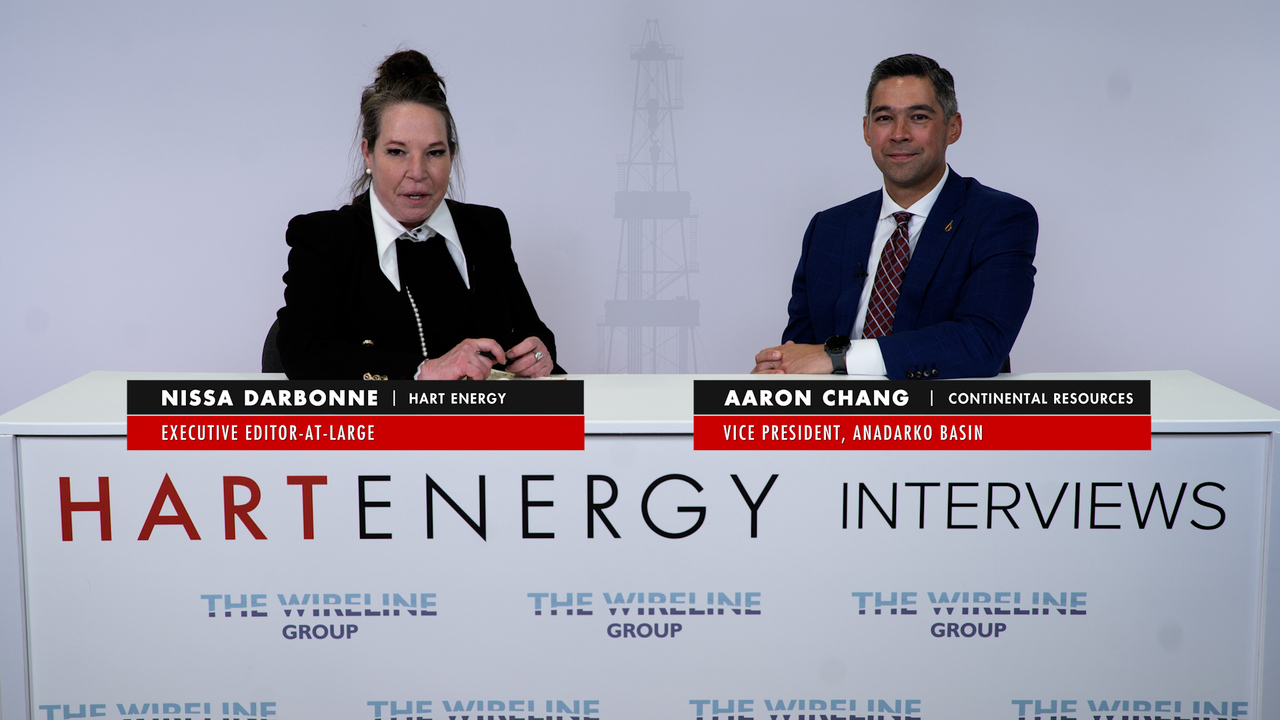
Nissa Darbonne, executive editor-at-large, Hart Energy: Hi, thank you for joining us. I'm Nissa Darbonne, executive editor-at-large for Hart Energy. We're at SUPER DUG 2024 in Fort Worth, the 19th annual SUPER DUG here in Fort Worth, and I'm visiting with Aaron Chang. Aaron is vice president of the Anadarko Basin for Continental Resources. Aaron just spoke here at SUPER DUG and the intel that he shared with everyone was quite fascinating to go over.
First, thank you for joining us, Aaron.
Aaron Chang, vice president of the Anadarko Basin, Continental Resources: Thank you for having me.
ND: To go over some of the things that we learned, you depicted the variability of ranging from the Bakken, the Permian, to the Powder River, to the Anadarko Basin, all of the areas Continental operates in currently. And again, also all oil. That's where you're focused. You depicted the Bakken as being the most reliable, predictable, whereas the Anadarko is the absolute least amongst those four. Tell everyone what maybe contributes to this.
AC: Sure. So the chart that Nissa is referring to is a chart of a distribution of initial shut-in pressures versus TVD [true vertical depth]. And in the Anadarko Basin, we deal with depth changes across multiple sub plays that range in from 8,000 ft-TVD below subsurface to as deep as [18,000 ft] or 19,000 feet deep. And when you're referring to the Bakken, it's a very homogenous rock. And the depositional history of the Bakken is such that most of that history is deposited in [8,000-ft] and 10,000-foot TVD. And so a big portion of the GOR [gas/oil ratio] changes, the differences in thermal maturity happen because of the depositional history of the Anadarko Basin, which leads to the major variability in the ISIPs [instantaneous shut-in pressure] that we deal with and the complexities on the stimulation side.
ND: Also too, we talked about the Marietta Basin a little bit lesser known basin. It's south of Oklahoma City. It's Love County, pretty much is the epicenter, south of Oklahoma City almost, if you will, maybe equidistant with Denton County where we are. No, are we in Denton? Tarrant, Tarrant County. Exxon Mobil for the most part kind of owns that basin. They've been making some really sweet wells there for a while. There are folks wondering if they're going to cut it when they're rationalizing their portfolio for having brought in Pioneer. You're very familiar with that basin. Would you tell everyone about it?
AC: Sure, yeah. The Marietta Basin is a geologic anomaly. It is so unique. It's the only place I know of in the Lower 48 where you have black oil deposited at [15,000-ft TVD to 15,500-ft TVD] to [16,000-ft TVD to 16,500-ft TVD] TVD. And with those depths come just a lot of challenges, from wellbore integrity to temperature issues. And Exxon has done some really neat things in that basin over the last couple of years. I think they've come a really long way when you look at some of the recent well performance from that area. And I think the question was whether or not Exxon may be willing to part ways with that asset post the closing or presumed closing of the Pioneer transaction. And I think it's one of those things that we have our eye on, Exxon Mobil, on Oxy, a lot of others on the tail end of these major transactions to better understand what maybe doesn't fit within their portfolio anymore. As an Anadarko leader, the Marietta is something that's always intrigued us. We have played around what I would call the fringes of it, but have never really got into the heart or the core of where Exxon operates. But we'd love to understand more about it.
ND: Also too, you have eight rigs drilling and two frac spreads out there at work. I don't recall. Is that just in the Anadarko?
AC: That is just in the Anadarko.
ND: Is that primarily concentrated in your SCOOP?
AC: Yes ma'am. The majority of it. We do have a rig that bounces back and forth, maybe gets into the southern and eastern extensions of our stack asset, but in today's world, for obvious reasons, we're predominantly focused on oil projects. And so the majority of our net rigs spend their time in the SCOOP asset.
ND: Well, Anadarko Basin's rig count overall has fallen in the past year from about 70 to about 55 now. I imagine that the frac spreads have kind of similarly fallen maybe in proportion to that as well. Would you say that most of the activity in the Anadarko has come to become concentrated where you are in the SCOOP, the Springer, the Sycamore, your play there?
AC: Yeah, great question. There's a distribution there of larger, what I consider to be maybe larger operators that predominantly focus their resources in the Anadarko across the SCOOP and STACK extensions. But you look at the rich history of the Anadarko Basin and the amount of resource across the strat [stratigraphic] column, there's always extensions of the basin further west and south and into the north into Major County as well, whereby you have operators focused on other benches beyond just the Woodford. The Red Fork as an example, is something that's become really topical and interesting to a few operators as of late. When you talk about the rig count and the stim [stimulation, or frac] crew count, it's amazing to me what we're doing today from an efficiency standpoint as an industry, not just Continental Resources. But what used to take us four times the amount of rigs to drill the same lateral footage we're doing with a quarter of that. And the stim story is no different, right? You look at that ratio of stim crew to drilling rig kind of historically being in that two to one ish ratio, and now we're creeping into the three to one and four to one ranges. And it's just incredible to me to see those efficiency gains across all of the industry and the resources required to develop the same amount of lateral footage that we were 15 years ago with much less equipment and much less people.
ND: Thank you. And one last question. I'll ask this one—this was the question that was brought up during the conference during Q&A after Aaron presented, and that is, so you obviously operate in the Permian Basin as well, Delaware and Midland, your interest in the Barnett and the Woodford there. What are your thoughts on those?
AC: So one of the things I love about Continental Resources is our exploration nature. And when we enter into a basin, or even in the basins we've operated in for 57 years, we have teams focused up and down the strat column on new and next generation opportunities. And I would say that was largely the intrigue of the Permian to Continental. The Third Bone, the Wolfcamp was largely and is largely today a known commodity. I think there's still some optimization efforts taking place, but what really intrigued us about whether it's the Permian, the Powder River Basin, the Anadarko, is how much resource is really yet to be exploited and discovered. And everyone I think knows about those resources, but whether or not they've been commercialized is to be determined. And so whether it's Barnett and Woodford in the Permian or some of the things we're doing in the Powder River in Oklahoma, it's just a really exciting time to be at Continental to continue to explore up and down the strat column.
ND: Thank you, Aaron.
AC: Thank you very much.
ND: And thank you for joining us. Find more on this and other actionable intelligence here at hartenergy.com.