井筒完整性/控制

针对 CO2 井喷的海底封盖烟囱使用情况进行评估

本文利用动态多相流模拟器来评估使用海底封盖堆栈应对 CO2 井喷的有效性和适用性。

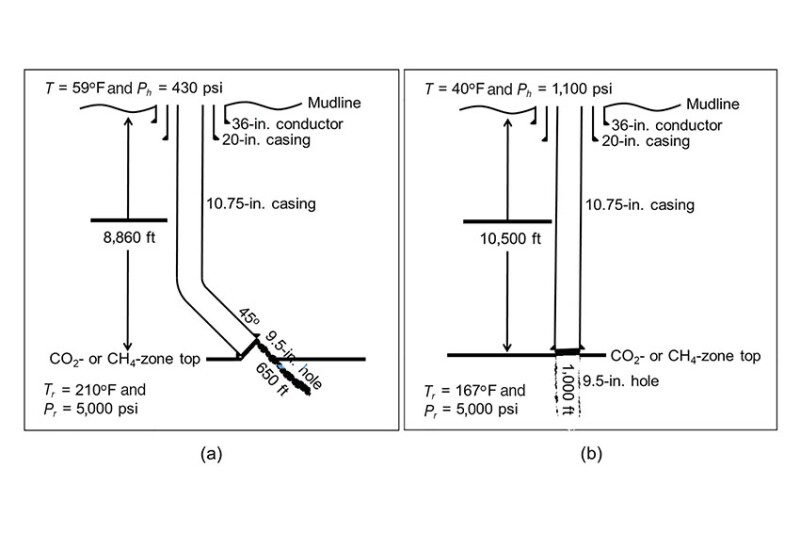
图 1 — 考虑的单元几何形状:(a)浅水场景(984 英尺)和(b)深水场景(2,500 英尺)。泥线处的静水压力 (Ph) 与水深一致。Tr = 储层温度;Pr = 储层压力。
图 1 — 考虑的单元几何形状:(a)浅水场景(984 英尺)和(b)深水场景(2,500 英尺)。泥线处的静水压力 (Ph) 与水深一致。<i>T<sub>r</sub></i> = 储层温度;<i>P<sub>r</sub></i> = 储层压力。
来源:OTC 35246。

使用动态多相流模拟器研究 CO 2井喷的封堵操作。按照封堵程序的典型顺序并应用软关闭,考虑了不同的主孔径和节流管线配置。此外,还研究了不同的储层流速、流体类型 [CO 2和甲烷 (CH 4 )] 和水深,目的是了解在不同条件下 CO 2井喷与 CH 4井喷的区别

介绍

在针对盐水层的海上二氧化碳封存作业中此类封存区的深度和压力梯度决​​定了封存的二氧化碳几乎始终处于超临界状态。鉴于这一现实,如果要规划出使用封盖堆应对海底二氧化碳井喷的途径,就必须在模拟中准确解决超临界到气相转变的复杂性、不同的压缩率(气体和超临界流体的压缩率)以及水合物的形成

图片尺寸 1280X1280
以 SPE 会员身份继续阅读
SPE 会员:请在页面顶部登录以访问此会员专属内容。如果您不是会员,但您认为 JPT 内容很有价值,我们鼓励您加入 SPE 会员社区以获得完全访问权限。
原文链接/JPT
Well integrity/control

Subsea Capping-Stack Usage Evaluated for CO₂ Blowouts

In this paper, a dynamic multiphase-flow simulator is used to evaluate the effectiveness and suitability of using a subsea capping stack to respond to a CO₂ well blowout.

Fig. 1—Well geometries considered: (a) shallow-water scenarios (984 ft) and (b) deepwater scenarios (2,500 ft). Hydrostatic pressures (Ph) at the mudline accord with water depth. Tr = reservoir temperature; Pr = reservoir pressure.
Fig. 1—Well geometries considered: (a) shallow-water scenarios (984 ft) and (b) deepwater scenarios (2,500 ft). Hydrostatic pressures (Ph) at the mudline accord with water depth. <i>T<sub>r</sub></i> = reservoir temperature; <i>P<sub>r</sub></i> = reservoir pressure.
Source: OTC 35246.

A dynamic multiphase-flow simulator was used to investigate a capping operation for CO2 well blowouts. Following the typical sequence of a capping procedure and applying a soft shut‑in, different primary bore sizes and choke-line configurations were considered. Additionally, different reservoir flow rates, fluid types [CO2 and methane (CH4)] and water depths were investigated, with the intention of understanding what differentiates a CO2 blowout from that of CH4 under varying conditions.

Introduction

In offshore CO2 storage operations targeting saline aquifers, the depth and pressure gradient of such storage zones dictate that stored CO2 will almost always be in a supercritical state. Given that reality, the complexities of supercritical-to-gaseous phase transition, varying compressibilities (of both gas and supercritical fluid), and the formation of hydrates all must be addressed accurately in simulation if a path to using capping stacks in response to subsea CO2 blowouts is to be charted.

×
SPE_logo_CMYK_trans_sm.png
Continue Reading with SPE Membership
SPE Members: Please sign in at the top of the page for access to this member-exclusive content. If you are not a member and you find JPT content valuable, we encourage you to become a part of the SPE member community to gain full access.