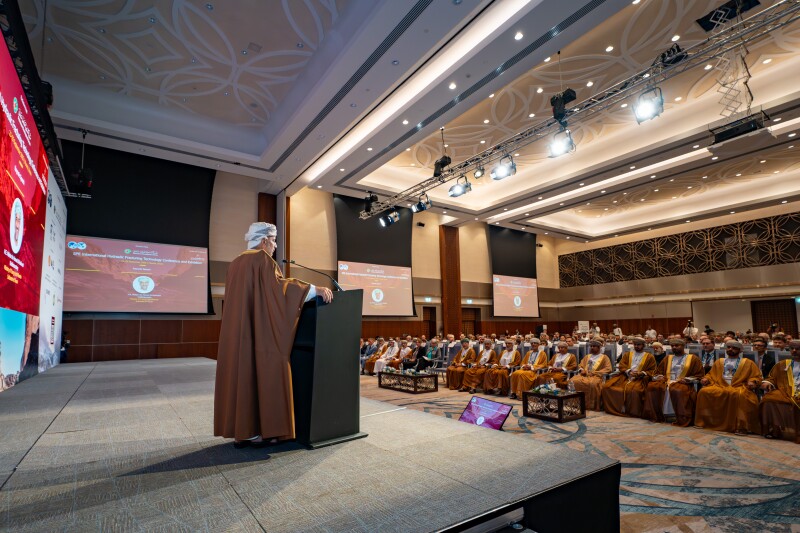
The SPE International Hydraulic Fracturing Technology Conference and Exhibition (IHFTC)opened its fourth edition in Muscat this week with an executive panel stressing cost discipline, sustainability, and the need for the Middle East region to learn at a faster pace than was demonstrated by the US shale experience.
Themed “Fracturing for a Resilient Energy Future—Innovation, Sustainability, and Global Collaboration,” the conference drew representatives from national oil companies (NOCs), global operators, and service providers to explore how hydraulic fracturing is reshaping energy security in Oman and across the region.
In his opening remarks, Badar Al Kharusi, conference chairman and the petroleum engineering director at Petroleum Development Oman (PDO), emphasized the transformative role of modern hydraulic fracturing worldwide. He noted that as unconventional technology spreads beyond North America, it is making a major impact in Argentina, scaling up in Saudi Arabia, and progressing steadily in the UAE.
At PDO, Al Kharusi said hydraulic fracturing has over the past 4 decades become a “key enabler in both unlocking tight gas and enabling oil recovery, reinforcing our position as a technical leader in the region.” He added that modern large-scale fracturing has proven to bring broad socio-economic benefits, from “creating hundreds of thousands of jobs” to “generating billions of dollars in income to producers, service providers, and in the form of government royalties and tax revenues.”
Mohsin bin Hamed Al Hadhrami, Oman’s undersecretary of energy and minerals, underscored the domestic importance of fracturing in sustaining economic growth and energy security. “Hydraulic fracturing for Oman is more important, actually, than many other countries because of the tight reservoirs,” that dominate Oman’s subsurface geology, he said. He also highlighted that Oman’s gas production and liquefied natural gas (LNG) exports climbed 5% from 2023 to 2024, but that the country is also facing a 9% increase in domestic power demand which means the country will need to increase output to keep pace.
Jennifer Miskimins, the incoming 2026 SPE President and department head of the petroleum engineering department at the Colorado School of Mines, welcomed attendees by stressing SPE’s global reach and the value of collaboration.
“Your presence is a testament to the shared commitment that we have in advancing our fields and exchanging ideas,” she said. “SPE’s mission has and always will be to connect its members to aid technology transfer around the globe through conferences such as this one.”
Panel Examines Costs, Sustainability, and Shale Lessons
The executive plenary session featured remarks from Hisham Siyabi, gas director at PDO; Oscar Bustos, advisor for unconventional resources at ADNOC; Terry Palisch, 2024 SPE President and chief technology officer at CARBO Ceramics; and Sherif Foda, chairman and CEO of NESR.
Their discussion focused on ways to drive down costs, increase the sustainability of unconventional operations and how the Middle East can learn from, but not replicate wholesale, the US shale playbook.
Siyabi noted that PDO is shifting from its long legacy of fracturing vertical gas wells into structural crests to fracturing deviated and horizontal wells that are targeting the edges of existing fields and gas trapped inside distinct layers of rock.
“In each of these transitions or inflection points, we have had to be at the forefront of fracking technology,” he said adding that PDO now needs to adapt to deeper resource rocks and those that also hold contaminants such as H2S. “Clearly, we will be on the lookout for technological enablers, as we have always done, to deal with these emerging challenges.”
Bustos outlined ADNOC’s plan to develop unconventional resources within the UAE with sustainable practices. This includes reducing fresh water use for fracturing fluids by tapping brackish aquifers and using industrial wastewater. ADNOC is also looking to simplify its fluid chemistries to just a few essential additives and, like many in the region, plans on sourcing sand locally.
A driving force for all unconventional programs he said comes down to gaining efficiencies while lowering the cost of development. “No matter the country, no matter the basin, they are more difficult to get and they're more challenging for the economics,” said Bustos. For ADNOC, this means it must be “aiming to reduce the cost, be more efficient, and do more with less.”
Foda of NESR, which is supporting Saudi Aramco’s unconventional campaigns, also emphasized the Middle East’s acute water constraints and its limited tolerance for the kind of trial-and-error that saw US operators drill tens of thousands of suboptimal shale wells in the early years. While looking to the US experience, he said the question in Saudi Arabia has been “can we lower the cost much faster?”
He noted that one lesson many US shale producers took nearly a decade to learn was the viability of stimulating wells with locally sourced sand that was once considered too weak to hold fractures open. After only a few years of testing in its unconventional fields, Foda said NESR and Aramco are already moving away from importing proppants from as far as Australia and instead tapping the country’s abundant desert sand.
On water use, he explained that each shale well in Saudi Arabia requires 200,000 to 500,000 bbl, equivalent to the annual consumption of 250 to 550 people. A solution being pilot tested now involves recycling produced water, stripping out salts as well as lithium and bromine which are rare earth minerals that can be sold to offset treatment costs.
As the lone North American representative on the panel, Palisch reminded attendees in Muscat of what the region stands to gain by pursuing cost and efficiency improvements. He pointed out that the US is now producing twice as much dry gas (3.2 Bcf/D) as it did 30 years ago with fewer than 100 gas-directed rigs, compared with about 1,200 rigs 3 decades ago.
Palisch said US operators have reached this level of output by steadily expanding technical limits. This includes drilling 3- and 4-mile laterals, adopting time-saving techniques such as simul-frac, and increasing proppant loadings to an average of 2,000 lb/ft of lateral, with some wells taking as much as 50 million lb in total.
“We're talking about three and four times the amount of energy that we're putting into these wells,” he said, compared to the previous decade.
Looking ahead, Palisch posed the challenge of applying US lessons internationally. “The question I started out with saying, can we apply these learnings? It's really not ‘can.’ It's just how. How do we apply these learnings across other regions?”
The conference continues this week with technical sessions and poster presentations from more than 165 companies and universities across 33 countries.