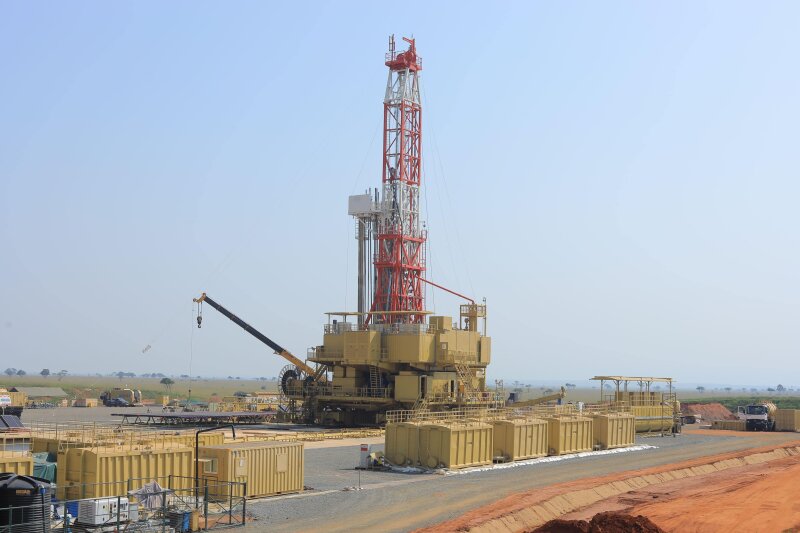
French supermajor TotalEnergies announced this week that it has begun commercial drilling operations at the Tilenga development in Uganda.
The $10-billion megaproject is expected to reach first production by 2025 and achieve a peak output of 190,000 B/D. The project’s partners are TotalEnergies (56.67%), CNOOC (28.33%), and the Uganda National Oil Company (15%).
Sanctioned last year, the development plans for Tilenga involve tapping into six fields with a total of 420 wells from 31 different well pads. At least one rig is currently operating while two more are expected to begin drilling later this year, according to the Petroleum Authority of Uganda.
In the face of environmental concerns over the project, part of which falls inside a national park, TotalEnergies plans to use buried flowlines, reinject 100% of the fields’ produced water, and has committed to zero routine flaring. The supermajor said it will use the field gas to support the project's electric needs while delivering any surplus power to support pipeline operations and the national grid.
In February 2022, SLB was awarded a large contract for directional drilling, completions, and artificial lift services by TotalEnergies. The China Petroleum Chemical Corp. was also awarded a separate contract last year to build the project’s oil and gas transmission systems. China's SINOPEC is the project's rig contractor.
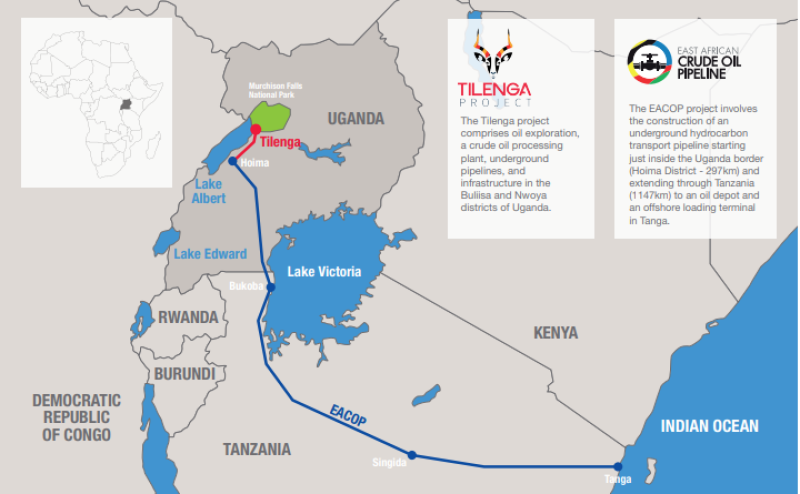
The Tilenga development is one of two projects that form the wider Lake Albert project in Uganda. The second is the Kingfisher project which is operated by CNOOC and began drilling operations in January. Plans for Kingfisher call for 31 wells from three pads that are expected to peak at 40,000 B/D.
With a cumulative plateau production of 230,000 B/D, the Lake Albert projects are to be supported by the East African Oil Pipeline (EACOP) that will deliver much of the new supply to the port city of Tanga in neighboring Tanzania. The 1443-km-long cross-border pipeline is expected to require an investment of $3.5 billion and will be the world’s longest heated pipeline, a feature required to efficiently transport Uganda’s waxy oil.
In addition to the EACOP, Uganda is seeking to secure its place as a rising oil producer with a 60,000-B/D refinery—a volume more than twice the country’s daily consumption. The government is seeking financing to support the building of the refinery which it estimates will cost around $4 billion.
Oil reserves were discovered in Uganda in 2006 but attempts to commercialize the resources were long stymied due to a lack of a legal framework and infrastructure. The country’s reserves are estimated to be 6.5 billion bbl with 1.4 billion bbl considered recoverable.