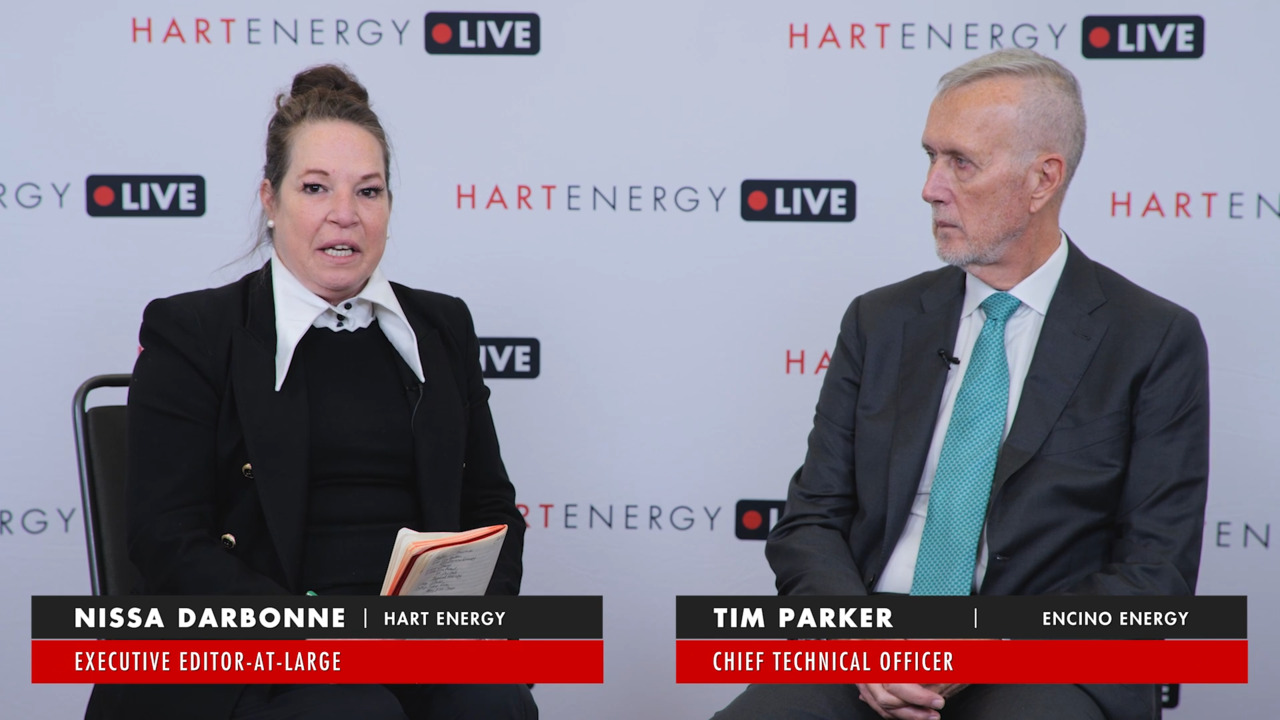
Nissa Darbonne, executive editor-at-large, Hart Energy: Hi, I am Nissa Darbonne, executive editor-at-large for Hart Energy. Thank you for joining us. We're visiting with Tim Parker. Tim is chief technology officer for Encino Energy, Ohio's new No. 1 oil producer. Tim just spoke at DUG Appalachia, the 16th annual DUG Appalachia Conference in Pittsburgh. Tim, first, thank you very much.
Tim Parker, chief technology officer, Encino Energy: Thank you. And congratulations on 16 of them. That's incredible.
ND: Yes, we appreciate that. I wanted to ask you—the Utica oil development. It's this north-south play in kind of a swath. There was a number that came out at some point that estimated the width of the fairway—the oil fairway. What is the correct number?
TP: Well, I mean, in part we're still figuring that out a little bit because we're actively pushing it updip, and we're not to the limit of that yet or we don't think we are. And that's clearly going to be a relationship between technology and cost. But I think we can demonstrate that there are at least 15 miles and maybe as much as 25 [miles] of width that are commercially viable today's pricing and today's costs. And that's certainly where we're making most of our investments.
ND: And also too, I understand, unlike natural gas in Appalachia being somewhat stranded, very confined to the basin due to insufficient takeaway for gas, there is no issue with oil takeaway.
TP: Well, there isn't any more. That's something that we had to solve. When we took over the asset, total production that we were marketing was about 16,000 barrels a day, and we were only marketing to three customers. And as we started to ramp up, we could see that we had to do something to build more customers, to build more markets, and our marketing team did an absolutely fabulous job with that. We're now marketing 60,000 barrels to more than 10 customers, and we have line of sight where we could market 100,000 barrels a day if we get to that stage. And so that's one of those hidden success stories inside our story that we're really proud of and has made it so that other operators ought to be able to follow along if they put the time in as our folks did.
ND: And the backstory on Encino's work in the Utica is Encino entered and began drilling itself six years ago in the play. It picked up its property from Chesapeake Energy, which had actually gotten to work in the Utica in 2011, 2012.
TP: That's right.
ND: At least that's when it started to report publicly on it. You have a really good look at some wells that have been online for quite a while of your own, but also too the ongoing performance of the legacy Chesapeake wells. What are the findings in terms of pressure and time and other details around them?
TP: Yeah, I mean this is a very well-behaved unconventional production environment. The big differences are, from some other place, is much lower water, and so we have a whole lot less water to have to deal with, which is a tremendous economic benefit to us. But beyond that, it's exponential decline. There's still some debate as to what the terminal decline will be, but it's exponential decline. We don't see any real bubbles at all. It is a little bit sensitive to system back-pressure, and so it is one of those where we do an ongoing dance with our gathering system to make sure that we are optimized. But that's part of what being a good operator is is working on those places where you optimize and get things right.
ND: Why do you think it was overlooked for so long? I mean, in a way, 12 or so years now, it's had recognition. Obviously it really needed, because it's tight rock, it needed frac, but also lateral wells from it. Why is it only now though that it's really a play?
TP: Well, I think that there are a couple of things. One, if you look at the history, there was a stampede when Chesapeake first announced that it became clear that there was a play here and there was a lot of money spent by some really big companies updip. And that money, which I don't know what the numbers are, but more than a couple of billion dollars I would guess, was spent in the wrong place. And people didn't understand. It got a bad name from those operators. And at the same time, people were making the gas side of [the Utica] work. The gas was much more forgiving. And so people sort of threw their hands up and said, “Oh, the oil doesn't work. We're going to go do the gas.” And then they didn't go do the hard work to go back and look at the oil.
The thing that we found when we looked at the data at the time that we did our acquisition is that the data was there to tell you that the play worked, but you had to do the work. You had to sweat it. And you couldn't just rely on commercial data services. You had to go work the data. And once you saw that, we were very confident that the oil part of the play was going to work and be economically compelling. We didn't know how far updip it was going to go. We still don't. It's getting bigger still. At the time we did the final investment decision, the board rolled their eyes at me when I said, “I think we're going to get more than a billion barrels here.” And it turns out I was wrong. It's going to be several times that. And so it's always nice to be wrong in that way.
ND: That's terrific. That's terrific. Great to hear. Thank you for joining us, Tim.
TP: Oh, thank you for the opportunity, Nissa. Always good to see you.
ND: And thank you for joining us. Find more actionable energy intelligence right here at hartenergy.com.