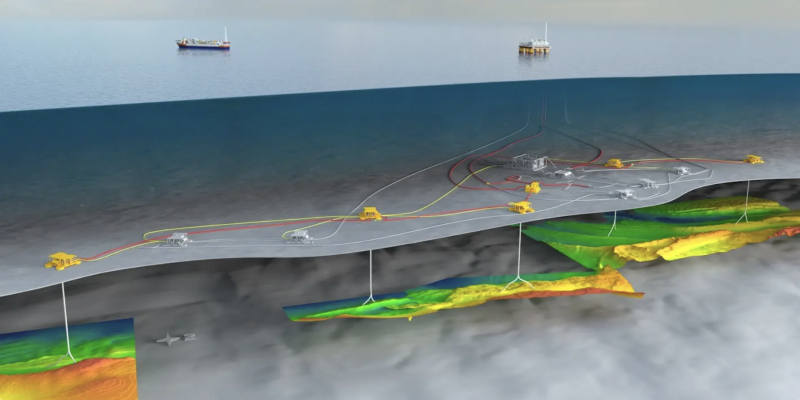
The Halten East project in the Norwegian Sea involves fields that if developed independently would be considered too marginal to be economically attractive.
Installation of the subsea template for Halten East.
Source: Equinor
The Equinor-operated Halten East subsea project in the Norwegian Sea has begun production.
Equinor announced first gas from the Gamma well on 17 March, and Norwegian authorities approved the plan for development and operation in February 2023. According to Halten East partner Vår Energi, the project went on-stream on time and on budget. Vår Energi also said additional wells will be brought on line throughout 2025 to reach peak production in 2026.
Halten East is the collective name for several smaller discoveries and prospects on the Norwegian Continental Shelf (NCS) that individually were not economically viable. In 2020, participants in the relevant licenses agreed to develop the discoveries as a unit. According to the Norwegian Offshore Directorate (NOD), the reservoirs contain gas and condensate in Jurassic sandstone in the Tilje, Ile, Garn, and Melke formations. Located at depths between 2000 and 3000 m, the reservoir volumes are relatively small but have “excellent” reservoir properties, the NOD said.
Equinor and its partners submitted the development plan to the Ministry of Petroleum and Energy in May 2022. The first phase of the development comprises six wells from five of the six discoveries in the area. The plan, which allows for three additional prospects, uses the existing infrastructure and processing capacity on the Åsgard B production semisubmersible.
The Halten East development in 200 m to 300 m water depth is tied back to Åsgard production units.
Source: Equinor
The project 35 km from the Åsgard field, includes the Gamma, Harepus, Flyndretind, Nona, Sigrid, and Natalia discoveries. The development included the installation of three subsea templates in the south and two subsea templates in the north.
The southern structures will be tied into a 49-km pipeline from Mikkel South to the Åsgard subsea compressor manifold station while the northern structure will be tied into a 22-km pipeline from Natalia to the subsea compressor manifold station.
The second phase, planned to go online in 2029, includes a sidetrack and up to three wells. Together, the two phases are expected to cost about $850 million (NOK 9 billion).
Equinor estimated recoverable reserves at around 100 million BOE from the six gas and condensate discoveries.
Gas, oil, and condensate are piped to Åsgard B for processing, with produced gas sent through the Åsgard Transport gas pipeline to Kårstø and exported onward to Europe. Oil and condensate are stored at Åsgard A and Åsgard C for export by tankers.
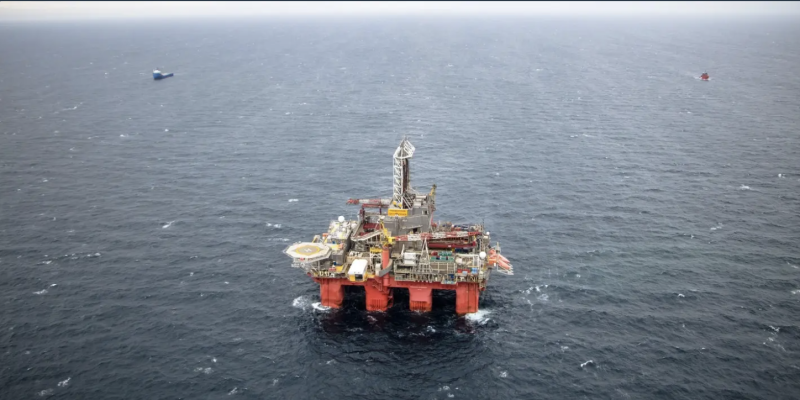
The Transocean Spitsbergen is a 6th generation dual-derrick winterized semisubmersible rig capable of drilling high-pressure/high-temperature formations. It is equipped with an automatic drilling control system.
Source: Jamie Baikie, SIGNAL2NOISE/Equinor
The Transocean Spitsbergen carried out the drilling. Aker Solutions, OneSubsea, Technip Norge, and TechnipFMC also won major contracts for the project.
Kjetil Hove, Equinor’s executive vice president for development and production on the NCS, said the operator expects to connect more than 30 discoveries to existing production hubs on the NCS by 2035.
Equinor operates Halten East with 69.5% interest on behalf of partners Vår Energi with 24.6% and Petoro AS with 5.9% interest.