BP Declares FID on Ginger Gas Field Offshore Trinidad
Ginger is among the 10 upstream projects that BP plans to bring on-stream by 2027 after resetting its strategy to raise oil and gas investments to $10 billion per year.
A subsea tree being offloaded at the Tembladora facility in Trinidad and Tobago prior to installation at the Cypre gas field.
Source: BP
BP Trinidad and Tobago (bpTT) has taken a final investment decision (FID) to develop the offshore Ginger gas field in the southeastern Caribbean, one of 10 new upstream projects the supermajor aims to bring on-stream by 2027.
In addition to greenlighting Ginger, BP also revealed that its Frangipani exploration well east of the Mahogany field gas hub identified multiple stacked gas reservoirs within the same geological structure some 50 miles off Trinidad’s east coast.
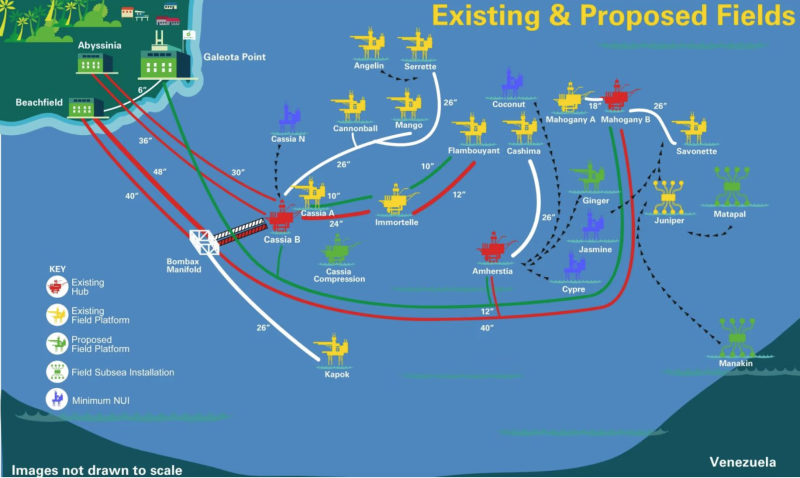
Four subsea wells will be drilled at Ginger in water depths of less than 300 ft (91 m) with subsea trees tied back to the existing Mahogany B platform. The subsea project will be bpTT’s fourth, BP noted in a 27 March press statement.
A first well was spud in January, and drilling is expected to resume in Q4. At peak, Ginger’s gas production capacity will reach 62,000 BOED, bpTT said.
bpTT President David Campbell said, “… the sanction of Ginger represents our commitment to continuing the development of resources in our existing acreage and to producing the gas that Trinidad and Tobago—and the world—needs.”
“With Frangipani, our objective was to prove that our continued progress in exploration and appraisal activity could unlock new fields and investment opportunities for the region,” he added.
bpTT has a 100% working interest in both the Frangipani and Ginger projects, which align with BP’s expected returns from upstream projects and are fully accommodated within BP’s capital expenditure plans, the supermajor noted in its statement.
Strategy Reset To Boost Oil and Gas Production
In March, BP CEO Murray Auchincloss said BP will raise its upstream oil and gas expenditures to $10 billion per year while it cuts investments in renewables by more than $5 billion a year.
The about-face was a response to shareholders demanding a refocus on higher-margin fossil fuel operations. BP aims to start up 10 new major upstream projects by the end of 2027, and a further 8–10 projects by the end of 2030.
Production is forecast to grow to 2.3–2.5 million BOED in 2030, with capacity continuing to rise to 2035. In contrast, BP’s 2020 strategy had pledged to reduce oil and gas production 40% by 2030 compared to 2019 levels.
Besides growing its production activity in Trinidad and Tobago, BP has also announced milestones offshore Egypt in the first quarter of 2025, including completing drilling operations and making two gas discoveries at the El Fayoum-5 and El King-2 exploration wells and starting production at the second development phase of the Raven field.
In a deal described in February by Auchincloss as possibly "one of the most important transactions BP has done in 20 years", BP agreed with the Iraqi government to rehabilitate the Kirkuk oil field and three adjacent fields in northeastern Iraq starting in 2025.
Trinidad & Tobago Support New Vision
In Trinidad and Tobago, the Western Hemisphere’s second-largest LNG exporter after the US, the Ginger development and the Cypre gas project fit well into BP’s strategy of maximizing production from existing acreage and developing capital-efficient projects that tie into existing infrastructure.
Cypre expects first gas in 2025 and is bpTT’s third subsea project. Ginger will be its fourth. Others are Juniper and Matapal.
Existing and planned field infrastructure offshore Trinidad.
Source: BP
As of year-end 2024, BP had drilled and completed four subsea wells under Cypre Phase 1 and had installed most of the subsea infrastructure, including the manifold, umbilical, and portions of the flowline and riser system, according to BP’s website.
Current work in progress focuses on installing flexible flowlines to route production from the Cypre field to the existing Juniper platform along with subsea control systems. Phase 2 drilling is anticipated to start later in 2025, BP said.
Divesting Low-Margin Mature Fields
In September 2024, BP also agreed to divest a package of four mature gas assets and undeveloped resources to Anglo-French independent Perenco T&T to further shift capital into growth opportunities.
Assets included the Immortelle, Flamboyant, Amherstia, and Cashima offshore gas fields and associated production facilities, plus the undeveloped Parang field. bbTT will continue to operate and own the assets as well as purchase produced gas to meet contractual obligations.
“Divesting these mature assets will high-grade our portfolio in Trinidad and Tobago as we focus on continuing to develop our shallow-water gas portfolio and pursuing growth opportunities with both deepwater and cross-border gas resources,” bpTT’s Campbell said at the time.
“This is part of our mission to accelerate gas production, create value, and unlock the energy future of Trinidad and Tobago. Meanwhile, Perenco will be able to apply their mature asset expertise to extend these fields’ producing life and support maximum recovery of resources.”