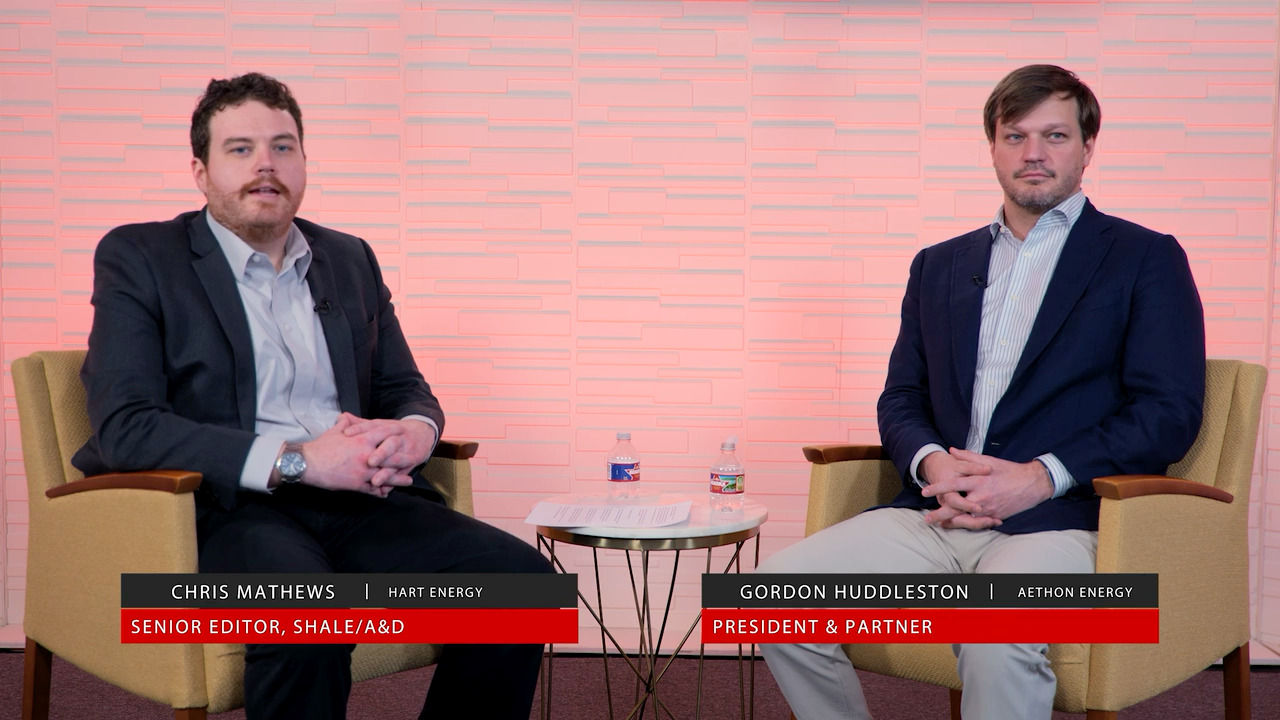
Hi, I am Chris Mathews, senior editor of shale and A&D for Hart Energy, and I'm joined by Gordon Huddleston. He's president and partner at Aethon Energy Management. Aethon is among the top natural gas producers in the Haynesville Shale and one of the largest privately held gas producers in the United States. So Gordon, thank you so much for being here to share some of the latest on Aethon. Appreciate it.
Gordon Huddleston, president and partner of Aethon Energy: Yeah, thank you, Chris for having me. Appreciate it.
CM: Maybe start out with just Aethon's latest outlook for the natural gas macro environment right now. There's so many moving parts, LNG, AI, weather. What's the latest?
GH: For sure. I mean, it tends to be, and has shown to be quite a volatile commodity, but I think what we're seeing is this realization that there's this strategic imbalance coming as the LNG demand that is forecasted to show up here later this year and is already starting to show up. You've seen Venture Global's Plaquemines project starting to pull a lot of gas. I think it's pulling about 1.2 Bs [Bcf] a day, but certainly weather as always influences natural gas pricing significantly. And we've seen some colder temperatures, as I think everyone's aware, materialize here recently. And I think the other thing that's interesting is while supply and demand have grown considerably, storage has remained relatively flat. So if you think about that, it's about, call it a little more than 4 Tcf of storage. That cushion has grown as a percentage basis smaller over time. And unfortunately that's resulted in, I think what we're going to see is more volatility over time because of that.
CM: But generally, I think producers are excited about the prospect of prices increasing in the future, especially on the back of LNG buildout, AI, some of these trends. A couple of years down the road, what do you think prices might look like? Look into to your crystal ball, if you may.
GH: Sure. I think last year was a bit challenging and we've saw a lot of delays on the LNG front, so producers probably got in front of the demand. And I think we're being very probably a little more slow to react to this future forecasted demand. We want to see it materialize before we do anything to grow production. So we're really remaining flat this year, but I think we expect there to be significantly higher pricing because you're talking about 5 Bcf a day, almost 5% of total supply that needs to be increased. And so that necessitates a significant price signal to a broad base of producers, not just in the Haynesville, but in other basins and in secondary and tertiary acreage, that there needs to be increased rig activity to meet that level of demand. And so we think that's somewhere in the $5 plus range. And so while that may seem high during the Russia-Ukraine situation, we went to $8 and $10, I think we all recognized and could see the activity levels that was probably unsustainable, but we do need to see broad-base increases in activity to meet this projected supply or demand rather.
CM: No, absolutely. You shared a bit about 2025 maybe keeping production flattish, but what else can you share about 2025 drilling and spending plans?
GH: Yeah, and so we're, this year we're planning on keeping rig activity relatively flat, so we'll run about five-and-a-half, six rigs down from seven. We've seen significant rig efficiency gains over the last several years, doubling rig efficiency over the last two years. And so that really rig count is always a little misleading. And I think it's probably not the best way to track activity levels. It's really about what is the productivity? What other number of wells that you're turning to sales? One thing that's unique about the Haynesville, and I think you saw ourselves and Expand [Energy] do this last year, is that we deferred, we completed wells, drilled and completed them, and then deferred turning those wells to sales. And with that in Appalachia, you have to flow these wells back or there are issues around the damage you can do around the formation. And so the Haynesville's a bit unique in that it gives operators a little flexibility there to respond to different pricing scenarios, but certainly in this price environment, we expect to maintain normal operations from that standpoint.
And then I think also we're seeing a lot of inbounds around on the AI side as well, just the power demand associated with that. Now the LNG is still significantly more, but whether it materializes in two to three Bs over the next several years, that's just incremental demand that is going to predominantly be coming from natural gas. And we're one of the lowest methane emissions as a producer. And so our gas is some of the best gas from an LNG feedstock as well as from a power generation, especially for those customers that have more of a sensitivity around that than others. And I think certainly the tech companies are very focused on their own emission targets, and so that's a really good synergy.
CM: Yeah. Well, we can talk about AI here. There's so many numbers tossed out about what demand might look like for the natural gas side to fuel AI, high performance computing in general. Talk about the Permian data center opportunities, Appalachia wants some of that, but I've seen some announcements in Louisiana around the Haynesville for data centers being sited there. Do you think that's an opportunity for the area? I guess give me your outlook for what you see happening at point for AI.
GH: Sure. I mean, Meta's made a big announcement around a large facility in partnership with Entergy, Louisiana was very forward thinking. They've passed some legislation that gives some tax advantages for data centers to be located there. And if you really think about the total emission footprint, if you can co-locate these facilities right by where the gas is being produced and it's already being produced in the lowest way possible from a methane emissions standpoint. And we also happen to have a carbon capture project right there as well, that really, that fully integrated value chain ultimately results in the best, the cleanest way to generate power if you're going to use natural gas. And so we expect that to be a portion of the overall power generation story as these data centers scale up. And even if you put that aside, I think there's just going to be increased power demand as we've electrified more things in our lives, we expect to see that. And natural gas still is a great fuel when even paired with things like renewables and others that are more intermittent. It acts as a great baseload supply.
CM: It has been wild to see the demand forecast thrown out there over the coming years.
GH: And I think that's what's interesting. It is really hard to pinpoint. And anyone that's been through '01, the dot-com crash, I think there's always some hesitation about what does this really look like, and how sustainable is it? But I think you look at what we're doing, rich media is what really excites us about AI. I think to create any video, you think it's 5 second videos, 150 AI-generated images. So there's a significant computational requirement to do that. And so I think maybe sometimes it's really difficult to forecast, but I think you're going to see a lot of different applications for these technologies that can be applied to a lot of different things. The question is how are these companies going to monetize them? And ultimately that's going to translate into the sustainability of this big capital spending. So I mean, we're early days, but look, this demand was not projected to be there several years ago. And so it's all incremental. And I think that's what concerns us, is that ultimately we thought the power forecasts were always understated, that there was always going to be more power demand than people anticipated. And then now you've got this incremental, and then on top of that, you've got the growing LNG demand. And so I think the market may not fully appreciate how much gas we're going to need over the next several years.
CM: So on to LNG, maybe a little more firm and ongoing business at this point compared to the AI projections, Aethon is already a huge supplier of natural gas to LNG developers on the Gulf Coast. How do you see that part of Aethon's business evolving over time as more projects tick online?
GH: Well, I think LNG is such a great opportunity for U.S. producers because it gives us exposure to these foreign indexes, but also if there's a weather event in another part of the world, LNG benefits from that. And gas is going to move that direction as it's required by the end user. And so it really gives you that opportunity to get exposure to, on a global basis obviously, where the potential price disruptions are occurring. And it also, for the end user, that's a positive because it should also result in less price volatility. If you're in a very, where you don't have a lot of options from a gas standpoint, you now get exposure to a global index, and hopefully that's a little less volatile. So we've been working on LNG opportunities for some time. We're today about 20% of the gas that Cheniere exports comes from Aethon. And so we're one of the largest suppliers.
Our emissions are what I would say the lowest in North America, and that's partially due to our proximity to the Gulf Coast. And so we have a very low on a Scop 1 and 2 basis, a very low footprint, getting the gas to the customer. And then the Haynesville is just unique. It's dry gas doesn't need compression. We're using all electric frac fleets. We're using biofuel rigs, so we're running natural gas in our rigs to reduce our emissions as well. It means very limited processing. And so that makes it the molecule of choice. And that's a great thing, especially as the EU puts in place these regulations around low-emission natural gas that they want to import. Otherwise they're going to tax it. So we've been working with a lot of different providers about how to get additional exposure, and that's something that we'll continue to do.
CM: Fantastic. So Aethon is one of the few companies that actually does real exploration today. You guys are one of the leading explorers in the western Haynesville extension in Robertson and Leon counties [Texas] and have drilled a number of wells there, monster wells. What can you tell us about the western Haynesville and kind of your plans there for that play?
GH: Sure. So we started looking at that play 2018, 2019, and we're really excited about it. We feel like we've gotten, kind of high graded to a position that we felt like was probably the most prospective in terms of thickness and also depth. These are deep wells and it gets quite a bit deeper in different parts of the play. We had a lot of experience drilling our [Texas] acreage in San Augustine County and Angelina [County] with our Black Stone Minerals' partnerships. We've drilled today about more than 450 wells in the Haynesville and Bossier. And so I think that experience, that learning curve that we've gone through on a lot of other areas has translated really well in the western Haynesville. So today we've drilled about 10 wells, and we've seen really great results. I mean, these are, call it three-and-half Bcf type-curve wells, maybe more. And we're not seeing significant declines at this time.
And so these wells are tubed up, but they're produced around 25, 26 million [cubic feet] a day. So we're very excited. But at the same time, we're taking kind of a wait-and-see approach. Our reservoir sciences teams as we look at our simulations for these reservoirs, really trying to understand are we doing the right things in terms of how we're drilling and completing these wells and making sure we're doing the right proppant loading and we want to understand what the fracture networks are doing, if we're seeing any fracture closures given the amount of overburden. So they're expensive, we're around the $23, $24 million mark, but that also means that you need to see these big productivities, and we're seeing that, and I think we just don't want to go put a lot of capital at risk at this stage while we're still understanding the reservoir and how it's responding. And so we're going to drill a couple more wells this year and then we'll continue to refine that. And then I think move to between the Bossier and the Haynesville, probably more increased development over time.
CM: Very good. Thank you so much. And Gordon, Aethon just has so many options at its disposal right now. When you think about the future, we've talked about the potential appetite for an IPO at some point. You talk about being IPO ready on that front. How do you think about just the multitude of options for Aethon going forward here?
GH: Sure. I think we're fortunate to be in a situation where we have a lot of different options. And you can't say that for everybody. And I feel that ultimately we're going to do whatever. We're a private equity firm, so every day you don't sell, you're buying. So we try to run the business that way. We're always need to be in the seat of creating value for our shareholders. And ultimately, and our family itself is also a very large shareholder. And so we really are lucky in that we can have a lot of different paths that we can take. And so for several years we've been looking at what those options are going to be. We have been IPO ready and continue to be. And certainly the capital markets have been doing quite well. I think as people are starting to realize that gas is going to a very long term fuel, in the sense of it's going to underpin a large part of the energy for this country and for the world.
And so we will continue to assess that. And I think, but ultimately, we're seeing a lot of interest from counterparties that are trying to understand their exposure to us domestic gas pricing. So these people that have these liquefaction contracts are trying to understand, Hey, how am I going to supply gas for a 20-year contract? Where am I get this gas from for 20 years? And what price? And there are very few companies like Aethon, and certainly I think we're the only private that can along the Gulf Coast, supply [and] have 20 or 30 years of inventory. And I think that's unique about Aethon. And we're also integrated, so we have our own midstream across the bulk of our assets. So our margins are the highest in North America. When you add that all up, there's a lot of different, interesting options for us on different ways we can partner and find ways to continue to create additional value.
CM: Well, it seems just like exciting times on many different fronts for Aethon right now.
GH: Yeah, it's a lot of fun. I think we've got a great team. I'm really proud of the work they do every day, and we try to have fun with it. I mean, you spend more time at work than you do at home, so hopefully you enjoy that.
CM: Great. Well, Gordon, thanks so much for being here and sharing some of the latest on Aethon. We appreciate your time.
GH: Great. Thanks so much.
CM: Of course. For more on the Haynesville Shale and more on Aethon Energy Management, you can head to HartEnergy.com.