油田化学

测量水力压裂液与钢、水泥和页岩的相互作用

本文的作者证明,未来的采出水管理和结垢矿物控制可能需要考虑钢铁、水泥和页岩对流体化学和矿物沉淀的连续暴露效应。

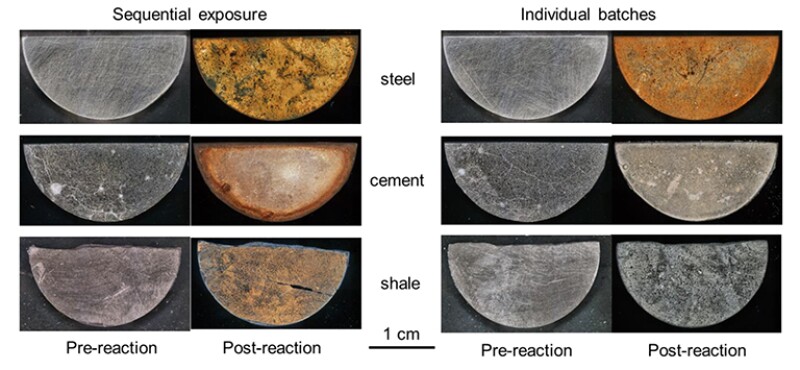
反应前后连续曝光批次和单个批次的钢、水泥和页岩试样的显微图像。
简·辛普森

人们对暴露于水力压裂液(HFF)的深层页岩储层的岩石/流体相互作用进行了大量研究。然而,流体/钢/水泥成分对近井筒页岩区域化学的影响却被忽视了。在完整论文中描述的研究中,将同一批次的钢材、水泥和页岩样品在 66°C 下依次暴露于 HFF 中 3 天。与新鲜 HFF 直接暴露于页岩的反应不同,钢和水泥的流体化学性质和暴露表面在暴露后发生了显着变化。

方法

完整的论文详细介绍了实验材料,包括由岩心样品和特色水力压裂液制成的多个钢、水泥和页岩半圆试样。

顺序暴露实验。对于顺序曝光批次,将三个钢试样放置在装有 300 mL HFF 的硼硅酸盐瓶底部。暴露 3 天后,所有三块钢片均被移除。收集并过滤 100 mL 反应流体用于流体化学分析。然后,将两块水泥试片放入瓶中,在相同温度下与剩余的200 mL液体发生反应。

SPE_logo_CMYK_trans_sm.png
成为 SPE 会员继续阅读
SPE 会员:请在页面顶部登录才能访问此会员专享内容。如果您还不是会员,但发现 JPT 内容很有价值,我们鼓励您成为 SPE 会员社区的一部分,以获得完全访问权限。
原文链接/jpt
Oilfield chemistry

Hydraulic Fracturing Fluid Interactions With Steel, Cement, and Shale Measured

The authors of this paper demonstrate that future produced-water management and scale-mineral control may need to consider the sequential exposure effect of steel, cement, and shale on fluid chemistry and mineral precipitation.

Microscopic images of the steel, cement and shale coupons from the sequential exposure batch and individual batches before and after reaction.
Jan Simpson

Numerous studies have been conducted on rock/fluid interactions of deep shale reservoirs exposed to hydraulic fracturing fluid (HFF). However, the effect of fluid/steel/cement components on the chemistry of the near-wellbore shale region has been overlooked. In the study described in the complete paper, steel, cement, and shale samples were exposed to HFF sequentially in the same batch for 3 days at 66°C. Unlike the reaction of fresh HFF to direct exposure to shale, the fluid chemistry and exposed surfaces of steel and cement were altered significantly after exposure.

Methods

Experimental materials, including multiple steel, cement, and shale half-circle coupons made of core samples and the featured hydraulic fracturing fluid, are detailed in the complete paper.

Sequential Exposure Experiment. For the sequential exposure batch, three steel coupons were placed at the bottom of a borosilicate bottle with 300 mL of HFF. After 3 days of exposure, all three steel coupons were removed. 100 mL of the reacted fluid was collected and filtered for fluid-chemistry analysis. Then, two cement coupons were placed in the bottle to react with the remaining 200 mL of fluid at the same temperature.

×
SPE_logo_CMYK_trans_sm.png
Continue Reading with SPE Membership
SPE Members: Please sign in at the top of the page for access to this member-exclusive content. If you are not a member and you find JPT content valuable, we encourage you to become a part of the SPE member community to gain full access.