Yahoo Finance
NEW YORK – Oil prices were little changed in volatile trade on Tuesday as a stronger U.S. dollar and demand concerns offset supply worries after Russia said OPEC+ was ready to deepen output cuts in the first quarter of next year.
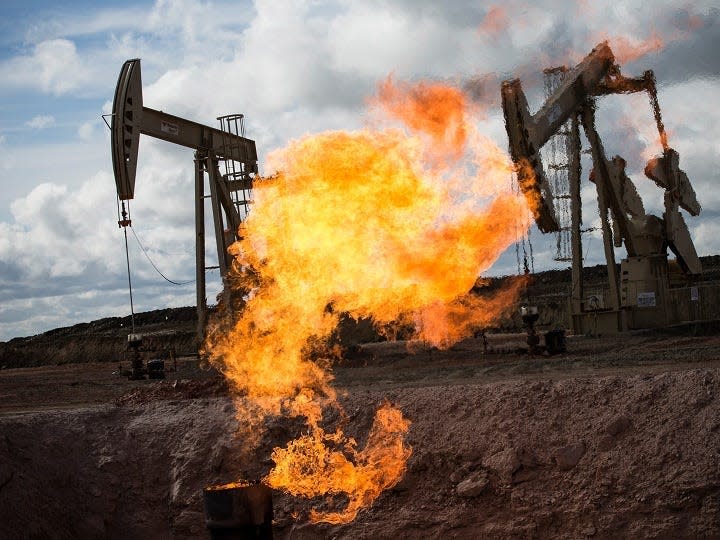
Source: Reuters
Brent futures fell 29 cents, or 0.45%, to $77.74 a barrel by 12:30 p.m. EST (1730 GMT), while U.S. West Texas Intermediate (WTI) crude fell 20 cents, or 0.35%, to $72.84.
Russian Deputy Prime Minister Alexander Novak was reported as saying that OPEC+ stands ready to deepen oil production cuts in the first quarter of 2024 to eliminate “speculation and volatility” if existing actions to cut production were not enough.
OPEC+ groups the Organization of the Petroleum Exporting Countries (OPEC) and allies such as Russia.
On Nov. 30, OPEC+ agreed to output cuts of about 2.2 million barrels per day (bpd) for the first quarter of 2024. But at least 1.3 million bpd of those cuts were an extension of voluntary curbs Saudi Arabia and Russia already had in place.
Analysts at FGE, an energy consultancy, said the additional OPEC+ cuts were below the 1 million bpd reduction the market expected, noting the group was only likely to deliver cuts closer to 500,000 bpd compared to the fourth quarter.
The Kremlin said the OPEC+ production cuts will take time to kick in. President Vladimir Putin will visit OPEC members the United Arab Emirates and Saudi Arabia on Wednesday and host Iranian President Ebrahim Raisi in Moscow on Thursday.
Russia’s oil and gas revenues dropped in November to 961.7 billion roubles ($10.53 billion) from 1.635 trillion roubles in the previous month due to the cyclical nature of profit-based tax payments.
Top oil exporter Saudi Arabia lowered the price of its flagship Arab Light crude to Asian customers in January for the first time in seven months, reacting to weakening premiums in the physical market amidst supply overhang concerns.
On Tuesday, Libya’s National Oil Corporation said it was on track to reach oil output of 2 million bpd in the next three to five years and was planning bidding rounds for exploration blocks by the end of 2024.
DEMAND CONCERNS
Elsewhere, countries at the COP28 climate conference are considering calling for a formal phase-out of fossil fuels as part of the United Nation summit’s final deal to tackle global warming.
In the United States, the dollar rose to a two-week high against a basket of currencies after fresh employment data showed U.S. job openings dropped in October to the lowest level since early 2021.
The slowing labor market and subsiding inflation have raised optimism that the U.S. Federal Reserve is probably done raising interest rates this cycle, with financial markets anticipating a rate cut in mid-2024.
A stronger dollar can reduce oil demand by making the fuel more expensive for buyers using other currencies.
Lower interest rates, meanwhile, could increase oil demand by making it cheaper for consumers to borrow money to purchase more goods and services.
In Europe, European Central Bank (ECB) board member Isabel Schnabel told Reuters the ECB could take further interest rate hikes off the table given a “remarkable” fall in inflation.
Meanwhile, major Chinese state-owned banks were busy buying the yuan to prevent it from weakening too much after rating agency Moody’s cut China’s outlook to negative.
(Reporting by Natalie Grover, Emily Chow and Colleen Howe; Editing by David Goodman, Edmund Blair and Emelia Sithole-Matarise)

